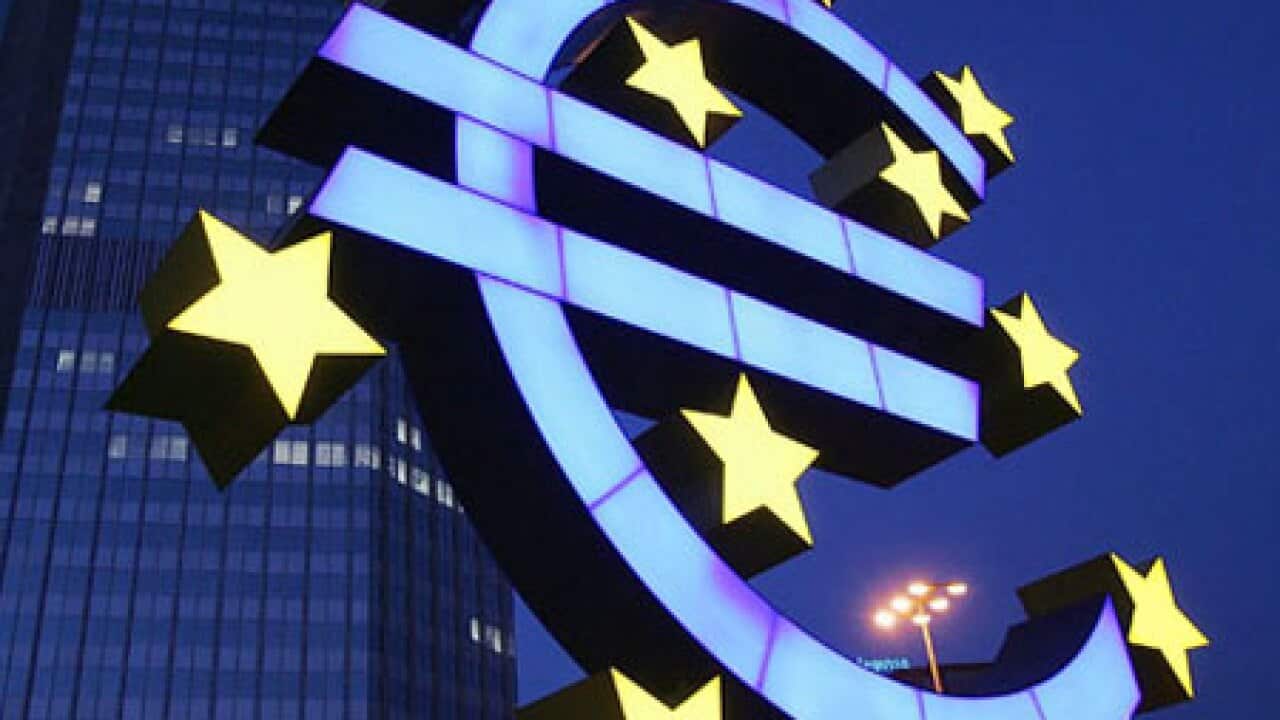
Europe's debt crisis deepened after Spain was slapped with a credit downgrade and pressure mounted for urgent approval of a giant bailout for Greece that could run to 120 billion euros.
European shares tumbled and the euro sank to a new one-year low against the dollar after Spain was hit by the credit downgrade.
European stock markets plunge
London's benchmark FTSE 100 index shed 0.30 per cent, the Paris CAC 40 index plunged 1.50 per cent and the Frankfurt Dax dropped 1.22 per cent.
The Madrid stock exchange fell nearly three per cent with banks leading the losses as Santander, Spain's biggest bank, shed 4.81 per cent.
News that makes sense
Your trusted source for staying up-to-date with the world around you. Get free daily news updates and analysis, straight to your inbox.
US stocks claw back from heavy losses
US stock markets instead pushed back from last session's drubbing, with all of the major indices up at the close and the Dow again passing the 11,000 point mark.
The Dow Jones Industrial Average rose 53.28 points (0.48 per cent) to 11,045.27 in final trades after a brutal session on Tuesday that saw the index lose more than 200 points.
The Nasdaq composite was up 0.26 points (0.01 per cent) to 2,471.73 and the Standard & Poor's 500 index was up 7.65 points (0.65 per cent to 1,191.36.
Fears of widening eurozone debt crisis
The head of the IMF warned confidence in the entire 16-nation euro area was now at stake and Greek Prime Minister George Papandreou said the EU "must prevent a fire... from spreading to the entire European and world economy".
IMF managing director Dominique Strauss-Kahn and European Central Bank president Jean-Claude Trichet travelled to Berlin to drum up support for an EU-IMF aid plan for Greece in which Germany would have to pay the lion's share.
"It is perfectly clear that the negotiations with the Greek government, the European Commission and the IMF need to be accelerated," German Chancellor Angela Merkel said after meeting with Strauss-Kahn.
"We hope they can be wrapped up in the coming days and on the basis of this, Germany will make its decisions," she told reporters.
Germany has said it will lend Greece the money it needs to avoid a default only if Athens promises to make further budget cuts.
But there were signs of a hitch in the negotiations after Greek Labour Minister Andreas Loverdos told reporters that Athens was resisting demands by the EU and the IMF to cut salary bonuses in the private sector.
"We have been asked for a cut which we do not accept," Loverdos said.
Financial markets meanwhile reeled for a second day, following credit downgrades for both Greece and Portugal on Tuesday that heightened investor fears that the Greek debt drama is spreading to other weakened euro nations.
The European single currency plunged to its lowest level against the dollar in more than a year and was trading at 1.3198 dollars in late deals, while bond and stock markets across much of Europe were also sharply down.
"The downgrade of Spanish government debt by S&P is another alarming sign that the effects of the Greek crisis are spreading," said European economist Ben May at research firm Capital Economics in London.
S&P lowered Spain's long-term sovereign credit rating to "AA" from "AA+" and said the outlook was negative, meaning there could be a further downgrade.
Credit ratings are closely watched by financial market professionals as a guideline on whether or not to invest in stocks, bonds and currencies.
Spain appealed to those investors, with Deputy Prime Minister Maria Teresa de la Vega saying her country was cutting its debts. "I want to send a message of confidence to the population and of calm to the markets," she said.
The Greek crisis has snowballed in recent months and is seen by many as a sign of things to come for other highly-indebted economies in Europe.
The current crisis is now at a crunch point as Greece has said it needs emergency loans by May 19 in order to avoid defaulting on its debts.
Trichet warned time was fast running out and Germany must quickly decide whether to contribute its share.
"There is an absolute necessity to decide very rapidly," he said after meeting top officials in Berlin.
Strauss-Kahn struck a similarly ominous note, saying: "It is the confidence in the whole zone that is at stake."
Herman Van Rompuy, the European Union's president, said earlier the eurozone's leaders would meet around May 10 for a summit on the debt crisis.
Two German lawmakers, who met with Strauss-Kahn and Trichet, said the size of the rescue loan package could be as high as 120 billion euros (158 billion dollars) over three years, although Merkel declined to give a precise figure.
The idea of aiding Greece is also deeply unpopular in Germany, where many workers have been forced for years to accept wage cuts in order to hold on to their jobs.
Greece meanwhile acted to stop speculators operating on the Athens stock exchange after having its credit rating slashed to "junk" status on Tuesday -- a move that triggered investor concern of a possible imminent debt default.
That in turn has heightened worries about banks with exposure to Greek debt.
French bank Credit Agricole on Wednesday said it had exposure of around 850 million euros (1.12 billion dollars), mainly through its Greek unit Emporiki.
The interest rate Greece has to pay to borrow money was around 9.919 percent late on Wednesday, higher than for emerging markets like India and Mexico.
The Greek government also faced growing domestic discontent, with some sporadic protests on Wednesday and a general strike planned for May 5.
Many Greeks are against the bailout as they believe the EU and the IMF will impose overly stringent conditions in return for the loans.
Despina, the 51-year-old owner of a small interior decorating business in the northern port town of Thessaloniki, told AFP she was against paying taxes as part of government reforms brought on by the debt crisis.
"The state has never given us anything, and now it wants to take everything away," she said.
"What scares me is not that there is not a cent left. It is that the mentality is changing. They want to turn us into Germans."







