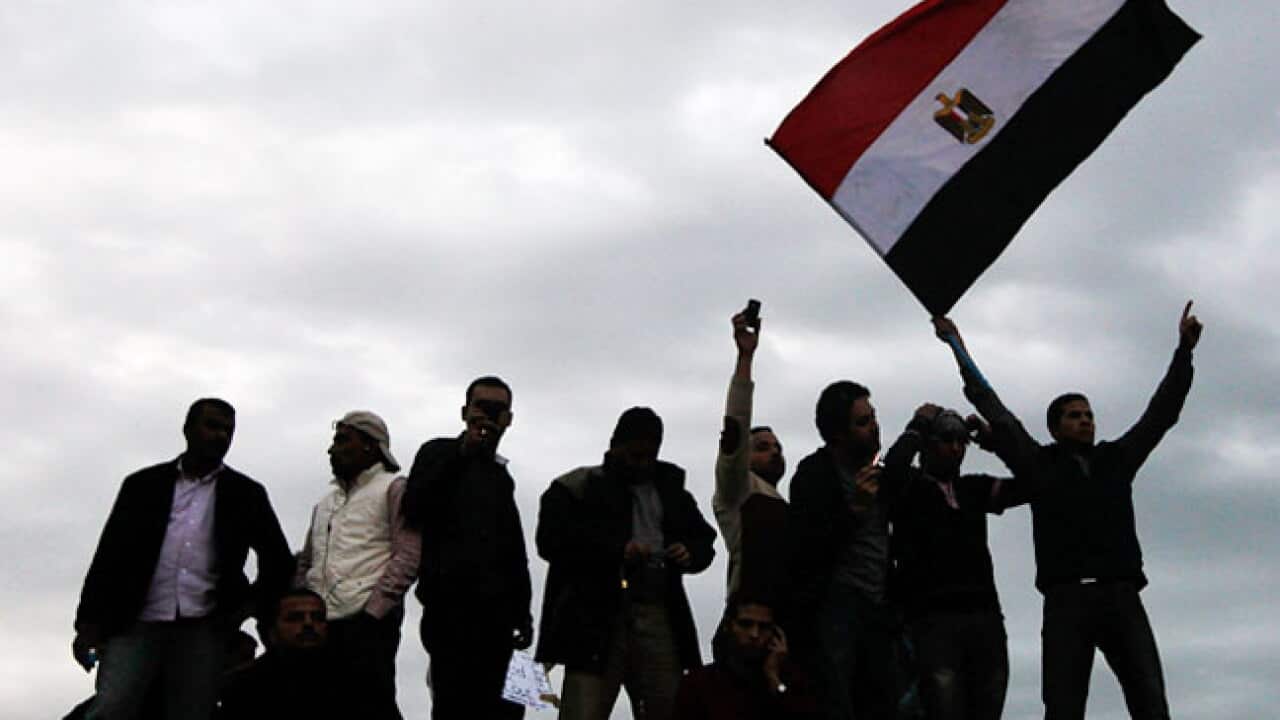
Egypt's defiant strongman Hosni Mubarak showed no sign of quitting Saturday, the 12th straight day of Cairo protests demanding he end his 30-year grip on power, as international calls grew for him to go.
Mubarak defied a huge rally on the Muslim day of prayer Friday on Cairo's Tahrir Square -- the epicentre of the protests -- and in Alexandria aimed at forcing him to stand down.
Gunfire crackled early Saturday on the square where thousands spent a chilly night encircled by tanks, while solidarity rallies gained ground around the world with demonstrations planned in London and Paris.
Protesters in Cairo sat down around some of the tanks, loyal to the all-powerful military that has not yet intervened in the deadly revolt, fearing that they would leave the square after some of their engines started running.
Many on the square worry that interior ministry riot police and militants loyal to Mubarak's ruling National Democratic Party will swarm the protest with unknown consequences if the military withdraws.
News that makes sense
Your trusted source for staying up-to-date with the world around you. Get free daily news updates and analysis, straight to your inbox.
A witness said the soldiers wanted to move to allow the removal of burnt-out cars being used as barricades to protect the demonstration.
US President Barack Obama meanwhile hinted that Mubarak should step down saying the "patriot" should "listen to what is being voiced by the Egyptian people," while EU leaders clearly said it was time for change.
Obama said he understood "some discussions" had begun on a political transition, with details to be worked out by Egyptians themselves, and said violence against demonstrators was unacceptable.
"We continue to be crystal clear that we oppose violence as a response to this crisis," he said, as Egyptian authorities called for protesters thronging central Cairo to go home but also vowed not to use force.
European leaders were more forthright.
At a summit in Brussels, the 27 EU governments said Egypt's "transition process must start now" and condemned this week's violence, while issuing a veiled threat to suspend aid.
Mubarak himself has said he would like to quit but fears that chaos would ensue.
Clashes left at least eight people dead and more than 800 hurt on Wednesday and Thursday. According to UN estimates, more than 300 people have been killed since the protests began.
Mubarak's one-time foreign minister and a possible future presidential candidate, Arab League chief Amr Mussa, said on Friday he doubted his former boss would leave any time soon.
"I do not think he will leave. I think he will stay until the end of August," Mussa told France's Europe 1 radio before himself later going to Tahrir Square in what his office called a "calming gesture."
The New York Times reported that Washington has been pushing proposals for Omar Suleiman, Mubarak's veteran intelligence chief and now vice president, to head a transitional government.
But Prime Minister Ahmed Shafiq ruled out the possibility that Mubarak would transfer power to Suleiman.
On the Muslim day of prayers and rest, tens of thousands of people from all walks of life filled Tahrir Square for what was billed as a mass rally got the president's "day of departure."
A pro-government rally in the upscale Mohandeseen neighbourhood of the capital was attended by just dozens of people.
The White House meanwhile rejected Mubarak's warning of chaos.
Mubarak and his government should sit down with a broad coalition of opposition and civil society groups shut out of power in Egypt to discuss a new political compact, White House spokesman Robert Gibbs said.
"There are concrete actions that he can take, and the vice president can take, towards moving in the path of real change that can lessen instability and can ensure that we don't descend into the chaos that he describes," Gibbs said.
Defence Minister Mohammed Hussein Tantawi -- regarded by Washington as a key plank of any post-Mubarak administration -- visited Tahrir Square to appeal to demonstrators to end their protest in the light of Mubarak's pledge not to seek re-election in September.
He urged opposition leaders, including the supreme guide of the powerful Muslim Brotherhood, Mohammed Badie, to join talks with the government on a political transition.
The prime minister reiterated late on Friday that the anti-regime protesters would not be removed by force, while Finance Minister Samir Radwan apologised to anyone who had been subject to "harsh treatment."
"I would apologise to any journalist or any foreigner, or any Egyptian for that matter, that has been subjected to this harsh treatment," Radwan told CNN after dozens of journalists and human rights activists were beaten or detained.
"I inquired and I was told that there is zero tolerance, zero tolerance of this government on attacks against foreigners, let alone journalists whom we need to have them on our side, to watch this situation unfold and convey a much better image to the outside world," he said.
Radwan acknowledged the protesters had "fair demands."
"They are talking about jobs. They are talking about corruption. They are talking about, you know, the freedom and so on... Now the fact that there are other political agendas that interfered with the situation, and unfortunately on Wednesday the situation turned a bit nasty."
Egyptian journalist Ahmed Mohammed Mahmud died on Friday of gunshot wounds sustained during clashes between Mubarak supporters and anti-government protesters, the state-owned Al-Ahram daily said.
It said he had been shot by sniper fire while taking pictures from his flat near Tahrir Square.
France's Canal+ television said that two of its journalists who were arrested on Thursday had been released, while London-based human rights watchdog Amnesty International said two of its staff who had been detained had also been freed.







