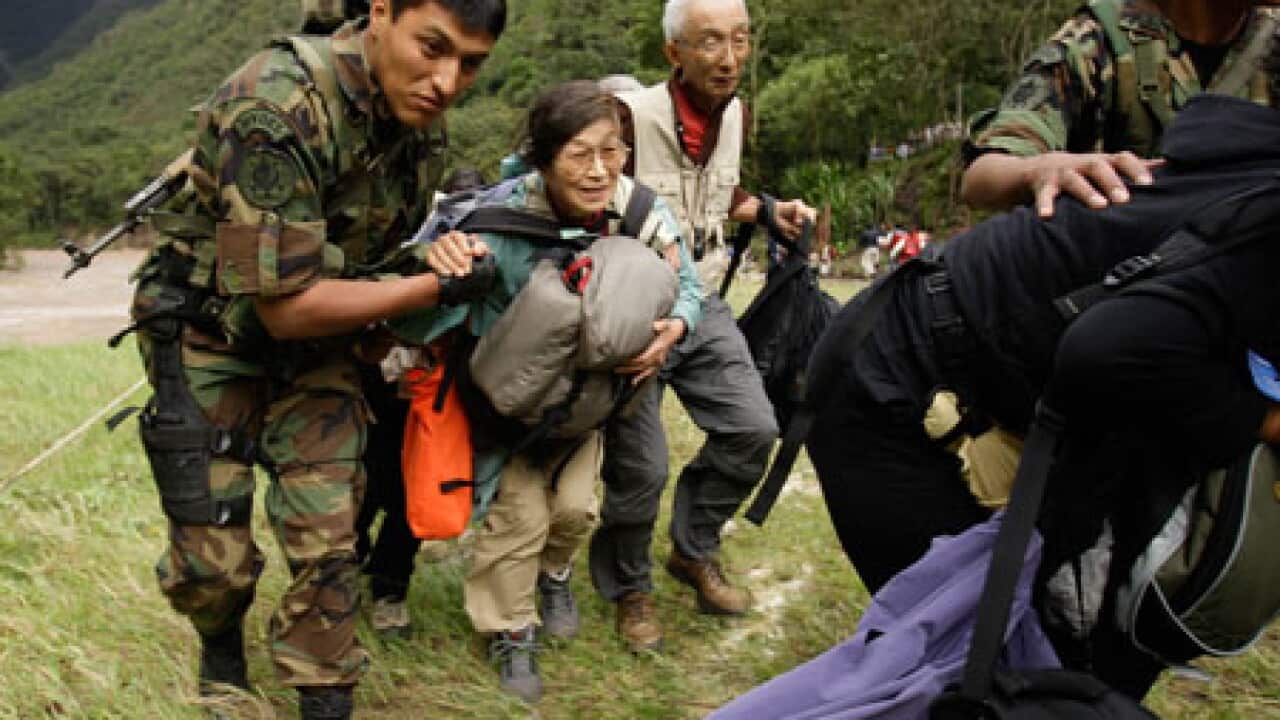
The Department of Foreign Affairs estimates around 200 Australians are trapped.
Many Australians are believed to be trapped in towns which have been affected by mudslides, forcing the closure of roads and rail lines.
News that makes sense
Your trusted source for staying up-to-date with the world around you. Get free daily news updates and analysis, straight to your inbox.
Meanwhile helicopters have airlifted around 600 tourists from the Inca ruins of Machu Picchu.
"We have evacuated 600 tourists, but there are still almost 1,500 at Machu Picchu," Prime Minister Javier Velasquez told reporters.
Rain delaying operation
About a dozen helicopters were used in the unprecedented airlift but "the persistent rains in the Cusco region are delaying the operation," he added.
The railway line that transports tourists between Aguas Calientes, at the foot of the ruins, and the city of Cusco, the ancient Inca capital, has been damaged and the tracks remain snapped.
Hundreds are still said to be stranded in Aguas Calientes with scores more believed trapped on the Inca Trail, a narrow Andean pathway up to Machu Picchu that takes four days to complete.
Tourists still trapped
With the trail already cut in several places by landslides, there are fears for the remaining backpackers on the trek.
"People are sleeping in the street square, they are sleeping in gyms, in schools, on trains, in makeshift tents. People are just distressed," Julie Nemcich, 29, told the Australian Broadcasting Corporation from Aguas Calientes.
A 23-year-old Argentine tourist and a 33-year-old Peruvian mountain guide died on the trail, buried under mudslides, the National Culture Institute in the nearby town of Cusco said.
The other fatalities occurred along the valley leading to Cusco and in the town itself.
Bribing accusations rejected
But Velasquez rejected accusations that the government was giving priority to foreign tourists and that some were bribing their way out. He said people over 60, children and the sick were the first to be evacuated.
The Peruvian government has also sent food aid to the 8,000 residents of Aguas Calientes, cut off by landslides and swollen rivers.
Officials defended the slow pace of the operations, saying they were being hampered by the heaviest rains in 15 years.
"We didn't think the evacuation would take so long. We are making every effort" to wrap it up in the next 24 hours, Tourism Minister Martin Perez told the radio station RPP.
50 Americans airlifted
About 50 Americans have been airlifted out but some 400 remain in the affected region, half of them in areas being evacuated, State Department spokesman Philip Crowley said Wednesday.
"For the moment I don't think they're at any particular risk, but obviously when the weather clears we want to get them down as rapidly as possible," Crowley told reporters in Washington.
He said around 15 US embassy personnel had headed to the Cusco region to work with Peruvian authorities in the evacuations.
300 Chileans trapped
Fernando Celis, one of 300 Chileans trapped in Machu Picchu, complained to the online news website Emol that food was running short.
"We haven't been given anything to eat," he said, adding vendors at the site had doubled their prices when it became clear the foreigners were stuck.
Machu Picchu is one of the most popular tourist destinations in Latin America, attracting more than 400,000 visitors a year. The 15th-century Inca citadel is located on a high mountain ridge 70 kilometers (43 miles) from Cusco.
The country's civil defense service estimated the homes of 1,300 people in poor rural areas -- many of them riverside dwellings made of clay and straw -- have been destroyed. Another 12,000 people were affected to a lesser degree, losing possessions or suffering property damage.







