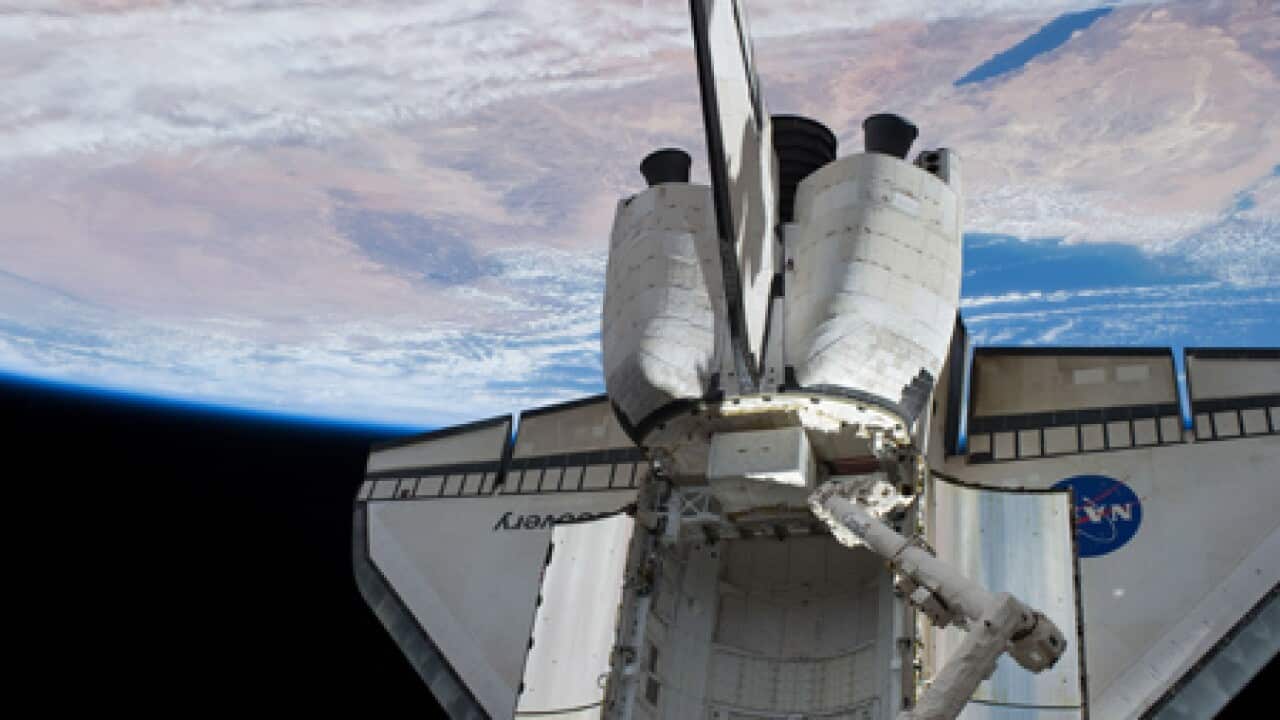
The crew of the soon-to-be-retired Discovery had been on a two-week resupply trip to the International Space Station.
NASA's Mission Control gave Discovery's astronauts approval for the landing at 9.08am (2308 AEST) after repeated delays on Monday and earlier on Tuesday due to rain and fog.
News that makes sense
Your trusted source for staying up-to-date with the world around you. Get free daily news updates and analysis, straight to your inbox.
"Welcome home. Congratulations on an outstanding mission," Mission Control told the Discovery crew.
"What a great mission," said Poindexter. "We enjoyed it."
The shuttle dropped from orbit over the Pacific Ocean and followed a rare course that took it over much of the US upper Midwest and Southeast, leaving a glowing contrail for ground observers.
Discovery's crew delivered nearly eight tonnes of scientific equipment and other supplies intended to fortify the orbiting science laboratory for operations well beyond the final shuttle flight.
New gear for space station
The new research gear includes an Earth observations rack to hold cameras and spectral scanners for studies of the atmosphere, geological formations as well as weather induced crop damage.
During three spacewalks, two of the astronauts wrestled with bulky bolts to replace a boxy coolant tank that is essential to the long term function of the station's life support systems.
Poindexter's crew included pilot Jim Dutton and mission specialists Dottie Metcalf Lindenburger, Stephanie Wilson, Rick Mastracchio, Clay Anderson and Naoko Yamazaki of the Japan Aerospace Exploration Agency.
With Discovery's return, NASA counts just three more missions before it retires the shuttle fleet.
The space agency will rely on Russia to transport astronauts to the orbiting science laboratory until it can help to foster a healthy commercial space taxi industry.
US President Barack Obama reinforced the controversial policy during a visit to the Kennedy Space Centre last week.
Shuttle Atlantis will fly next, with a lift off tentatively scheduled for May 14.
Final shuttle missions
During its 12-day mission, six astronauts will deliver a Russian mini-research module and external spare parts, including power storage batteries, a communications antenna and a radiator as well as Canadian and European robot arm components.
Endeavour is to follow, with a launch scheduled for July 29.
Endeavour's cargo includes the Alpha Magnetic Spectrometre, an internationally-sponsored physics investigation for the study of cosmic radiation and anti-matter.
If the scheduling holds, Discovery will lift off for the station on September 16 for the final shuttle flight with yet more cargo and a pressurised storage module.
With only a few missions remaining, many at NASA are beginning to realise the long-running shuttle program is winding down.
"For me, we are heads down focused on the mission, trying to make sure it's safe and successful," said Bryan Lunney, the NASA flight director who supervised Discovery's descent. He'll oversee Discovery's journey on the final shuttle flight as well.
"I haven't gotten too philosophical or concerned about the future. I'm just taking care of business."







