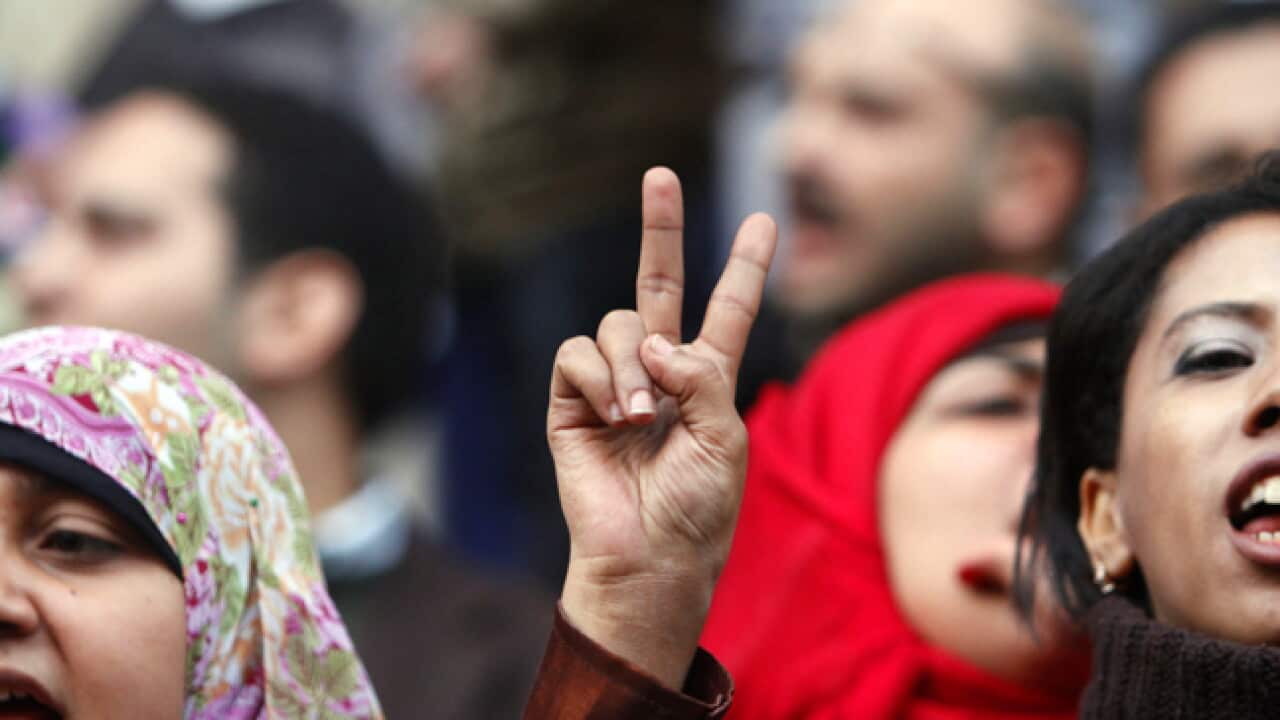
Protests raged in Egypt for a third straight day as pro-democracy activists, galvanised by the return of dissident Mohamed ElBaradei, vowed to step up efforts to oust President Hosni Mubarak.
ElBaradei, a Nobel laureate and former chief of the UN nuclear watchdog, arrived from Vienna Thursday evening in Cairo, where according to his brother he will join mass protests planned after weekly Muslim prayers on Friday.
"It is a critical time in the life of Egypt. I have come to participate with the Egyptian people," said ElBaradei, a vocal critic of Mubarak, as he left Cairo airport.
News that makes sense
Your trusted source for staying up-to-date with the world around you. Get free daily news updates and analysis, straight to your inbox.
Earlier in Vienna he told reporters he was ready to "lead the transition" in Egypt if asked.
"If people, in particularly young people, if they want me to lead the transition I will not let them down. My priority right now is to see a new Egypt and to see a new Egypt through peaceful transition," he said.
His arrival came on the third straight day of angry nationwide protests, which have built into the largest uprising in three decades, during which seven people have been killed -- five protesters and two policemen -- and more than 100 injured.
A security official told AFP that around 1,000 protesters had been arrested since the protests began.
While a heavy security clamp Thursday prevented protesters from massing in the centre of Cairo as they did Tuesday and Wednesday, violent clashes erupted in the cities of Suez and Ismailiya, and in a Sinai town where a protester was shot dead by police, according to witnesses.
The demonstrations against Mubarak's autocratic rule, inspired by the groundbreaking "Jasmine Revolution" in Tunisia, have sent shockwaves across the region and prompted Washington to prod its long-time ally on democratic reforms.
Events on the street sent jitters Thursday through Egypt's stock exchange, which suspended trading temporarily after a drop of 6.2 percent in the benchmark EGX 30 index, a day after it fell six percent.
The stock market closed with a drop of over 10 percent on Thursday,
The secretary general of Egypt's ruling National Democratic Party meanwhile told reporters Thursday that the authorities are open to dialogue with the country's young people who are spearheading demonstrations.
"We have held several meetings with the youth, but in the future we will be more understanding in our approach so that they can be participants," Sawfat al-Sherif told a news conference, without saying more about what he meant.
Earlier in the day, members of the pro-democracy youth group April 6 Movement said they would continue to take to the streets, defying a ban on demonstrations announced on Wednesday.
"To continue what we started on January 25, we will take to the streets to demand the right to life, liberty, dignity and we call on everyone to take to the streets ... and to keep going until the demands of the Egyptian people have been met," the group said.
Opposition groups circulated SMS messages and posted appeals on social networking site Facebook for fresh demonstrations "to demand the right to live with freedom and dignity."
"We've started and we won't stop," one demonstrator told AFP.
Clashes broke out in the north Sinai town of Sheikh Zuwayed where, according to witnesses and relatives, Mohamed Atef, 22, died when he was shot in the head by police during a firefight.
In Suez, east of Cairo at the mouth of the Suez Canal, anti-riot police fired rubber-coated bullets, tear gas and water canon at hundreds of people gathered to demand the release of some 75 people arrested on Tuesday and Wednesday.
An AFP photographer said protesters later hurled molotov cocktails at a fire station in the city, setting it ablaze.
In Ismailiya to the north, witnesses reported that police were on Thursday firing tear gas at demonstrators, who responded by throwing rocks.
The United States, Egypt's chief ally in the Arab world, meanwhile issued a nuanced written statement in Obama's name on Egypt.
"The Egyptian government has an important opportunity to be responsive to the aspirations of the Egyptian people, and pursue political, economic and social reforms that can improve their lives and help Egypt prosper," it said.
"The United States is committed to working with Egypt and the Egyptian people to advance these goals," it added.
The statement also underlined US support for basic democratic freedoms "including the rights to freedom of expression, association and assembly".
The protests are the largest in Egypt since bread riots in 1977, four years before Mubarak came to power.
Among protesters' demands are the departure of the interior minister, whose security forces have been accused of heavy-handedness; an end to a decades-old state of emergency and a rise in minimum wages.







