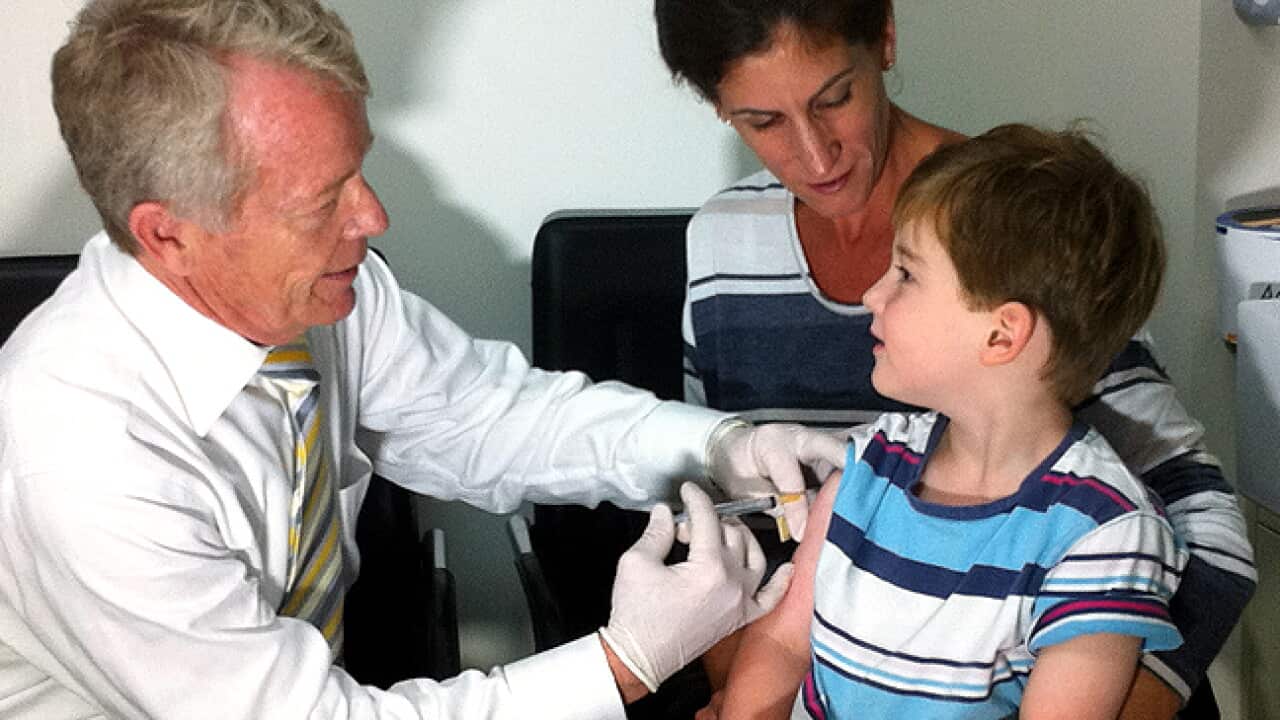
A new documentary airing soon on SBS Television takes a deep look at the science lying beneath the fierce debate over vaccination.
It's an issue where emotions run high, especially so since the advent of social media, where tales can often take on a life of their own.
Prize-winning science-documentary film-maker Sonya Pemberton had just completed her latest production, Catching Cancer in 2009.
News that makes sense
Your trusted source for staying up-to-date with the world around you. Get free daily news updates and analysis, straight to your inbox.
It was a film about viruses and cancer, and, when it went to air, Ms Pemberton was caught off-guard by the vehemence of the mail from one stream of critical viewers.
Using vaccines, even if they were going to stop a cancer, was a bad idea, they insisted, especially the cervical-cancer vaccine, as it was called at the time.
"I was startled -- and a bit shocked -- at the level of fury and anger behind some of these emails and correspondence."
"It started me wondering why people were so concerned about vaccines that they would take the time to write me letters and emails basically shouting from the rooftops that I was misguided, at best, or in the pocket of Big Pharma, at worst."
"And I was so baffled by this reaction that it started me paying attention to the whole debate. And I wanted to understand why people were so frightened around vaccines, or so distrustful of vaccines, that they would take a very straightforward science film and take offence at that."
The result, four years later, is another Sonya Pemberton documentary that takes a hard -- but unceasingly respectful -- look at a critical national and international debate.
That is, to vaccinate or not to vaccinate.
The 90-minute film, entitled Jabbed: Love, Fear and Vaccines, is a joint venture that involved SBS and will be televised on SBS ONE on Sunday night (May 26) at 8:30pm.
Ms Pemberton looked at the science behind vaccinations, tracked epidemics, talked with vaccine-makers, alternative healers, psychologists, anthropologists, victims, parents.
Immunologist and former Australian of the Year Sir Gustav Nossal, interviewed for her film, praises it as a powerful documentary deserving of the widest-possible distribution.
Pemberton says she was "very careful" to be as respectful as possible.
"I made a decision that I would not ridicule people, I would not be disrespectful of people having different views.
"That said, I'm a science film-maker, so I follow the science. And if your argument has no science, or disproven science, then I am not going to give you, kind of, equal weight (importance), because that's just not a science film."
The documentary includes heart-rending stories of children who have suffered major health issues after being vaccinated.
For example, this father speaking emotionally of the life his son is left with after a polio vaccination gone wrong.
"Gordon will never hold a job. He'll never wave goodbye to you. He'll never reach out and shake your hand, or speak a word, or get married, or do any of the things we associate with value or success."
Yet, even that scene ends with a twist about where that leaves the parents' views on whether vaccination is good or bad.
Sir Gustav Nossal, speaking ahead of the film's release, offers a perspective from his own childhood in the 1930s in Vienna, Austria, before his family moved to Australia.
"When summer came, and one of the poliomyelitis or infantile-paralysis epidemics was on, our mothers wouldn't let us do the two things that we really wanted to do on a weekend -- namely, go to the pictures or visit the swimming pool."
"That's how frightened they were that we would catch polio. And, in fact, the wards of the infectious-diseases hospital were full of kids in respirators because they'd caught polio and they had what we call the bolder variety, so it paralysed the muscles of respiration."
Dr Jonas Salk of the United States discovered and developed the first polio vaccine in the 1950s.
A global effort to eradicate polio in 1988 has reduced the number of cases worldwide from an estimated 350-thousand a year then to about a thousand a year now.
Hopes of completely eliminating the disease have run into resistance to taking the vaccine in parts of Nigeria, Pakistan and Afghanistan, though, keeping it alive.
Sir Gustav Nossal says, yes, the live, oral poliomyeletis vaccine perfected by U-S medical reseacher Albert Sabin in the 1960s causes paralysis -- but once in two million doses.
"The risk-(versus)-benefit equation for vaccines is just immensely positive. Let me give you one statistic that I'm very fond of. There's a bleeding disease called purpura, where you don't die but you come out in very nasty little blotches under the skin. Now, the incidence of that from the measles vaccine is something like about one in a hundred thousand (100,000). Now, what is the incidence of measles itself? One per cent. Let me ask you, what would you sooner (have), a one-in-a-hundred-thousand chance or a one-in-a-hundred chance?"
Diseases largely eradicated 40 years ago are returning around the world as nervous parents skip vaccinations for their children and adults, at times, skip their own.
Measles has made such a strong comeback that 28-thousand cases were reported across Europe in 2011.
One in four were hospitalised, and nine people died.
Swiss Nobel Prize-winning immunologist Rolf Zinkernail, who studied at the Australian National University, has told SBS Radio's German program there is a clear message.
"Very clear message, that vaccines against all known and recognised and severe childhood infections reduce the chances of severe sequelae (outcome), like brain damage, with measles virus by at least a factor of a hundred to a thousand. So, yes, while it is not excluded that an individual may potentially suffer, the population has a benefit of that factor of a hundred to a thousand."
Likewise, mirroring elsewhere in the world, whooping-cough infections are at their highest levels in Australia in more than half a century.
In 2011, there were nearly 40 thousand cases.
Research conducted for the documentary suggested only two per cent of Australians oppose vaccination.
But it found, with stories abounding about the potential risks, more than half of parents have concerns about vaccines and almost one in 12 delay or avoid vaccinating their children.
Professor Zinkernail says parents who decline to vaccinate their children are being irresponsible.
"They are profiteers -- that's what I would use as a term -- because they use others to provide the protection for their own children. And that's an unfair position to take. And we all know that, if protection by vaccination of the population drops below 82 per cent in measles, measles -- clinical measles -- will be back. And then the children who are not vaccinated will suffer with a hundredfold greater frequency of some serious disease, caused usually in the brain by measles virus. I would even go further and say, 'They are not (just) idiots, they are irresponsible parents.'"
And Sonya Pemberton, who set out to try to understand the issues around the vaccination debate, how does she come away from her documentary feeling?
"Let's not kid ourselves, some of these stories are brutal. And they're brutal on the side of what happens when you don't vaccinate, and they're brutal on the rare occasion when a vaccine reaction is significant. Both of these fears are valid, and both of them are worth discussing. But I think the film clearly comes to the point at the end to say, 'The vaccines are needed. The vaccines have done tremendous good -- there's ample evidence of that -- and they're the best option we have right now.'"







