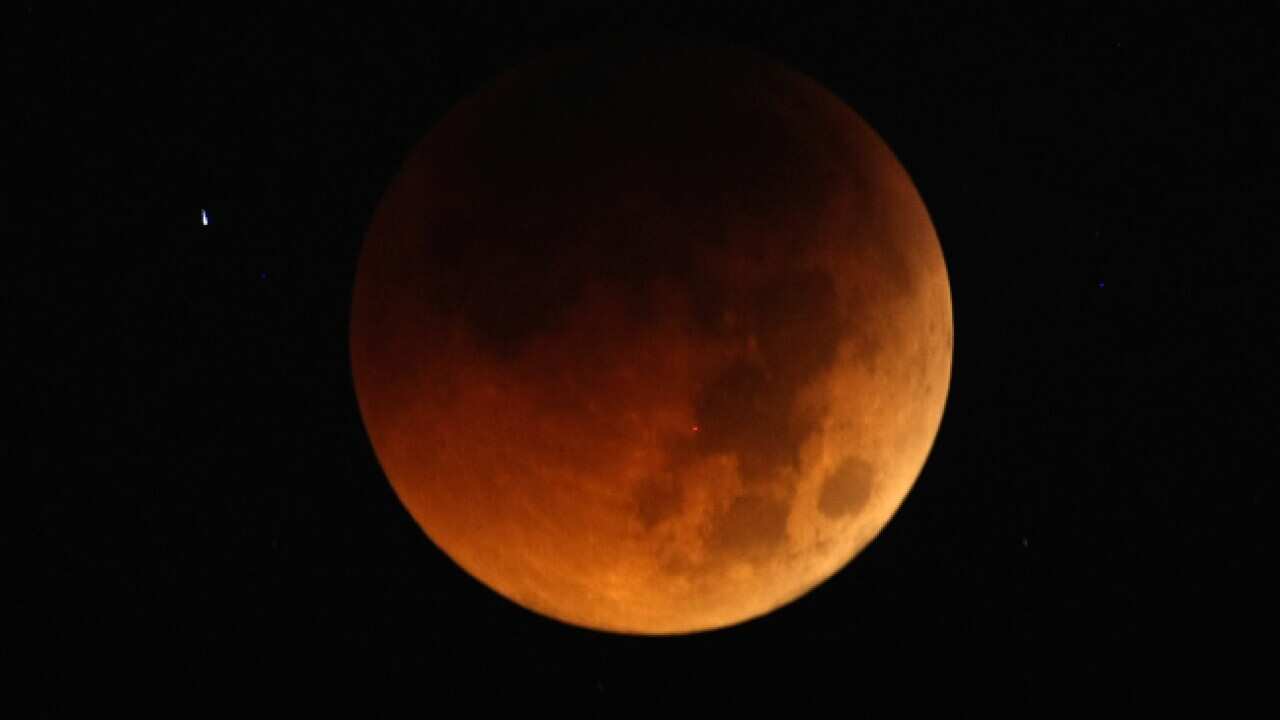
Parts of Asia, New Zealand, Australia, Africa and the Middle East have been treated to a 'red moon' as the earth cast its shadow in a lunar ecilpse early this morning, the first of 2011 and the longest in nearly 11 years.
A total lunar eclipse occurs when Earth casts its shadow over the Moon.
The lunar face turned reddish, tinged by light from the Sun that refracts as it passes through the atmosphere.
The terrestrial shadow starts to fall at 1724 GMT and lifts at 2300 GMT, although "totality" -- when the lunar face is completely covered -- runs from 1922 to 2102 GMT, according to NASA's veteran eclipse-watcher, Fred Espenak.
The 100-minute period of totality is the longest since July 2000.
News that makes sense
Your trusted source for staying up-to-date with the world around you. Get free daily news updates and analysis, straight to your inbox.
"The entire event will be seen from the eastern half of Africa, the Middle East, Central Asia and western Australia," says Espenak.
"Observers throughout Europe will miss the early stages of the eclipse because they occur before moonrise. Fortunately, totality will be seen throughout the continent except for northern Scotland and northern Scandinavia."
Eastern Asia, eastern Australia and New Zealand will miss the last stages of the eclipse because they occur after moonset.
Totality will be visible from eastern Brazil, Uruguay and Argentina. None of the eclipse will be visible from North America, though.
The next total lunar eclipse is on December 10.
There will be partial solar eclipses on July 1 and November 25. The next total solar eclipse will take place on Nov 13 2012, in a track running across North Australia, New Zealand, the South Pacific and southerly South America.







