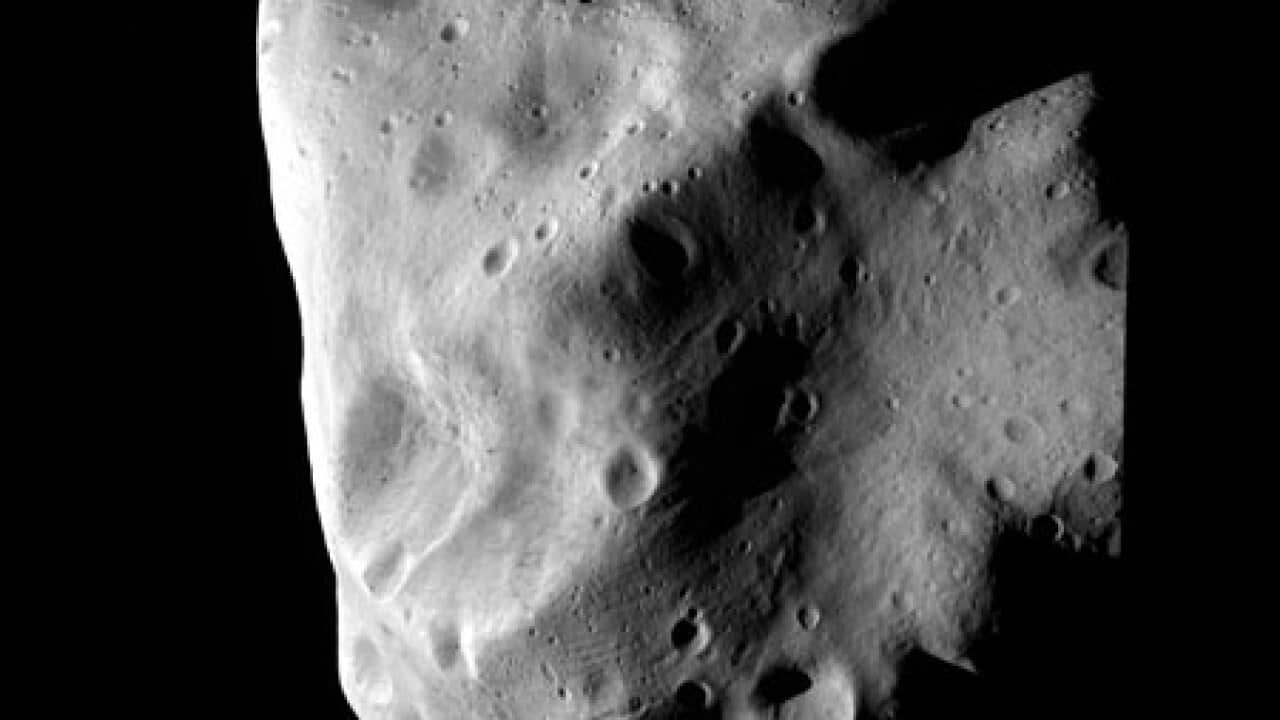
IN THE beginning, there was water. Earth's life-sustaining liquid came from the dust from which the planet was born, a new look at these particles suggests, and not simply from collisions with objects that later crashed into the planet from space.
The origin of the oceans has long been a mystery. Earth's birthplace in the dusty nebula around the young sun should have been hot enough to keep any water vaporised. So it seemed clear that the dust that coalesced to create Earth was bone dry, and that water somehow arrived later.
News that makes sense
Your trusted source for staying up-to-date with the world around you. Get free daily news updates and analysis, straight to your inbox.
Ice-rich comets or asteroids from farther out in the solar system could have supplied it, but that raises a further problem. Comets are richer in deuterium, a stable heavy isotope of hydrogen, than Earth's oceans. And asteroids should have brought more platinum and other rare elements than have been found. These mismatches are difficult to explain if most of Earth's water came from impacts.
Now, it seems that water may after all have been present in Earth's building blocks. Simulations by Nora de Leeuw of University College London and colleagues suggest that the dust grains from which Earth formed had such a tenacious grip on water that they could have held onto the molecules despite the high temperatures.
De Leeuw's team created computer models of dust grains made of olivine, a common mineral both in our solar system and in the dusty nebulae around other stars, and calculated what happened when water molecules attached themselves to the irregular surfaces of these fluffy grains. This process releases a lot of energy, which means that a large amount of energy would be needed to detach the molecules.
According to the models, the dust grains should be able to hold onto water at temperatures up to 630 °C - high enough for them to have retained it during Earth's formation.< "Some of the Earth's water probably came from this source, and quite possibly most of it," says co-author Michael Drake of the University of Arizona, Tucson. As the planet coalesced from the dust, pressures and temperatures would have grown high enough to detach the water from the grains, freeing it up to become streams and oceans.
Fred Ciesla of the University of Chicago, who was not on the team, says its results strengthen the argument that water was present in Earth's raw materials.
Even if it was, this was probably not the only source of our water. Some asteroids are known to be rich in water, and some of these would inevitably have crashed into Earth during the chaotic early days of the solar system. "The key for us now may be figuring how much water was brought in by the different mechanisms," he says.







