By Ian Musgrave
News that makes sense
Your trusted source for staying up-to-date with the world around you. Get free daily news updates and analysis, straight to your inbox.

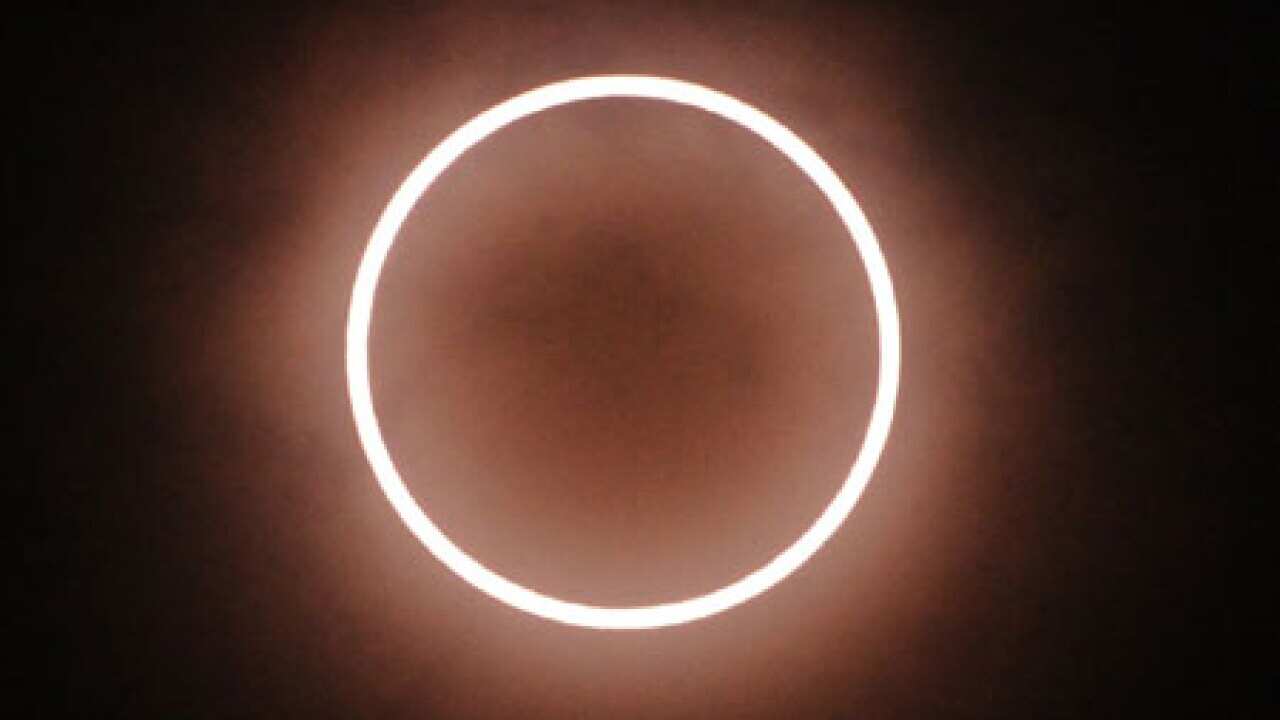
On the morning of May 10, there will be an annular Solar eclipse. In an annular eclipse the Moon does not completely cover the Sun, and the Sun forms a thin ring around the Moon at maximum eclipse depth.
The annular eclipse will be seen from a thin strip in WA, the Northern Territory and remote far north Queensland. Everywhere else will see a partial eclipse of varying depth, the north-east coast of Australia having the best views. The eclipse starts shortly after sunrise. In places along the annular eclipse path, such as Tennant Creek (NT) and Musgrave Roadhouse (QLD), viewers will see a thin rim of Sun around the moon.

Elsewhere viewers will see between 13% (Hobart) – 83% (Cairns) of the Sun covered by the Moon.
A diagram showing eclipse times in Universal Time is here, and an interactive map of the path is here. Click on the map for local timings of the eclipse.
Do NOT look directly at the Sun! Do not use so called filters. Over exposed film, smoked glass etc. used as filters are NOT, repeat NOT safe. Only special solar-rated viewing spectacles from astronomical suppliers should be used (for one example see here), they may cost a bit, but your eyesight is without price. Never use eyepiece filters for telescopes. These can crack at inopportune times and destroy your eyesight. In the annular eclipse path, as there is always some of the solar disk visible, at no time is it safe to view the eclipse with the unaided eye.

The easiest and cheapest way to observe this event is by making a pinhole in a stiff square of cardboard and projecting the image of the Sun onto a flat surface. You are basically making a simple pinhole camera, which will reveal the changes to the Suns outline quite satisfactorily. A card with a 1 mm hole should be projected onto a surface (eg white paper, or a white wall) about 20 cm away, a 5 mm hole should be projected onto a surface 1 to 1.5 meters away.

Partial Eclipse as seen from Perth at just after sunrise, 6:58 am AWST Ian Musgrave
You need to create a reasonable sized image, so you need a fair distance between the pinhole and the surface you project the image on. This will mean the image is going to be fairly dim, so you also need some sort of sun shield to keep in image in shadow. I use the longest available postpac postal tube, with alfoil over the top (and the pinhole in the alfoil), and wide ring of stiff cardboard to ensure that the image of the sun is projected into a dark area. This link will show you several methods to make pinhole projection systems.
You can also use binocular and telescopic projection systems. This link will show you how to make safe solar viewing and telescope projection systems. Here is my step by step guide to making a binocular projection system, and a guide to aiming your binoculars or telescope when you can't actually look at the Sun. And this is the projection system I use with my refractor telescope.
Remember, do NOT look directly at the Sun, as irreparable eye damage or blindness can occur (see this video for a graphic demonstration).
| City | Eclipse Start | Mid Eclipse | Eclipse End | % Sun covered |
| Adelaide (ACST) | 7:09 am | 8:15 am | 9:22 am | 38 |
| Alice Springs (ACST) | below horizon | 8:07 am | 9:31 am | 79 |
| Brisbane (AEST) | 7:41 am | 8:58 am | 10:28 am | 40 |
| Cairns (AEST) | 7:28 am | 8:49 am | 10:27 am | 83 |
| Canberra (AEST) | 7:50 am | 8:55 am | 10:10 am | 26 |
| Darwin (ACST) | below horizon | 8:07 am | 9:28 am | 68 |
| Hobart (AEST) | 8:06 am | 8:59 am | 9:57 am | 13 |
| Melbourne (AEST) | 7:50 am | 8:52 am | 10:02 am | 25 |
| Musgrave Roadhouse (AEST) | 7:26 am | 8:47 am | 9:29 am | 95 Annular eclipse |
| Perth (AWST) | below horizon | below horizon | 7:45 am | - |
| Rockhampton (AEST) | 7:34 am | 8:54 am | 10:30 am | 56 |
| Sydney (AEST) | 7:50 am | 8:57 am | 10:14 am | 27 |
| Tennant Creek (ACST) | 6:57 am | 8:07 am | 9:28 am | 95 Annular eclipse |
| Townsville (AEST) | 7:29 am | 8:49 am | 9:28 am | 74 |
Ian Musgrave does not work for, consult to, own shares in or receive funding from any company or organisation that would benefit from this article, and has no relevant affiliations.








