Morsi had been due to meet French President Francois Hollande on Friday to discuss France's military intervention in Mali, which he has criticised.
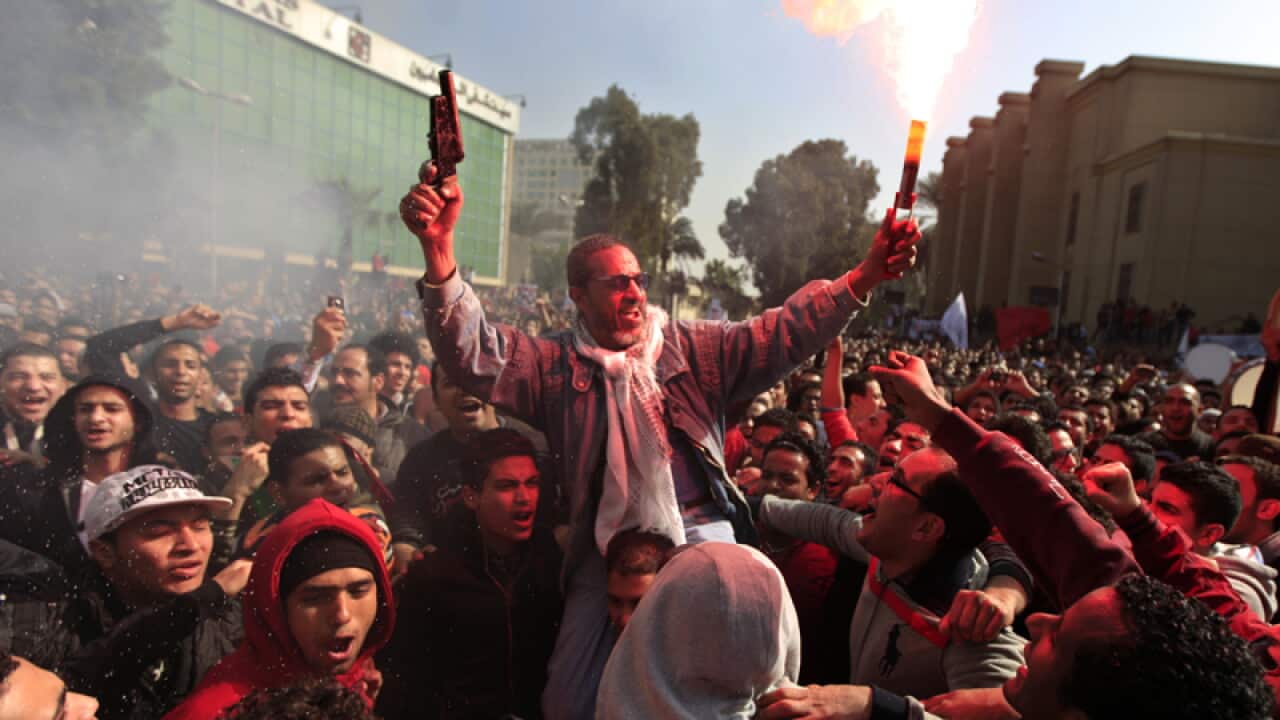
The Egyptian opposition has pledged mass protests on Friday after violence sweeping the country left at least 52 dead in five days.
Morsi's office said earlier Tuesday that his scheduled two-day trip to Germany starting on Wednesday was still on but had been cut back to just a few hours.
News that makes sense
Your trusted source for staying up-to-date with the world around you. Get free daily news updates and analysis, straight to your inbox.
After winning a tug-of-war with the opposition over Egypt's new constitution in December, Islamist Morsi faces a fresh crisis, one that is hard to pass without him making concessions.
The gravity of the crisis was highlighted Tuesday by Defence Minister General Abdel Fattah al-Sissi, who warned if the current situation persists it could "lead to a collapse of the state".
Egypt has been rocked by rioting since Thursday night which has killed at least 52 people, forcing Morsi to impose emergency and night-time curfews in the worst-affected provinces of Port Said, Ismailiya and Suez Canal.
On Saturday, violence exploded in Port Said after a court sentenced to death 21 supporters of a local football club for their involvement in a deadly soccer riot last year. Forty-two people have died so far in Port Said.
Sissi, also Egypt's military chief, urged all parties to bury their differences and find a solution to the country's "political, economical, social and security" problems.
The military faced a tough task, he said, as it did "not want to confront Egyptian citizens who have a right to protest" but it also had "to protect vital institutions".
On Monday, the senate ratified a law granting the armed forces powers of arrest and allowing them to "support the police in maintaining order and protecting vital installations until the end of parliamentary elections and whenever the National Defence Council (headed by Morsi) requests it".
In November, Morsi had a showdown with the main opposition National Salvation Front over the Islamist-drafted constitution.
But the president came out on top with the charter being adopted through a referendum in December, despite mass demonstrations by his adversaries.
This time, however, the situation is more complicated.
"This crisis will not pass easily," said Mustafa Kamel El-Sayyed, professor of political sciences at Cairo University.
The tussle over the constitution had "put liberals and leftists on one side and Islamists on the other, with the people not really being involved," he said.
"But this time the people are part of it, protesting over the deterioration of their living conditions."
And also this time, according to Sayyed, a new element has emerged on the scene.
"A group of young anarchists (nicknamed as the Black Bloc) who are ready to engage in violence with the police," he said.
The mysterious Black Bloc comprises masked youngsters presenting themselves as the defenders of protesters opposed to Morsi. They express readiness to counter Islamists who they say have previously attacked the protesters.
"Without any concessions on the part of the president and the Muslim Brotherhood from where he comes, there will be no solution," said Abdallah Essennawi, a columnist with the independent Al-Shuruq newspaper.
"The solution to the crisis cannot be achieved by using security forces as they are exhausted and the army does not want to confront civilians," he said.
General Sissi's declaration was "a clear warning to Morsi, and to some extent to the opposition".
Morsi "would have to make concessions and accept a key demand of the opposition which is to form a national unity government led by a heavyweight personality like Mohamed El-Baradei," he said, referring to the head of the opposition National Salvation Front.
But Sayyed does not foresee "Morsi making concessions" on his own, saying the "army would be forced to intervene indirectly and discreetly to dictate policy measures, including formation of a national unity government" to stabilise Egypt.
Fahmi Howeidi, an editorial writer close to Islamists, went further.
"It would be brave on the part of Morsi to initiate early presidential elections along with the legislative poll" in spring, he wrote in Al-Shuruq.







