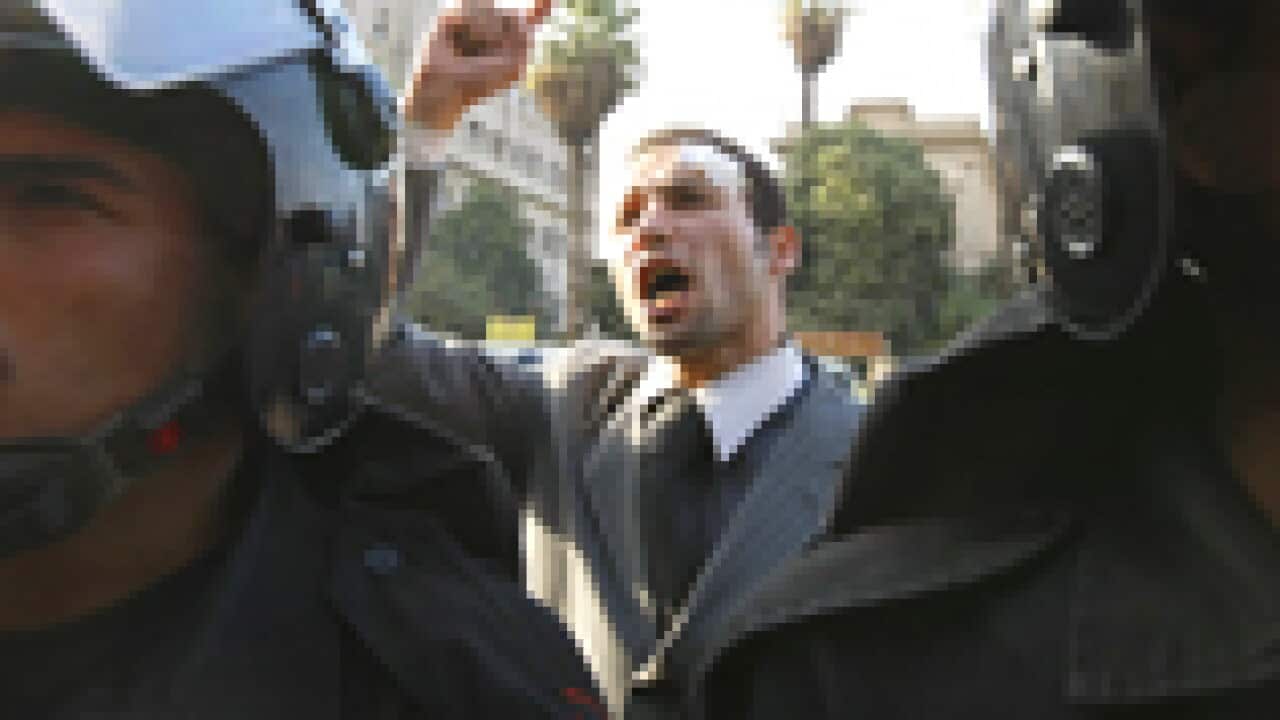
Egypt's political unrest leaves Washington torn between freedom-seeking protesters and a government that has been a vital ally -- a dilemma with deep implications for its troubled Middle East policy.
Egyptian President Hosni Mubarak has been a fulcrum of US regional strategy for decades, a guarantor of his nation's peace with US ally Israel and a central player in successive and frustrated American peace initiatives.
But with his 30-year rule seemingly under threat, amid talk of a possible "Arab spring" of revolt against authoritarian rulers, US policymakers must pick their way through a political minefield.
News that makes sense
Your trusted source for staying up-to-date with the world around you. Get free daily news updates and analysis, straight to your inbox.
"They are in a difficult position because there is all sorts of momentum in Egypt -- and in Washington people think that the dominoes just are going to fall," said Gregory Gause of the University of Vermont.
"I think they are probably pulled in two directions," Gause, a political science professor said.
More optimistic US cheerleaders, including neo-conservative remnants of the George W. Bush administration, will increasingly demand robust support of protesters, hoping for a wave of democratic change in the Middle East.
And should tens of thousands of Egyptian pro-democracy protesters violently clash with security forces built with $1.3 billion in annual US military aid, the Obama team's position may become unbearably uncomfortable.
Realists however fret about the loss of a stalwart US-leaning voice in a tough neighborhood where US influence is fraying, and fear a post-Mubarak government, possibly including the Muslim Brotherhood, hostile to Washington.
They argue that if protests subside, Mubarak will not forget who his friends were in his moment of crisis.
Significant political pressure is building on Obama, who will likely be blamed by pundits on either side for any outcome unfavorable to American interests -- despite limited US leverage in the crisis.
Obama weighed in on the situation for the first time on camera on Thursday, following previous comments by Secretary of State Hillary Clinton and his spokesman Robert Gibbs.
"Violence is not the answer in solving these problems in Egypt," Obama said in a YouTube question-and-answer session.
"The government has to be careful about not resorting to violence. The people on the streets have to be careful about not resorting to violence."
Obama described the demonstrations as the result of the "pent-up frustrations" of the population in Egypt, and said he had always made clear to Mubarak it was "absolutely critical" for him to move towards political reform.
Meanwhile, Clinton reinforced Obama's message when she spoke Thursday to Egyptian Foreign Minister Ahmed Abul Gheit.
"She encouraged restraint and dialogue, and offered US support for reforms," Clinton spokesman Philip Crowley said on Twitter.
Washington's stance has been seen in some quarters as a subtle move towards protesters, and away from Mubarak.
Leslie Gelb, a former senior US defense and foreign policy official, said in a Daily Beast blog Thursday that even the current nuanced US position was fraught with danger.
"The very assertion of 'not taking sides' is itself a tilt away from the all-out support traditionally given by Washington to this Egyptian strongman in recent decades," he wrote.
But a senior US official told AFP the administration was not choosing one side or the other, though added that Obama had consistently pressed Mubarak to loosen political controls.
The official also said US statements were consistent with Obama's language on democracy in his Cairo speech to the Muslim world in 2009 -- and administration statements since.
Obama's position partially recalls the US response to anti-government protests in Iran last year.
At first, he took pains to avoid drawing the United States into the situation, reasoning that an endorsement of protests might give the Iranian government an excuse for a crackdown.
But his approach sparked fierce domestic criticism and he moved to withering denunciations of Tehran when authorities suppressed the protests.
As Egypt's unrest escalates, there will likely be calls for Obama to "get on the right side of history" or risk alienating a future popular reform movement in the Arab world.
However, the crisis plays out, the stakes for Washington are huge.
"If the government changes in Egypt in a direction that is less cooperative with the United States, that has a big impact on American interests in the Middle East," said Gause.
Meanwhile, Clinton's spokesman PJ Crowley said at a press briefing Thursday that Washington did not believe that events in Egypt would spill over to other countries within the region.
"What happens going forward will be something that develops indigenously country-by-country," he said.
But, he added, "we believe that governments need to take advantage of this opportunity to expand their dialogue with their populations and respond to the aspirations of their people."







