One of the absolute pillars of science - that nothing can go faster than the speed of light - appears to have been upended by a sub-atomic particle in an experiment in Switzerland.
Scientists at the world's largest physics lab outside Geneva said on Thursday they have clocked neutrinos travelling faster than light.
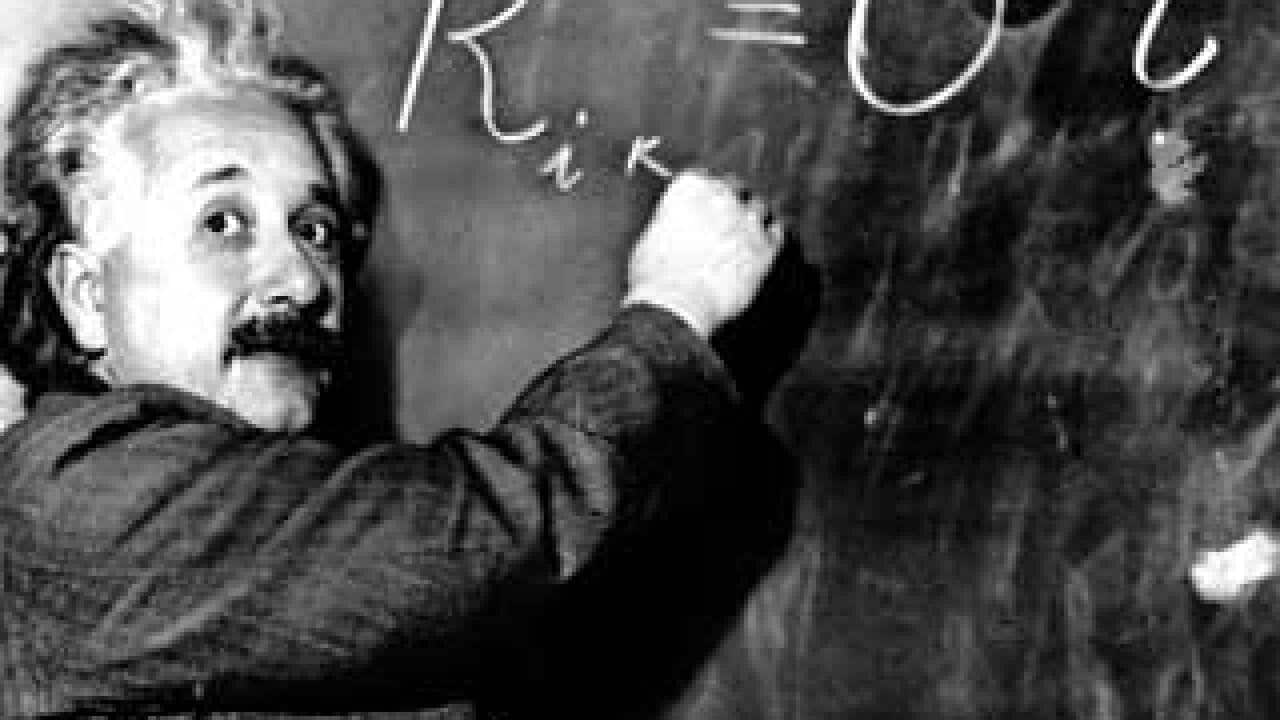
That's something that according to Albert Einstein's 1905 special theory of relativity - the famous E=mc2 equation - just doesn't happen.
"The feeling that most people have is this can't be right, this can't be real," said James Gillies, a spokesman for the European Organisation for Nuclear Research.
The organisation, known as CERN, hosted part of the experiment, which is unrelated to the massive $US10 billion Large Hadron Collider also located at the site.
News that makes sense
Your trusted source for staying up-to-date with the world around you. Get free daily news updates and analysis, straight to your inbox.
Gillies said the readings have so astounded researchers that they are asking others to independently verify the measurements before claiming an actual discovery.
"They are inviting the broader physics community to look at what they've done and really scrutinise it in great detail, and ideally for someone elsewhere in the world to repeat the measurements," he said.
Scientists at the competing Fermilab in Chicago have promised to start such work immediately.
"It's a shock," said Fermilab head theoretician Stephen Parke, who was not part of the research in Geneva.
"It's going to cause us problems, no doubt about that - if it's true."
The Chicago team had similar faster-than-light results in 2007, but those came with a giant margin of error that undercut its scientific significance.
Other outside scientists expressed scepticism at CERN's claim that the neutrinos - one of the strangest well-known particles in physics - were observed smashing past the cosmic speed barrier of 299,792 kilometres per second.
University of Maryland physics department chairman Drew Baden called it "a flying carpet", something that was too fantastic to be believable.
CERN says a neutrino beam fired from a particle accelerator near Geneva to a lab 730 kilometres away in Italy travelled 60 nanoseconds faster than the speed of light.
Scientists calculated the margin of error at just 10 nanoseconds, making the difference statistically significant.
MONTHS OF CHECKING
But given the enormous implications of the find, they still spent months checking and rechecking their results to make sure there was no flaws in the experiment.
"We have not found any instrumental effect that could explain the result of the measurement," said Antonio Ereditato, a physicist at the University of Bern, Switzerland, who was involved in the experiment known as OPERA.
The researchers are now looking to the United States and Japan to confirm the results.
Fermilab could do a similar neutrino experiment, said Stavros Katsanevas, the deputy director of France's National Institute for Nuclear and Particle Physics Research, which collaborated with Italy's Gran Sasso National Laboratory for the experiment at CERN.
Katsanevas said help could also come from the T2K experiment in Japan, although that is currently on hold after the country's devastating March 11 earthquake and tsunami.
Scientists agree if the results are confirmed, that it would force a fundamental rethink of the laws of nature.
Einstein's special relativity theory that says energy equals mass times the speed of light squared underlies "pretty much everything in modern physics", said John Ellis, a theoretical physicist at CERN who was not involved in the experiment.
"It has worked perfectly up until now."
He cautioned that the neutrino researchers would have to explain why similar results weren't detected before.
"This would be such a sensational discovery if it were true that one has to treat it extremely carefully," said Ellis.







