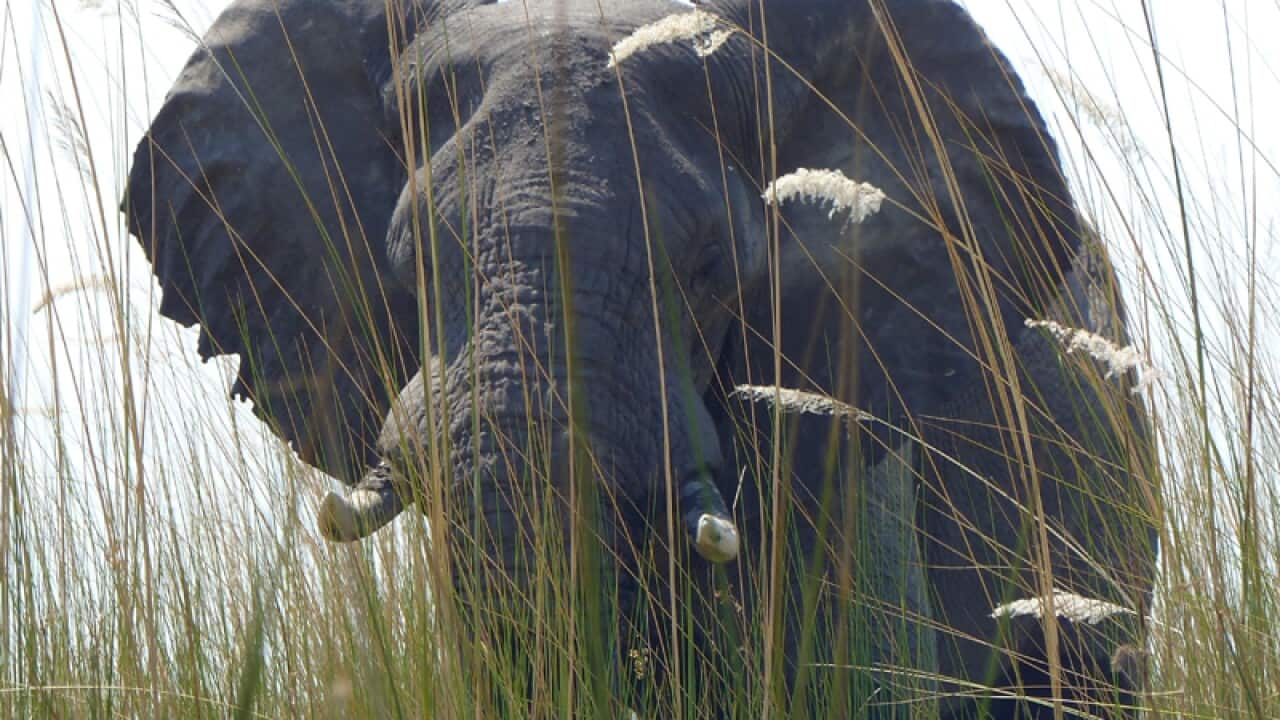
There's an old saying that elephants never forget. You also can say they almost never sleep.
Scientists says a first-of-its-kind study tracking the sleep behavior of wild elephants found the world's largest land mammal sleeps two hours per day on average, and some days not at all, and does so mostly standing up.
This represented the shortest-known sleep time of any mammal. Previous research showed captive elephants got four to six hours daily.
"Sleep needs to be studied in an animal's natural environment if we are truly to understand it," said Paul Manger, a research professor in the School of Anatomical Sciences at the University of the Witwatersrand in South Africa who led the study published in the journal PLOS ONE.
The researchers monitored two free-roaming female African elephants in Botswana's Chobe National Park for 35 days. They got data to track sleep accurately from a wristwatch-sized device implanted under the skin of the trunk that was not harmful to the animals. They used a satellite-tracking collar with a gyroscope to monitor their location and sleep position.
News that makes sense
Your trusted source for staying up-to-date with the world around you. Get free daily news updates and analysis, straight to your inbox.
"We do feel these two elephants are representative of the broader population," Manger said, adding he hoped future research could be done with larger numbers of wild elephants, including males.
The elephants sometimes went up to 46 hours without sleep while walking distances of about 130 km, possibly to avoid threats like lions or human poachers.
They typically slept somewhere between 2 am and 6 am. After a sleepless night, they had no extra sleep the next night. The maximum sleep recorded was five hours in a day. They spent just 17 per cent of their sleeping time lying down.
The next shortest sleepers among mammals may be domestic horses, which get under three hours daily. Some mammals have been shown in captivity to sleep most of the day, including the little brown bat (19 hours), opossum (18 hours) and armadillo (17 hours), Manger said.
People average roughly six to nine hours, Manger said.
The elephants appeared to experience rapid eye movement (REM) sleep, associated with more dreaming and body movements and loss of muscle tone, only every three to four nights.
"REM sleep is often associated with the consolidation of memories. However, we do know elephants have good memories, so this finding contradicts one central hypothesis of REM sleep function," Manger said.







