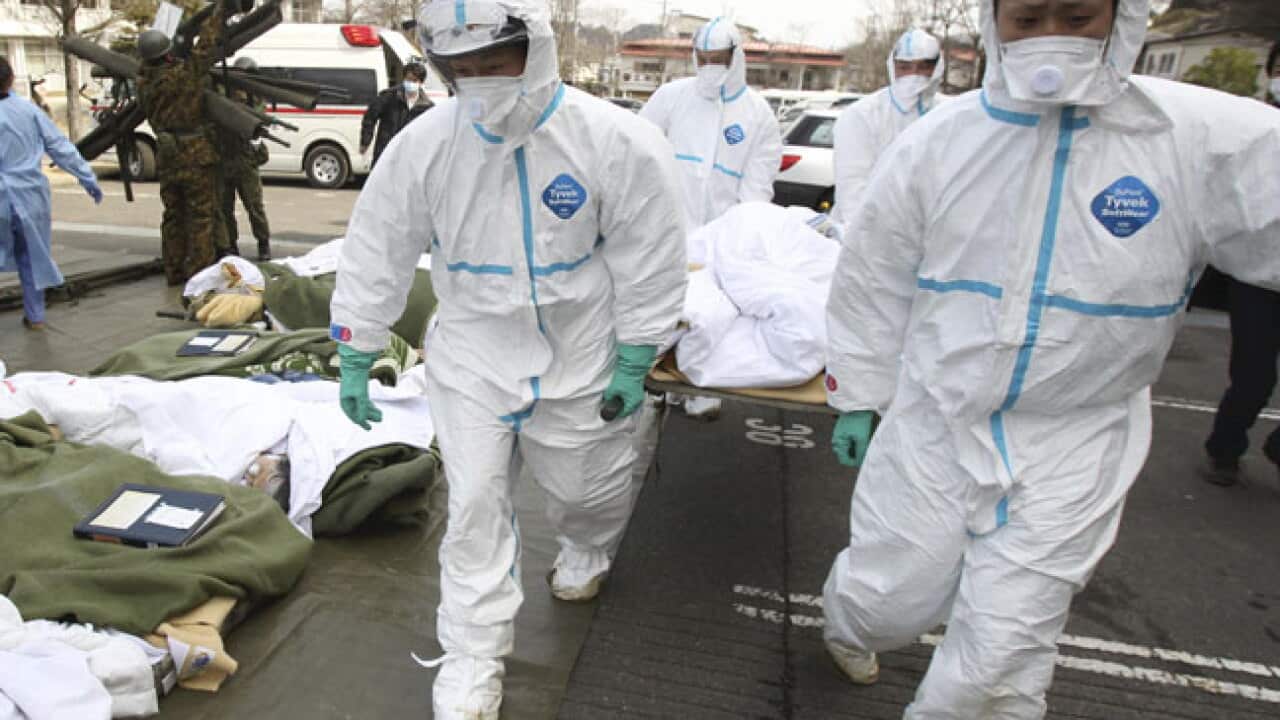
Excessive levels of radiation at a second Japanese nuclear facility after the earthquake have led authorities to report a state of emergency there, the UN nuclear agency said.
Japan battles a nuclear emergency in which the government said two partial meltdowns may have taken place and radiation had escaped from reactors at a quake-damaged atomic power plant.
About 200,000 people have been evacuated from residential areas around the Fukushima No. 1 plant, 250 kilometres (120 miles) north of Tokyo, amid growing global concern over the threat of a major disaster.
News that makes sense
Your trusted source for staying up-to-date with the world around you. Get free daily news updates and analysis, straight to your inbox.
Japan's top government spokesman Yukio Edano said it was highly likely that a partial meltdown had occurred in one reactor of the Fukushima plant, and that authorities were working on the assumption that one may occur in another.
Edano added that the radiation released into the air so far had not reached levels high enough to affect human health.
The crisis began with the massive quake and tsunami disaster, the worst on record in Japan, which caused electricity blackouts and led to malfunctions of the cooling systems of the plant's reactors.
Authorities immediately declared a nuclear emergency and have since scrambled to prevent reactors at two plants from overheating by pumping in water and releasing steam to depressurise them.
Operator Tokyo Electric Power (TEPCO) took the drastic measure of using seawater to cool reactor one -- where a huge explosion tore away the outer concrete housing while leaving the steel reactor intact.
The use of freely available, but corrosive, seawater is seen as a desperate step and an admission that the reactor will never again be operational.
The operator warned that another reactor, number three, was also overheating and that so much water had evaporated at one stage that the top three metres (10 feet) of mixed oxide (MOX) fuel rods were exposed to the air.
TEPCO later said that despite continuing efforts, it had not managed to ensure the tops of the fuel rods in the two troubled reactors remained submerged. Exposed rods are an indication of a possible meltdown.
Edano said the pressure build-up at reactor three had forced another release of vapour to depressurise the facility and that "we assume that a minute amount of radioactivity was released".
Nuclear plant operators must alert the government when the hourly level of radioactivity reaches 500 micro sievert -- and Edano said the level had topped 1,200 on Sunday morning.
Edano later warned of the risk that the building around reactor number three could also explode, but voiced confidence that the reactor would also survive and that there would be no adverse effect on the health of nearby residents.
The government has evacuated people from a 20-kilometre radius around the facility, while also moving people out of areas surrounding a second nearby plant, Fukushima No. 2, which has four reactors.
A total of 22 people have been hospitalised after being exposed to radioactivity, although it was not immediately clear to what degree they were exposed and what condition they were in.
The International Atomic Energy Agency said excessive levels of radiation had been detected at the Onagawa nuclear plant, but also said authorities had reported the three reactor units were "under control".
Japanese authorities are investigating the source of radiation, the UN nuclear watchdog said.
A cooling pump at another plant 120 kilometres from Tokyo, the Tokai No. 2, failed but a back-up was working, a plant spokesman said.
In the city of Fukushima, set amid mountains some 80 kilometres northwest of the seaside plants, fears of a greater emergency grew, and people rushed to stock up on supplies. Petrol stations have already run dry.
Hundreds joined orderly queues outside a co-op market where shop assistants wore surgical masks and overalls, and shoppers came out carrying as many bottles of water, groceries and other supplies as they could.
Naruki Ono, 40, who had travelled 40 minutes to reach the town, said: "People are nervous. People are not panicked, but nuclear plants are scary. The bottom line is: I will pray that the nuclear plant doesn't explode."
Early Sunday the country's nuclear safety agency rated the accident at four on an international scale from 0 to 7. The 1979 Three Mile Island accident in the United States was rated five while the 1986 Chernobyl disaster was a seven.







