As a team of international auditors prepared to descend on the Greek capital to determine whether Athens had made enough economic reforms to earn another eight billion euros in loans, fresh falls on European markets highlighted a general scepticism about whether the crisis could be tamed.
In a speech to the European Parliament, Jose Manuel Barroso, president of the European Commission, insisted it was "possible" and "vital" to overcome the crisis.
News that makes sense
Your trusted source for staying up-to-date with the world around you. Get free daily news updates and analysis, straight to your inbox.
"We are today faced with the greatest challenge our Union has known in all its history", he said in his annual "state of the union" to the parliament.
Barroso came out clearly in favour of the controversial creation of eurobonds, which would enable the pooling of debt between members of the 17 nations sharing the euro.
"Once the Euro area is fully equipped with the instruments necessary to ensure both integration and discipline, the issuance of joint debt will be seen as a natural and advantageous step for all," he said.
The 17-nation single currency area is sharply divided over eurobonds.
Belgium and Luxembourg, as well as states in financial trouble, such as Greece, favour their creation as the most effective and durable way to resolve the eurozone debt crisis.
But Germany, which enjoys the eurozone's lowest funding rates, opposes them, saying they would take the pressure off profligate governments to get their finances in order by providing cheaper cash than they could raise on their own.
German lawmakers are due to vote on Thursday on expanding the scope and size of the EU's current rescue fund -- the European Financial Stability Facility (EFSF) -- which has already helped bail out Ireland and Portugal.
Parliament in Finland, another country where there is deep-rooted reluctance to bailing out eurozone strugglers, was expected to hold its vote on Wednesday.
Greece's Socialist government is fighting hard to convince its EU peers -- who are also its creditors -- of its determination to pursue tough reforms regardless of political cost.
Prime Minister George Papandreou, who held talks in Berlin on Tuesday with German Chancellor Angela Merkel, said Greece was making a "superhuman effort" to bring down its massive debt of over 350 billion euros ($475 billion).
A delegation of auditors from the EU, the European Central Bank and the International Monetary Fund was expected in Athens by Thursday to check the government is delivering on pledges to cut back public spending.
In an interview with Greece's state television, Merkel said the audit could determine if the bailout set up in July will stand as originally agreed.
"Should we renegotiate or not?" Merkel said.
"Of course we would prefer that the figures remain unchanged, but I cannot foretell (the mission's report)," she said.
A government spokesman said Greece would escape default.
"We are not far from securing (the loan tranche). One by one, pending issues are settled," deputy government spokesman Angelos Tolkas told Flash Radio.
"The government is determined and has set a wager with itself. The climate has changed and is changing but it takes a constant effort from us."
However the Financial Times reported the bailout had run into trouble, with some eurozone members pushing for private creditors to take a bigger writedown on their Greek bond holdings.
The Greek parliament on Tuesday approved a controversial property tax that aims to plug a budget hole and help unlock the EU-IMF funds but this package is still not enough to save the Greek economy.
A new EU rescue worth 159 billion euros was put together in July but the Greek government must jumpstart a privatisation drive that is months behind schedule to secure the funding.
The next installment of debt aid due under its May 2010 bailout from the EU and the IMF is in the balance however until the end of the audit.
Athens says it needs the eight-billion-euro payment if it is to keep paying its bills.
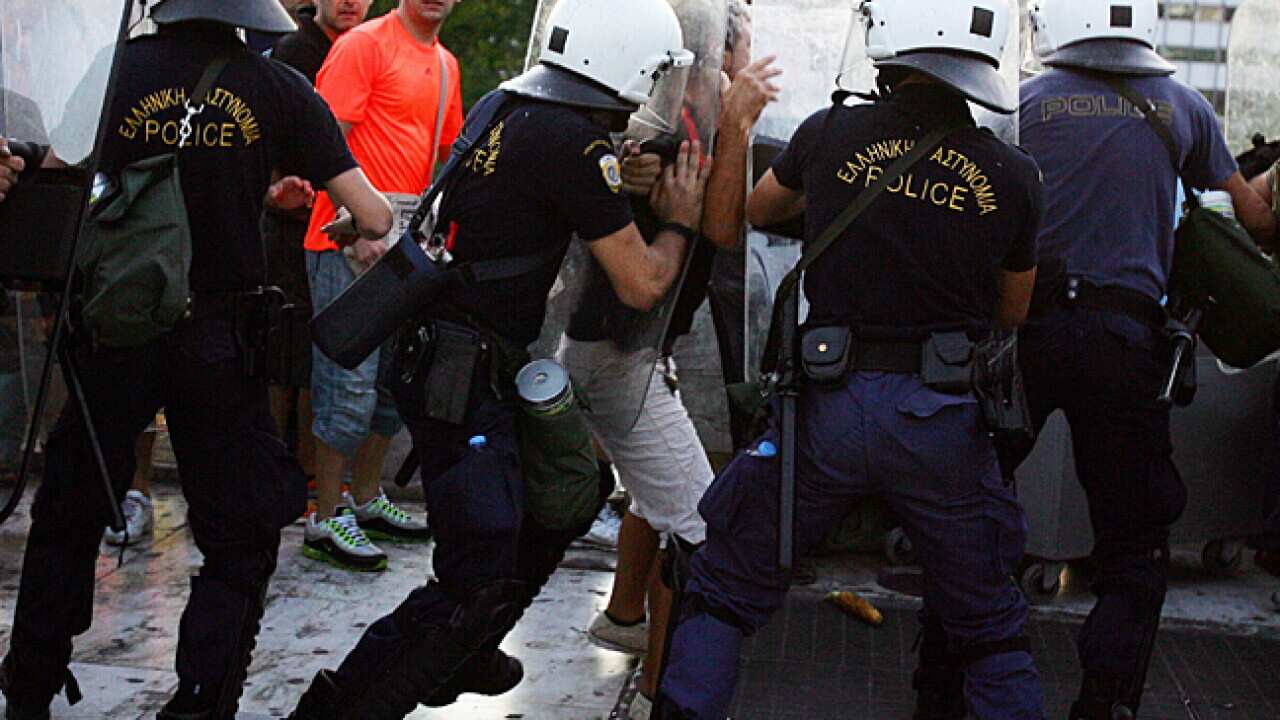
The government's austerity measures have met fierce resistance and the capital was again paralysed by a transport strike Wednesday ahead of protests by pensioners, municipal workers and students.
At one stage, police used tear gas to disperse the demonstrators, arresting one person.
The pervasive pessimism helped push the European markets into downward territory in early trading, with the exchanges in London, Frankfurt and Paris all recording losses of around one percent.
Asian markets mostly rose on Wednesday, after a rally on Wall Street and in Europe. But the gains, the second in a row, were tentative due to the lack of concrete evidence of a eurozone plan.







