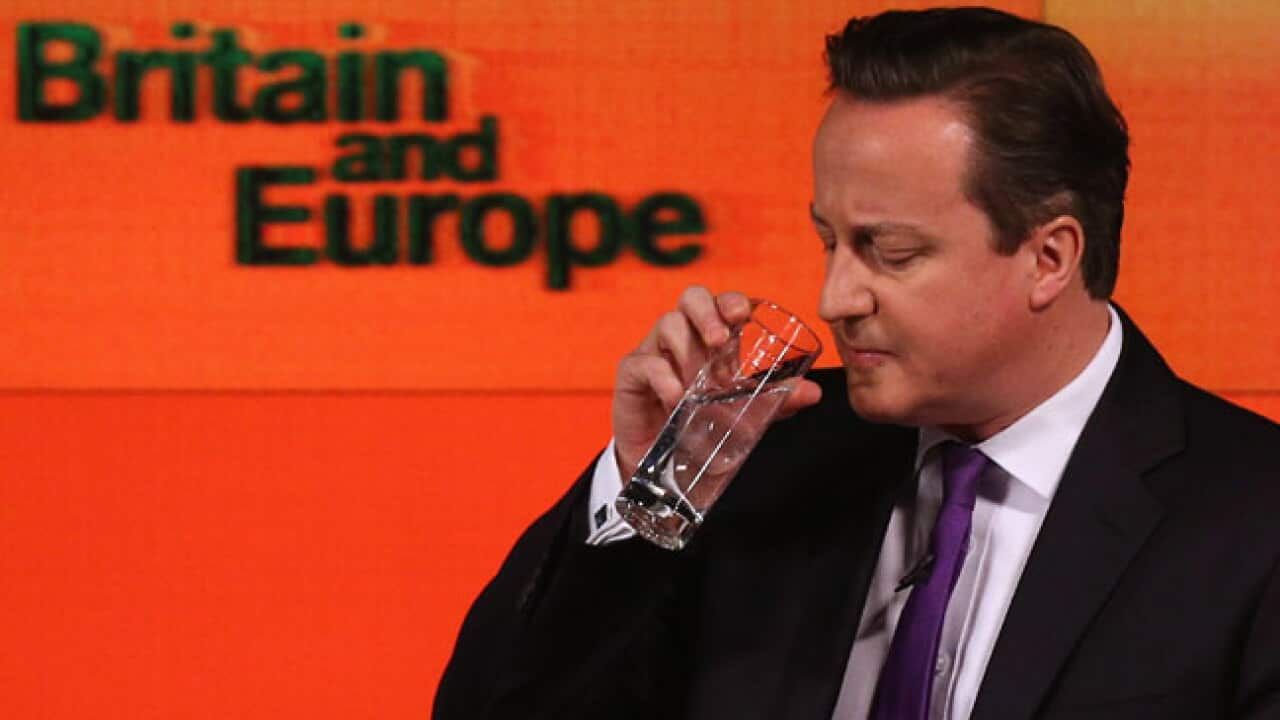
Prime Minister David Cameron promised Wednesday to give the British people a vote on EU membership, sparking immediate criticism from his main European partners.
In a long-awaited speech in London, Cameron vowed to hold a referendum by the end of 2017 giving voters the choice of staying in or leaving the European Union if his Conservative Party wins the next election in 2015.
He said he wanted to renegotiate the terms of Britain's troubled EU membership before putting the new agreement to a vote.
News that makes sense
Your trusted source for staying up-to-date with the world around you. Get free daily news updates and analysis, straight to your inbox.
But Europe's power couple France and Germany said Britain could not pick and choose its rules in the 27-nation bloc, with French President Francois Hollande warning that Britain's relationship with the EU was not up for renegotiation.
"The United Kingdom can perfectly well decide in a referendum to stay in or leave the European Union, that's a decision for the rulers of the country and the British people themselves," Hollande told reporters.
"But what I say on behalf of France, and also as a European, is that it is not possible to negotiate Europe for this referendum."
German Chancellor Angela Merkel struck a more conciliatory note, saying she was prepared to hear Cameron's "wishes".
"But one must keep in mind that other countries also have other wishes," she said, while Germany's foreign minister Guido Westerwelle warned Britain against "cherry-picking".
Cameron said the referendum would offer a "very simple choice" -- either to accept the outcome of the negotiations or to leave the EU altogether.
"It is time for the British people to have their say," he said.
If the centre-right Conservatives win the 2015 general election, the government would hold a referendum during the first half of the new five-year parliament.
Cameron insisted that Britain, a member of the European bloc since 1973, did not want to isolate itself but said disillusionment with the EU was "at an all-time high" and it was essential to change radically the way it functioned.
If reforms are not introduced, he warned, Britain could "drift" out of the EU.
Cameron said that if he managed to secure terms he was satisfied with, he would campaign "heart and soul" for Britain to remain within the EU, although he refused to say what he would do it he failed to reach a deal.
The prime minister said the EU was still grappling with problems in the eurozone -- of which Britain is not a member -- and was suffering "a crisis of European competitiveness".
The gap between the EU and its citizens had "grown dramatically in recent years", he added.
"If we don't address these challenges, the danger is that Europe will fail and the British people will drift towards the exit," he said.
Cameron has faced intense pressure from the Conservatives' eurosceptic right wing to take a stand on Europe, an issue that has long divided the party.
A leading Tory eurosceptic, Daniel Hannan, hailed the speech as "the most significant I've heard by a British prime minister in 40 years of membership", adding: "He's the first British leader to have trust in the electorate."
In a speech that he had originally planned to give in Amsterdam last Friday before the Algerian hostage crisis intervened, Cameron said his party would start negotiations after the next election, provided it wins.
"And when we have negotiated that new settlement, we will give the British people a referendum with a very simple in-or-out choice to stay in the EU on these new terms, or come out altogether. It will be an in-out referendum," he said.
Cameron said a rethink of Britain's membership was essential because British people resented the intrusion into national life of unnecessary EU rules and regulations.
His stance put him at odds with his government coalition partners, the pro-Europe Liberal Democrats.
Their leader, Deputy Prime Minister Nick Clegg, said an "ill-defined, protracted renegotiation" would make the job of rebuilding the recession-hit British economy harder.
Ed Miliband, leader of the main opposition Labour Party, also accused Cameron of "taking a huge gamble on the economy".
Tony Blair, the Labour former prime minister, said Cameron was playing with fire because it was easy to "lose control of the issue" in a referendum.
Martin Sorrell, the chief executive of advertising giant WPP who was among a group of prominent British business leaders to warn Cameron against holding a referendum, said uncertainty was now inevitable.
"We don't even know whether we will be able to renegotiate or not, so there's a lot of uncertainty," he said at the World Economic Forum in Davos.







