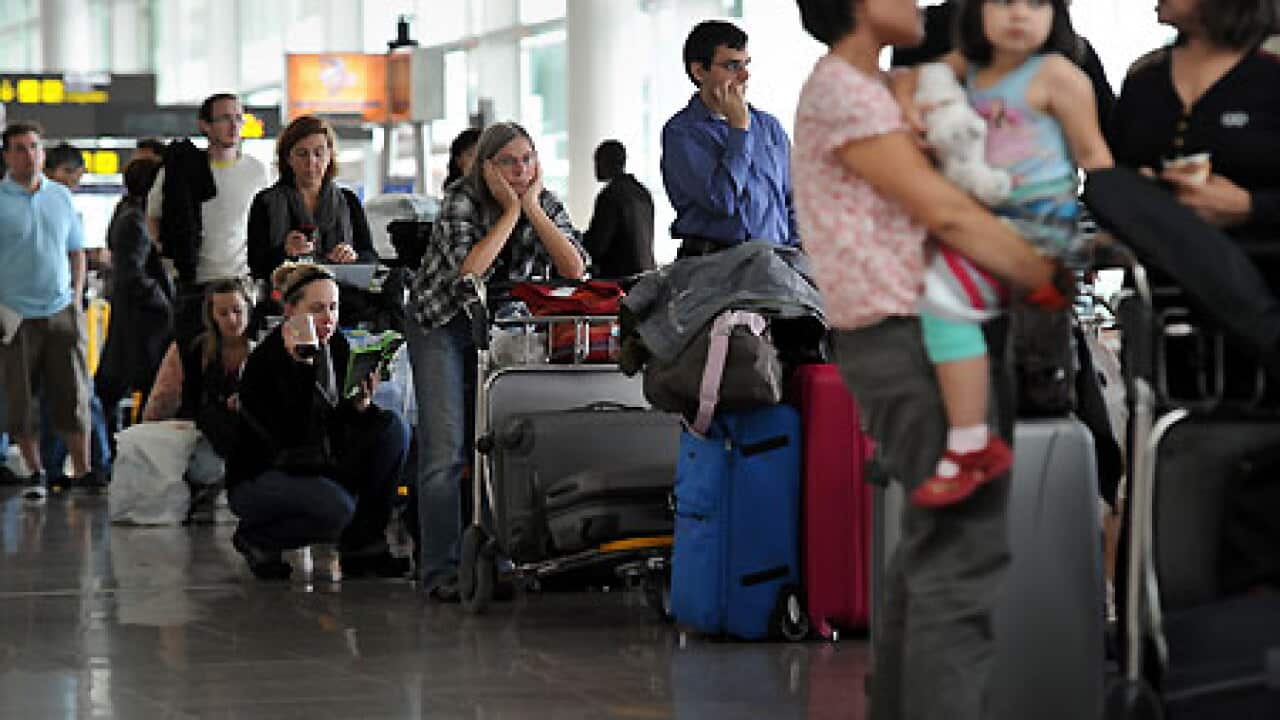
Europe's airspace reopened for business as Iceland's volcano lost its fury, leaving passengers scrambling to get home and recriminations flying over the 1.7 billion dollar cost of the crisis.
Three-quarters of flights scheduled in Europe were set to fly, said the body coordinating air traffic across the continent, a week after a volcanic eruption in Iceland caused the worst disruption to aviation since World War II.
While experts in Iceland said the Eyjafjjoell volcano had lost most of its intensity, airline bosses were frantically adding up the cost of the crisis which their umbrella body said cost 400 million dollars a day at its peak.
News that makes sense
Your trusted source for staying up-to-date with the world around you. Get free daily news updates and analysis, straight to your inbox.
80 percent of normal flights
British air traffic controllers said Wednesday they had handled about 80 percent of normal flight levels by 1700 GMT as services recovered from the Iceland volcano cloud chaos.
The National Air Traffic Services (NATS), which manages British airspace, said it had dealt with more than "2,600 movements in UK airspace up to 1800 local time -- approximately 80 percent of normal traffic levels".
It added traffic levels were expected to approach 90 percent from 0600 GMT Thursday morning.
A spokeswoman for London's Heathrow airport meanwhile said Europe's busiest air hub had handled 58 percent of flights by Wednesday evening that it normally deals with.
Travel hubs open
All Europe's main air hubs were up and running Wednesday and the Europe-wide coordinating body Eurocontrol said it expected some 21,000 flights in European airspace, against a typical 28,000, with almost normal traffic on Thursday.
"It is anticipated that almost 100 percent of the air traffic will take place in Europe tomorrow, Thursday 22 April," it said in a statement.
In Europe's far north, Helsinki in Finland and airspace over the remote Scottish isles of Orkney and Shetland were temporarily reclosed due to still unsafe ash levels.
But Iceland's other Nordic neighbours Denmark, Norway and Sweden lifted the last of their restrictions in a sign the worst of the threat had faded.
A test flight in Danish airspace Tuesday revealed a small quantity of volcanic ash but did not damage the plane's propeller engine, the SLV civil aviation agency said Wednesday.
SLV spokesman Thorbjoern Ancker told AFP that flights at slightly polluted levels were still conditional and "can only take place after authorisation by the SLV".
Millions had their travel plans affected since governments closed their airspace on April 14 and IATA, the body representing the global airline industry, put the overall cost at 1.7 billion dollars (1.3 billion euros).
European governments "must take their responsibility" and help the carriers, said IATA chief Giovanni Bisignani.
Bans caused misery
British Airways chief executive Willie Walsh had branded the ban unnecessary, with the disruption heaping more misery on an airline reeling from a recent strike.
British opposition leader David Cameron -- who is challenging Labour incumbent Gordon Brown for the premiership next month -- called for a public inquiry into the "muddle and confusion" in the government's handling of the crisis.
Germany's Lufthansa, Europe's largest airline by passenger numbers, said it would fly at full capacity on Thursday by operating around 1,800 flights compared to the 700 it was able to run on Wednesday.
The Czech Republic which reopened its airspace on Monday for 48 hours said Wednesday it would now remain open after an ash warning had been lifted.
All long-haul passenger services from Paris' main international hub Charles de Gaulle were operating as scheduled, while Air France said it had flown 40,000 stranded people back home since Tuesday.
"Our traffic has returned to normal," a spokeswoman said.
Some 450 British troops and 280 civilians left stranded by the volcanic ash cloud finally made it back home Wednesday after a warship came to the rescue.
HMS Albion sailed into Portsmouth Naval Base on the southern English coast after a day-long crossing from Santander in northern Spain.
The troops were returning from a six-month tour of duty in Afghanistan, while the civilians were largely holidaymakers left stranded by the closure of British airspace.
Volcano loses intensity
In Iceland, the civil protection agency said the volcano had lost nearly 80 percent of its intensity.
"Explosive activity has diminished. Ash production has gone down. It's really insignificant right now," said Pall Einarsson, a seismologist from Iceland's Institute of Earth Sciences.
Einarsson however said the volcano had "not gone to sleep" and that it was impossible to predict when it would stop erupting.
As recriminations flew, a vulcanologist advising the United Nations said authorities had no choice but to close their airspace for lack of hard facts about aircraft behaviour in volcanic ash.
Closure to air traffic "was the only measure that could be taken", said Henry Gaudru, president of the European Vulcanological Society.







