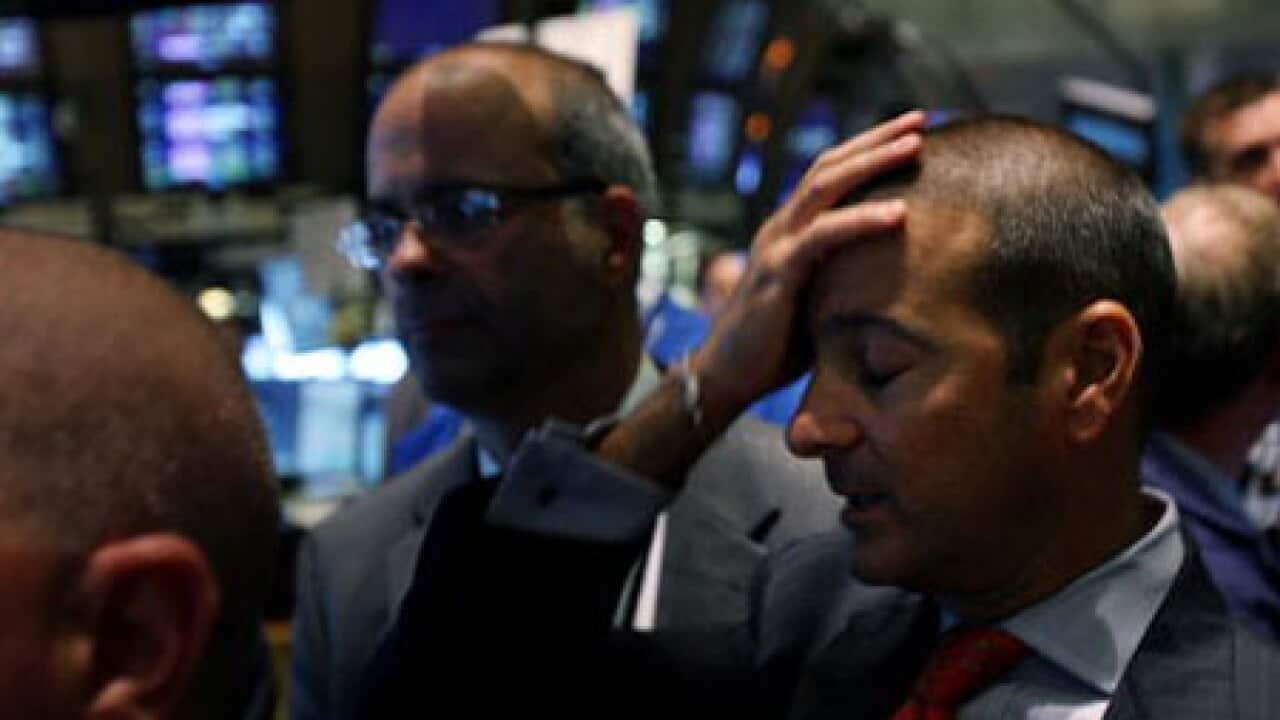
European stocks closed sharply lower Wednesday as any early optimism that the resignation of Italian Prime Minister Silvio Berlusconi would calm the markets disappeared in a wave of near panic.
Dealers said investors first thought Berlusconi's decision would clear the decks but as it became clearer that Italy faces possibly months of political uncertainty, they decided on safety first and put their money elsewhere.
Italian borrowing rates soared as a result to 7.0 percent and above, levels judged to be unsustainable in the longer term and putting its already strained public finances under even more pressure.
News that makes sense
Your trusted source for staying up-to-date with the world around you. Get free daily news updates and analysis, straight to your inbox.
In the fallout, stock markets stumbled badly and the euro tumbled as investors flocked into safehaven US and German government bonds, seen as the benchmark holdings to have in troubled times.
"The Italian bond market is in distress," said Kathleen Brooks, an analyst at traders Forex.com.
"Although Berlusconi promised to resign after the passage of austerity reforms get through parliament, the bond market may be reacting to the potential for a fractious coalition government getting into power, which could only exacerbate Italy's fiscal situation," she added.
In London, the FTSE-100 index of top companies closed down 1.92 percent at 5,460.38 points. In Paris, the CAC-40 lost 2.17 percent to 3,075.16 points and in Frankfurt the DAX 30 dropped 2.21 percent to 5,829.54 points.
Milan led the losers, falling 3.78 percent after being down more than 4.0 percent at one stage. Madrid, also seen as a possible eurozone debt crisis victim, was down 2.09 percent.
Some analysts said the crisis could be at the tipping point, with Italy too big to bail out given its economy is the third largest in the eurozone, accounting for 20 percent of the bloc's output.
"The bout of pessimism that gripped stocks ... is showing no sign of lessening its grip as the eurozone continues to shuffle its way toward the precipice," said Yusuf Heusen, sales trader at IG Index in London.
Berlusconi's decision "has done nothing to help stem the spiralling rise of Italian bond yields, leading some commentators to suggest that on paper the country is now past the point of being able to (be saved)," he said.
IHS analysts said "alarm bells are ringing that Italy is perilously close to slipping into insolvency" but they added that they thought Rome could keep its head above water for some months yet.
The acute tensions surrounding Greece and Italy pushed the euro below $1.36 for the first time in a month to $1.3598 in late London trade, down sharply from $1.3836 late in New York on Tuesday. The dollar firmed to 77.76 yen from 77.70 yen. Gold fell to $1,784 an ounce from $1,795.
In New York, the blue-chip Dow Jones Industrial Average was down 1.64 percent at around 1700 GMT and the tech-heavy Nasdaq Composite fell 2.06 percent.
Italy is a "a far larger problem than Greece because of its size. The drop in the major European stocks in New York trading shows just how bad it is getting all over again," said Jon Ogg of 24/7 Wall Street.
As investors put safety before profit, the spread on the rate of return between benchmark French and German government 10-year bonds rose to a record 1.47 percentage points, up from just 0.45 percentage points a year ago.
Germany, the eurozone's biggest economy and paymaster, is widely seen as the safest investment as fellow eurozone member states come under intense strain on the markets, with some analysts saying the whole euro project is at stake.
Markets have been punishing Italy for weeks over what is seen as Rome's inability to make the necessary changes to balance the budget and keep on top of its debt, now equal to 120 percent of gross domestic product.
As Italy looked to an uncertain future, Greece's stock market dropped by more than 3.0 percent -- before recovering to show a more modest loss of 1.61 percent -- as politicians there squabbled over choosing an interim prime minister to lead a crisis team to haul it back from the brink of disaster.
Berlusconi's move came just a few days after George Papandreou said he would step aside as prime minister and allow a unity government to take over in a bid to drag Greece out if its financial mess.
Greece's central bank chief on Wednesday said it was "imperative" for the squabbling parties to iron out differences and quickly decide on a unity government as the country faced bankruptcy.
Governor George Provopoulos said a coalition must be formed to implement the terms of a painstakingly agreed EU deal that would give Greece huge bailout loans and guarantees and forgive part of its debt mountain -- but in return for even more austerity.







