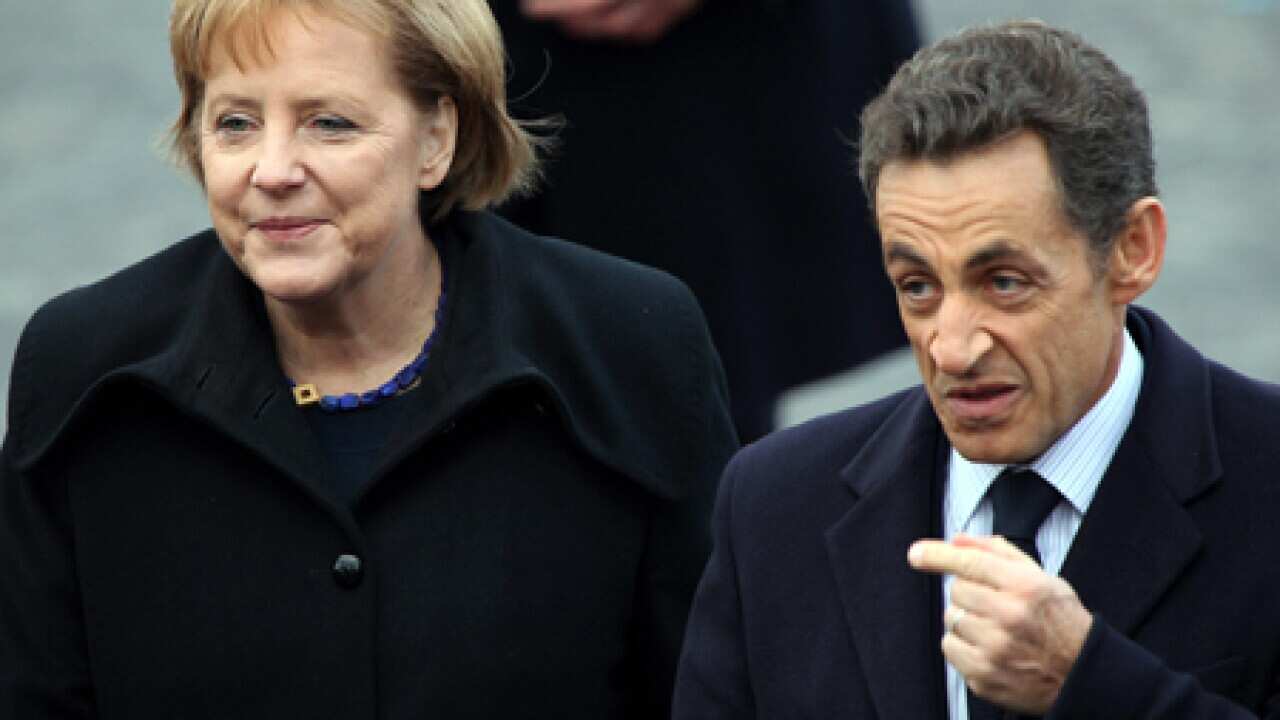
Germany and France have broken their deadlock over a new bailout for Greece ahead of an emergency eurozone summit aimed at saving the euro from the worst crisis in its 12-year history.
German Chancellor Angela Merkel and French President Nicolas Sarkozy, the eurozone's key players, agreed on a "common position" after late-night talks in Berlin just hours before the summit in Brussels on on Thursday, the French president's office said.
European Central Bank president Jean-Claude Trichet took part in the meeting.
News that makes sense
Your trusted source for staying up-to-date with the world around you. Get free daily news updates and analysis, straight to your inbox.
Officials refused to provide any details but the Franco-German agreement will lay the groundwork for negotiations between the eurozone's 17 leaders after weeks of debate over how to put a lid on the year-long debt crisis.
WARNINGS GIVEN
On the eve of the summit, the European Commission president Jose Manuel Barroso issued a dire warning that failure to find a solution could have global repercussions.
"Nobody should be under any illusion - the situation is very serious," Barroso warned on Wednesday.
It requires a response. Otherwise the negative consequences will be felt in all corners of Europe and beyond."
French Foreign Minister Alain Juppe also warned of the stakes involved: "We absolutely must find a solution in order to end international speculation and stabilise the eurozone... If this eurozone collapses it would be a disaster."
Nervous financial markets are keenly awaiting the outcome of the summit following several tumultuous days, with debt crisis contagion threatening to engulf Italy and Spain, the eurozone's third and fourth-largest economies.
Merkel had unsettled markets on Tuesday by downplaying expectations that the Brussels get-together would result in something "spectacular" to end Europe's problems in one fell swoop.
"Today's summit could provide the last chance for eurozone policymakers to get a grip on the region's debt crisis," said the research firm Capital Economics.
"Anything other than a very decisive response could see the situation become irretrievable," it said.
The European Union and the IMF provided last year a 110 billion euro ($A146.38 billion) bailout to Greece that has proved insufficient.
Since then, Ireland and Portugal received their own multi-billion-euro rescues.
BERLIN, PARIS AT ODDS
Berlin has been at odds with the ECB and Paris over Merkel's demands for private investors to shoulder some of the bill for the second Greek rescue, which will be the eurozone's fourth bailout.
There are concerns that any change to the terms of outstanding Greek sovereign bonds could prompt rating agencies to declare Athens in default, with potentially dramatic consequences.
Several options are now on the table, including a Greek bond swap to cut the country's debt by 90 billion euros and a special bank tax to raise another 50 billion euros, said a source familiar with the discussions.
The swap plan would offer financial incentives to Greece's private creditors, banks, insurers and other investors, in order to encourage them to exchange holdings maturing over the next eight years for new 30-year bonds.
The idea would be to give Athens time to revive its economy and clean up its public finances while reducing a debt mountain, which has reached 350 billion euros ($A465.77 billion).
The new rescue package would also include loans from eurozone nations and the IMF to the tune of 71 billion euros ($A94.48 billion), with longer maturities and more affordable interest rates, the source said.
On Wednesday, a senior panel advising the German government said it supported a bond buy-back, along with a substantial "haircut" on Greek debt.
Merkel's spokesman said only she had "taken note."







