The demands were set during talks between Greek Finance Minister Evangelos Venizelos and his 16 eurozone counterparts in Brussels, hours after rival Greek politicians struck a deal on austerity measures demanded by foreign lenders.
"Despite the important progress achieved over the last days, we did not have yet all necessary elements on the table to take decisions today," Eurogroup chief Jean-Claude Juncker told a news conference.
News that makes sense
Your trusted source for staying up-to-date with the world around you. Get free daily news updates and analysis, straight to your inbox.
The eurozone will hold a new meeting next Wednesday if all conditions are met, said Juncker, Luxembourg's prime minister.
Venizelos had urged his counterparts to endorse the debt relief deal, but the ministers first demanded that the Greek parliament approve the austerity measures agreed by the political parties when it convenes on Sunday.
The two other conditions are additional structural spending cuts of 325 million euros for 2012 and a written pledge from coalition leaders that they will implement austerity measures, Juncker said.
"These three elements that I mentioned need to be in place before we can take decisions," he added.
The pension cuts for what appears to be a minor sum compared to the overall bailout are turning into a deadly game of electioneering in Athens.
Opposition Conservative leader Antonio Samaras refused to back the pension cuts as part of a "staff-level" agreement reached between Greece's parties and international creditors.
Venizelos said the Eurogroup took that into consideration, and that the Conservatives, bidding to win elections pencilled in for April, hold the country's fate in its hands.
With crunch bond payments of 14.5 billion euros due March 20, he said: "It must decide -- if they want to stay in the eurozone, they have to say so clearly.
"If they don't, then they have to say that clearly as well," Venizelos said.
"The choice is between two decisions -- very difficult, and very, very difficult."
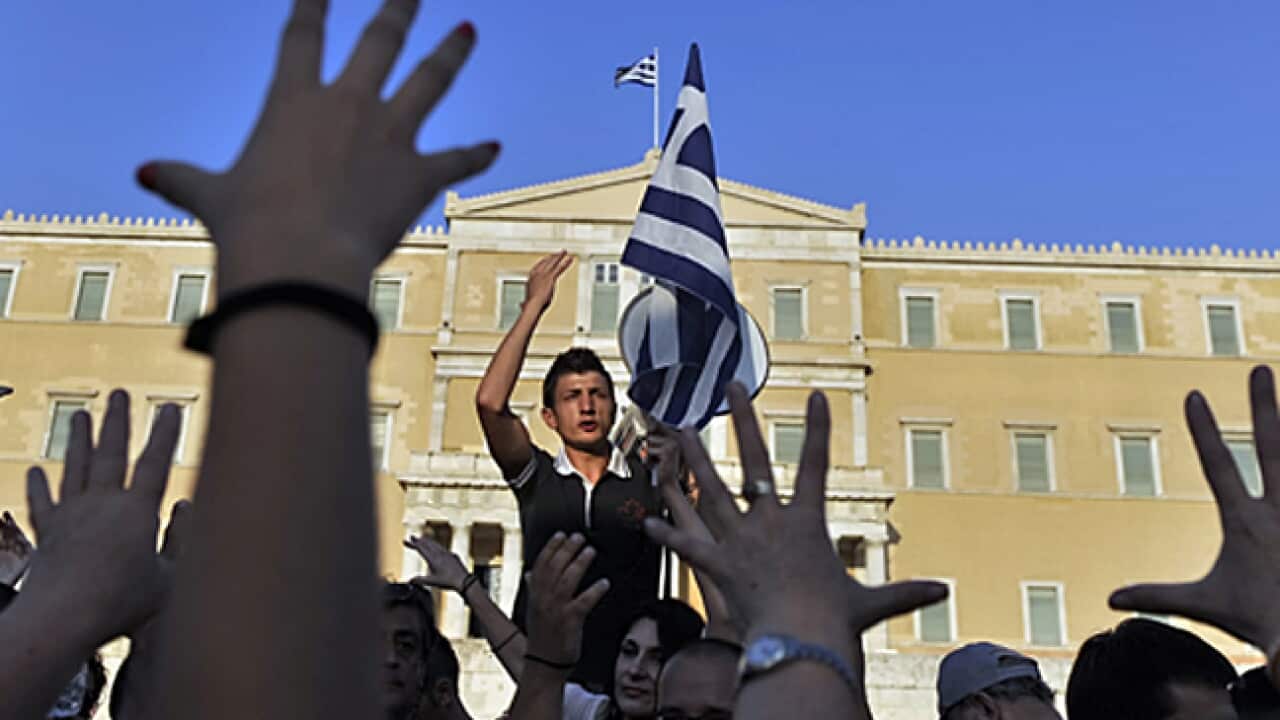
In Athens, some 8,000 angry Greeks took to the streets while unions called a 48-hour strike starting Friday over what they called "barbaric" wage and pension cuts.
Greek political leaders reached a last-minute deal Thursday on new austerity measures demanded by international lenders in return of the 130-billion-euro ($171 billion) bailout.
In parallel, Greece has been negotiating a debt writedown with its private lenders, hoping to slash 100 billion euros from its 350-billion-euro debt mountain.
But after seeing Greece drag its feet on reforms for the past two years, finance ministers want proof that Athens will follow through on its promises this time.
"All these measures are important to ensure a smooth implementation of the programme," said Juncker, pointing also to the general election context.
EU economic affairs commissioner Olli Rehn meanwhile said eurozone partners were also "seriously considering" opening an escrow account for Greece, which would block a portion of state revenues to guarantee the repayment of bailout loans.
The Franco-German proposal is "one possibility for reinforcing surveillance and effectively implementing the programme," he said.
Venizelos came to Brussels touting a "staff level" agreement between Athens and EU, IMF and European Central Bank auditors on "a new, strong and credible programme" of austerity.
He also said the "basic parameters" for a bond swap were agreed with private creditors.
German Finance Minister Wolfgang Schaeuble, whose country is the biggest contributor to bailouts of Greece, Portugal and Ireland, had warned before the meeting that no decision would be taken.
IMF managing director Christine Lagarde also cautioned that despite the "encouraging news" from Athens "there is still more to do."
Some of the eurozone partners, such as the Netherlands, stressed that they also have to get any package through their parliaments.
Diplomats said a crucial debt sustainability report was not ready, that the agreement with the banks did not meet conditions set by EU leaders in October and that trust in Greek promises had slumped to an all-time low.
Not a cent has been raised from a promised 50-billion-euro privatisation drive, he underlined.
Greece's debts amount to 160 percent of its gross domestic product, but its international backers are demanding that this be brought down to a maximum of 120 percent in 2020.
"People -- more than the four or five usual suspects -- were seriously underwhelmed by the 'deal' (struck by the Greek coalition)," said one senior ministerial official.







