in brief
- Argentina's football team have reignited international debate after waving a banner claiming the Falkland Islands belong to the South American nation.
- Australian Sally Poncet told SBS News the move is typical of Argentinian rhetoric toward the independent territory.
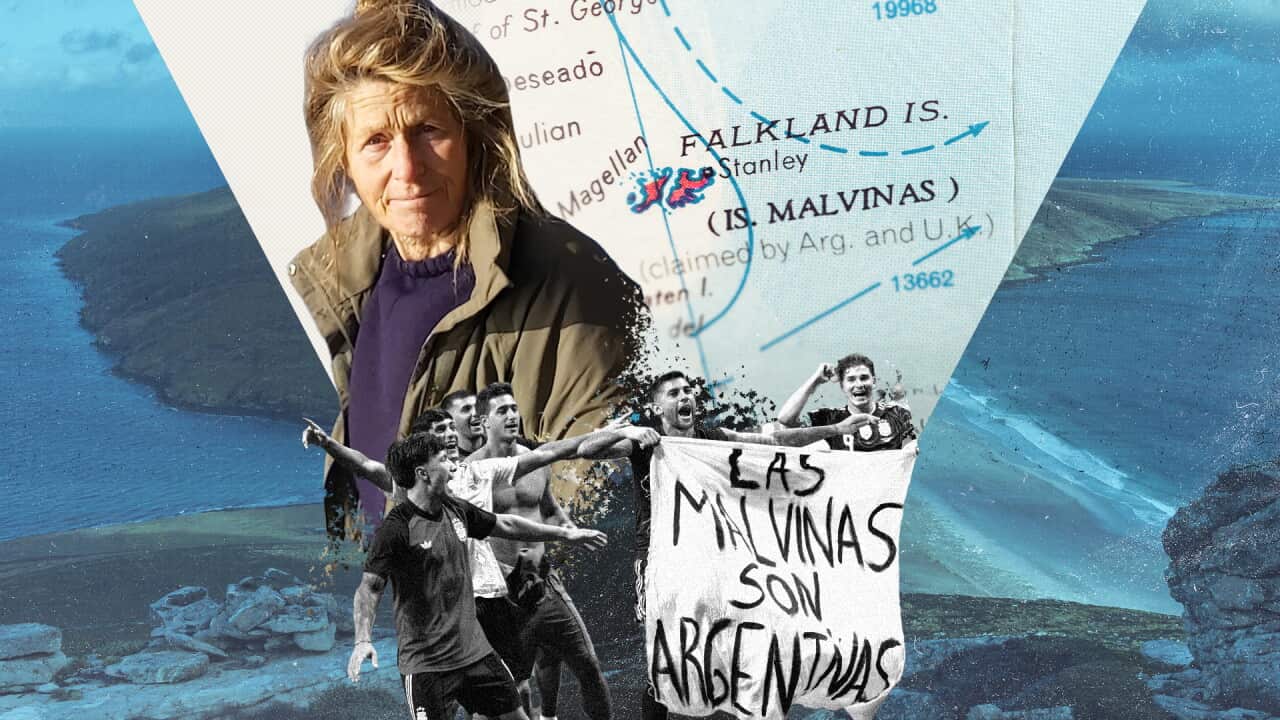
Another clash in one of football's fiercest rivalries has sent shockwaves through the island community that Tasmanian-born Sally Poncet calls home.
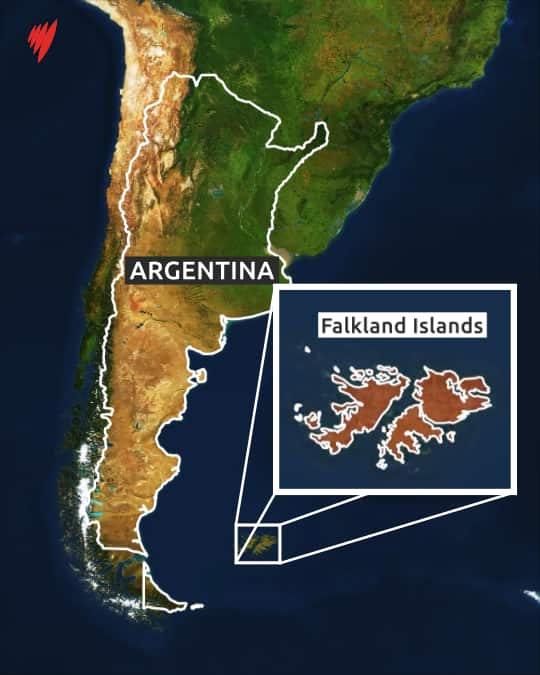
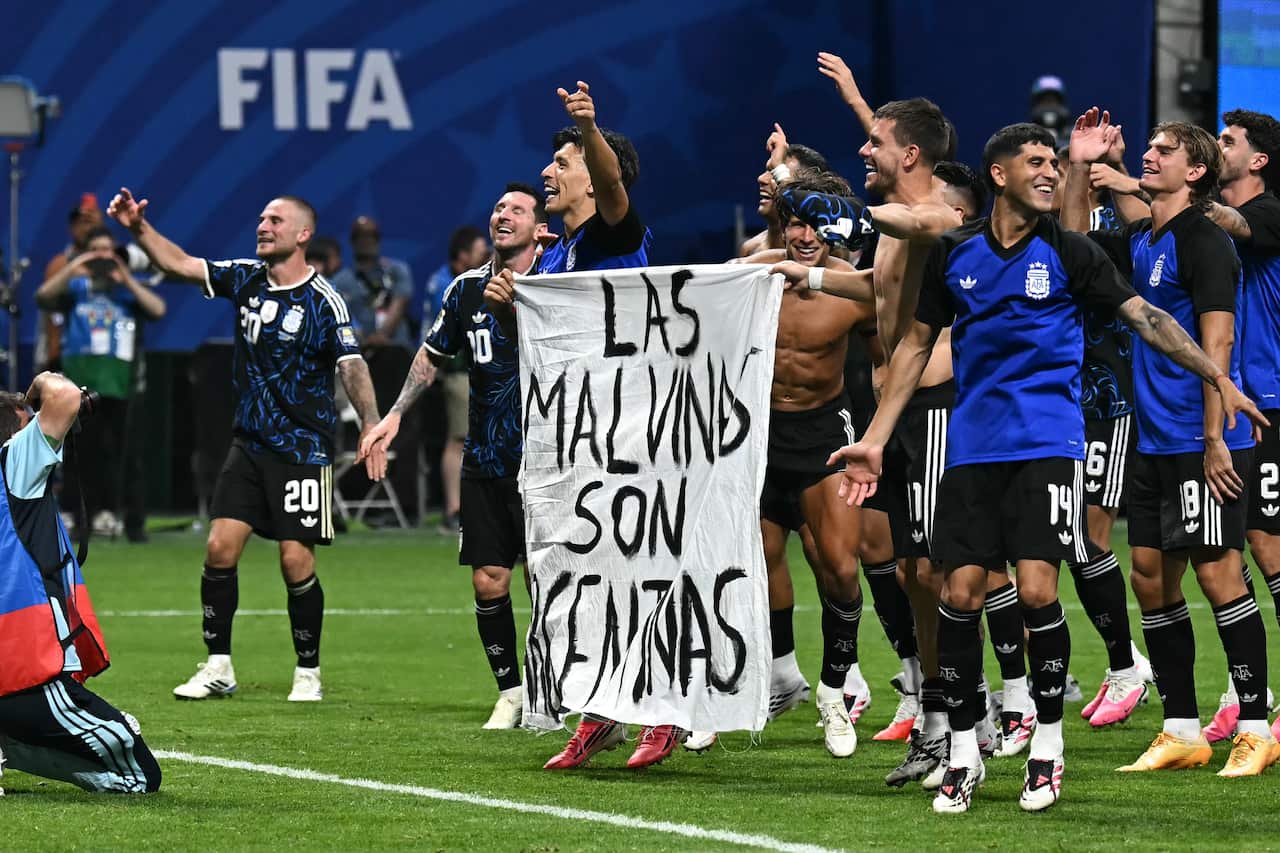
After a come-from-behind triumph over their English adversaries in the semi-finals of the FIFA World Cup on Thursday, Argentinian players unfurled a banner on the pitch in Atlanta reiterating their national claim over the islands less than 500km from their coastline.
"Los Malvinas Son Argentinas" (The Falklands are Argentine), the controversial banner read, using the Argentinian name for the South Atlantic islands that have been occupied by Britain since 1833.
For Poncet, who first fell in love with the place after seeing it from her yacht sailed with her then-husband in 1979, the move was a "crass" and "ignorant" display, but one she is more than accustomed to.
"It's just part of what we have to deal with," she told SBS News over the phone from the capital, Stanley. "It's just having a bully for a neighbour."
News that makes sense
Your trusted source for staying up-to-date with the world around you. Get free daily news updates and analysis, straight to your inbox.
Poncet settled on the Falklands in 1983, exactly one year after the end of the war over the territory between Argentina and Britain that killed 649 and 255 people from each country, respectively.
The shadow of that 74-day conflict, which began when the ruling Argentine military junta launched a surprise invasion and occupation, has never gone away, she said.
"It was huge, and it still is," she added. "We still live under threat and that history that we didn't ask for. We don't want it again, obviously, but we're still having to live with it."
'The Malvinas are Argentine'
Just 3,600 people live on the islands that are roughly comparable in size to the greater Sydney metropolitan area.
While it has an independent government, it relies entirely on the United Kingdom for geopolitical matters.
Outgoing UK Prime Minister Keir Starmer supported calls made to FIFA by UK business minister Peter Kyle, who has demanded an investigation into the banner-waving incident.
Kyle called the flag waving an "egregious violation" of FIFA rules, which ban political symbols on the field of play.
"The World Cup might not be ours, but the Falkland Islands definitely are," a Downing Street spokesperson said.
FIFA has said it is "assessing match reports" under "standard procedure", but it is not clear whether an investigation has been launched.
Right-wing Argentine President Javier Milei described the players' move as "perfectly valid and legitimate".
Milei, who is trying to leverage United States' support to claim the Falklands, cautioned against mixing politics and sport but said:
"The Malvinas are Argentine, we're going to recover them, and we will do it through diplomatic means."
The islands, which were previously uninhabited, were discovered by a British captain in 1690.
Britain established a permanent settlement on West Falkland in 1765, but Argentina argues Spanish presence on the islands means it inherited them when it gained independence in 1816.
The Falkland Islands government issued a press statement on Thursday echoing Kyle's statement, describing the banner-waving as "disappointing" but not surprising.
"The people of the Islands were victims of an aggressive invasion in 1982, which left many traumatised. The banner displayed by Argentina last night, therefore, was particularly insensitive for many people in the Falklands."
Argentinian players displayed the same slogan during a warm-up game ahead of the 2014 World Cup, for which they were fined around $37,000.
'Political football'
Poncet, who, like many islanders, runs a sheep farm, said the constant rhetoric from their neighbour is "unsettling".
"It's really tough because you have a life here," she said. "You have children, you have grandchildren, and you want them to have a stable future."
"If you have children in Australia, there's no way you'd think that, maybe in 10 years' time, you might belong to another country. But that's the situation we're living with here."
All Falkland Islanders have British passports. The local currency is the Falklands pound and, while people from all over the world — including a small handful of Argentinans — live there, English is far-and-away the dominant language.
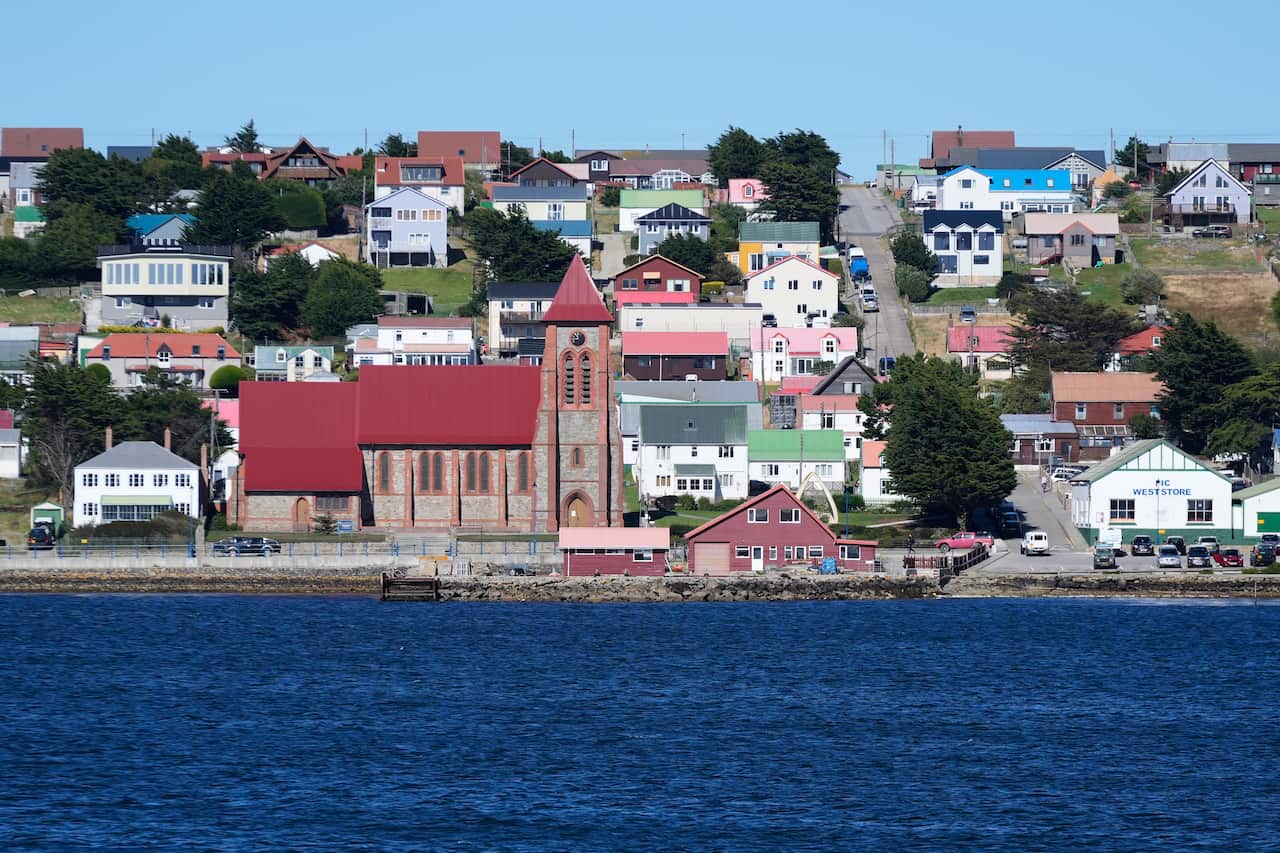
"You come here and think it's just like a village in England, and yet it's in the South Atlantic," Poncet said. "We have absolutely no affinity with the country that wants to take us over, absolutely none."
The country has no native trees, owing to its acidic, peat-bog soil and the relentless gales blown along the Roaring Forties — a global belt of powerful westerly air currents that never drop below an average of 15 knots on the islands. Average daytime highs are 15C in summer and 2C in winter.
Outside of local government roles, many people earn a living in fishing or farming. Self-reliance is key as there is just one flight a week off the island and supplies have to be ordered from the UK — which will arrive by boat in three to six months.
Despite its remoteness, the island "has plenty of work" and, going by GDP per capita, is one of the wealthiest nations on earth, with an economic output roughly 60 per cent higher than Australia's.
"It's not emptying of its young people like other small island nations are, it's thriving," Poncet said.
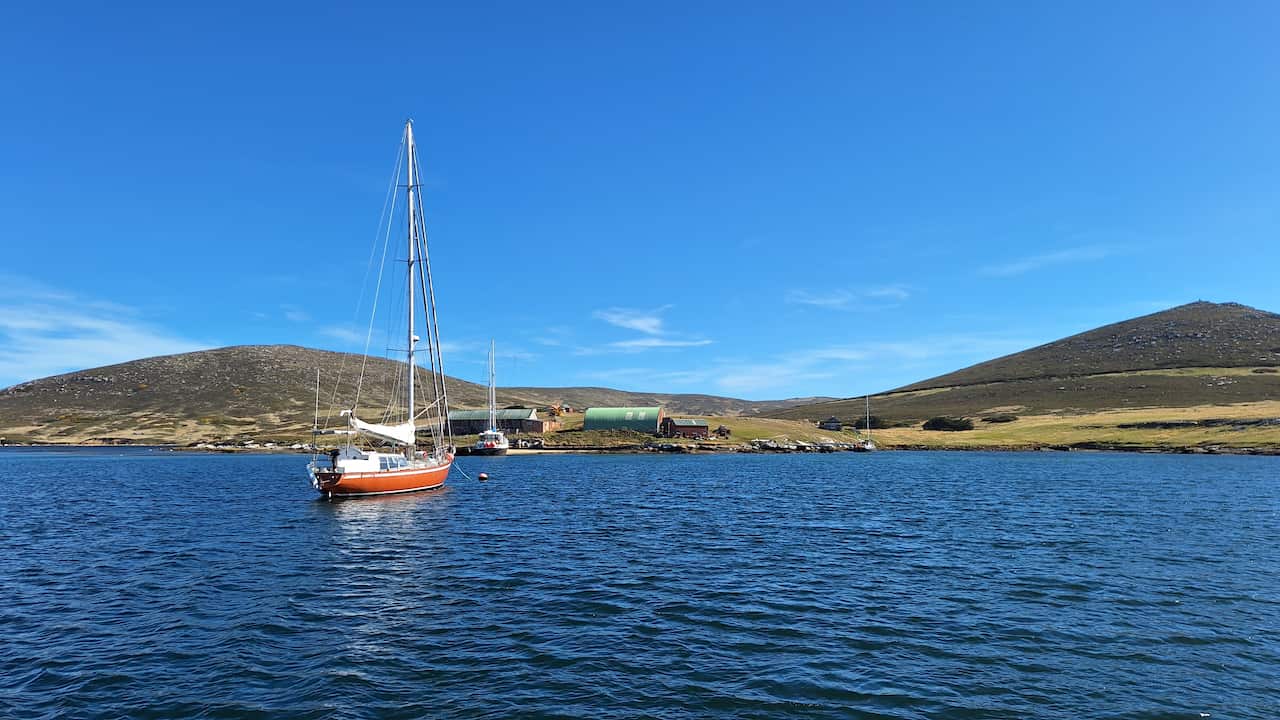
She echoes the government's sentiment that Falklanders don't want to be "used as a political football in every conversation about England and Argentina".
While the community is highly self-sufficient, it lacks a military.
Britain maintains a strong naval, air, and land force presence on the island, something that gives locals confidence the UK will defend them again if tensions with Argentina truly escalated.
"It's to Britain that we look," Poncet said. "Britain provides our defence."
While the banner-waving incident has brought the conflict back into international headlines, Poncet said islanders usually brush off such incitements.
"Their interest has never flagged," she said. "This is just Argentina who's at it again."
Those who clocked off early and gathered in Stanley's four pubs on Thursday were left somber by England's "disappointing" result against Argentina.
In the World Cup final on Monday, Poncet said much of the population looks forward to watching Spain defeat their neighbour — "to put it mildly".
For the latest from SBS News, download our app and subscribe to our newsletter.







