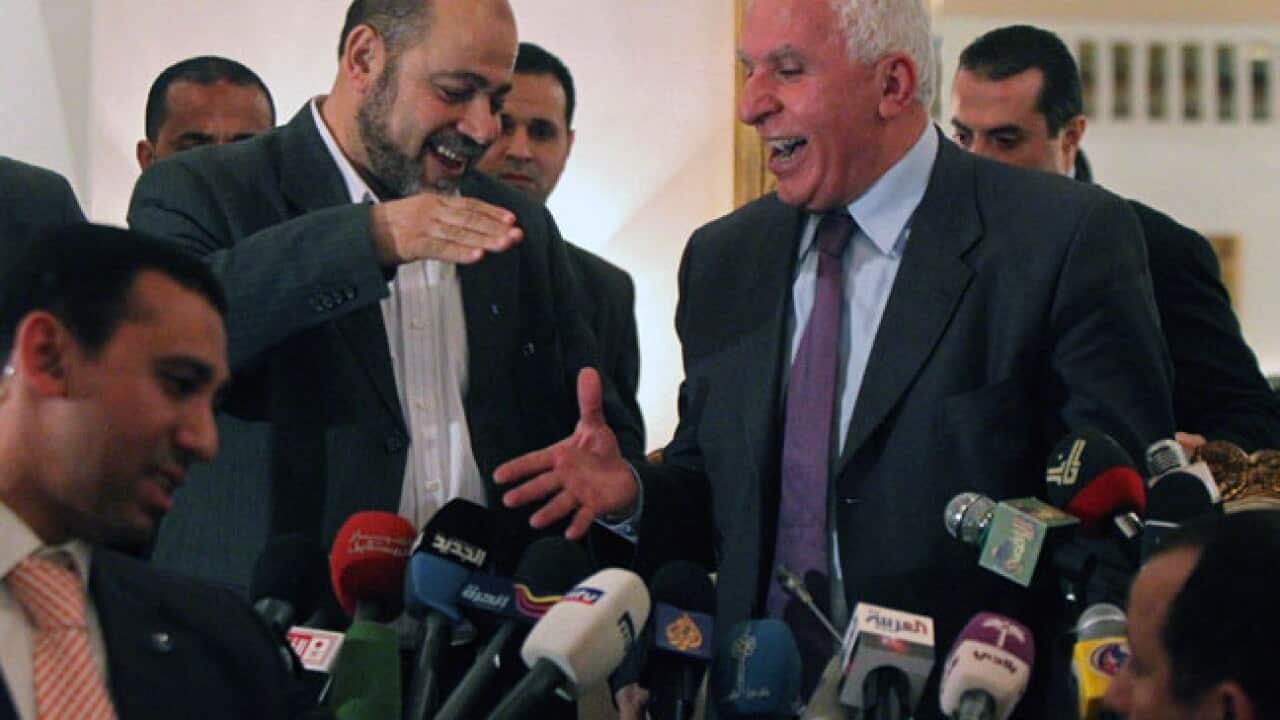
Rival Palestinian groups Hamas and Fatah have reached an "understanding" in Cairo on to set up a transitional unity government and to hold elections, prompting a swift warning from Israel.
Israeli Prime Minister Benjamin Netanyahu demanded that Palestinian president Mahmud Abbas, who heads Fatah, "choose between peace with Israel or peace with Hamas."
And Washington, the key sponsor of direct Israeli-Palestinian peace negotiations which collapsed last September, warned that any Palestinian unity government must renounce violence.
News that makes sense
Your trusted source for staying up-to-date with the world around you. Get free daily news updates and analysis, straight to your inbox.
"The United States supports Palestinian reconciliation on terms which promote the cause of peace," said US National Security Council spokesman Tommy Vietor.
"To play a constructive role in achieving peace, any Palestinian government must ... renounce violence, abide by past agreements, and recognise Israel's right to exist."
Fatah delegation chief Azzam al-Ahmad told AFP the two factions, which have been blood enemies for the past four years, had agreed to set up a "government of independents."
"This government will be tasked with preparing for presidential and legislative elections within a year," Ahmad said in a telephone call with AFP in the West Bank political capital of Ramallah.
Hamas delegation chief Mahmud Zahar, whose Islamist movement seized control of Gaza in 2007, told Al-Jazeera television the two parties had agreed to form a transitional government made up of personalities selected by both sides.
Cairo is to invite Palestinian factions to return at the end of next week to sign the agreement, which would also call for the release of political detainees by both sides, he said.
The elections for president and parliament would be held at the same time and a commission of 12 judges formed to rule on any disputes linked to the polling, said Zahar.
Netanyahu said such an agreement paved the way for Hamas to take control of the West Bank too, where Abbas and his Palestinian Authority have their headquarters.
"The Palestinian Authority must choose between peace with Israel or peace with Hamas. There cannot be peace with both because Hamas strives to destroy the state of Israel and says so openly," Netanyahu said.
Nabil Abu Rudeina, a spokesman for Abbas, dismissed these remarks.
"In reaction to Netanyahu's remarks we say that Palestinian reconciliation and the agreement reached today in Cairo is an internal Palestinian affair," he told AFP. Netanyahu, for his part, "must choose between peace and settlements."
Hamas and Fatah were on the verge of agreeing to the same Egyptian-mediated deal in October 2009 but the Islamists backed out, protesting the terms had been revised without its consent.
Wednesday's deal was brokered in Cairo where the factions met with Egypt's new spy chief Murad Muwafi, whose predecessor Omar Suleiman tried unsuccessfully to bridge a split that has left Gaza and the West Bank ruled by rival administrations.
Tensions between the two movements date back to the start of limited Palestinian self-rule in the early 1990s when Fatah strongmen cracked down on Islamist activists.
They worsened in January 2006, when in a surprise general election rout, Hamas beat the previously dominant Fatah to grab more than half the seats in the Palestinian parliament.
Hamas expelled Fatah from Gaza after a week of deadly clashes in June 2007, cleaving the Palestinian territories into rival hostile camps.
The reported deal won support on the streets of the West Bank and Gaza Strip, where demonstrations have been held calling for the two camps to patch up their differences.
"We hope the reconciliation will meet the demands of the Palestinian people, especially the young people who have recently come out demanding an end to the divide," said Gaza City resident Ahmad al-Wan.
"Every Palestinian citizen supports unity between Fatah and Hamas, we are brothers," said Mohammed a 48-year-old farmer and Fatah supporter from the West Bank city of Hebron.







