In brief
- Rostering data has revealed a surge in workplace no-shows during the Socceroos' World Cup matches.
- Some Australian fans told SBS News of their plans to "chuck a sickie" for the Paraguay match, which was on a workday.
The Socceroos' World Cup lunchtime clash against Paraguay last Friday saw a spike in workplace no-shows, new data reveals, likely driven in part by a surge in staff calling in sick.
Rostering data provided to SBS News by workforce management software company Deputy showed absenteeism rose across the hospitality, retail, and services sectors.
The data tracked rostered shifts that went unworked and did not differentiate between those who called in sick, took annual leave or were no-shows.
But the increase in absenteeism, also seen during Australia's earlier World Cup fixtures, corresponded with the Socceroos' matches, suggesting at least some were calling in sick.
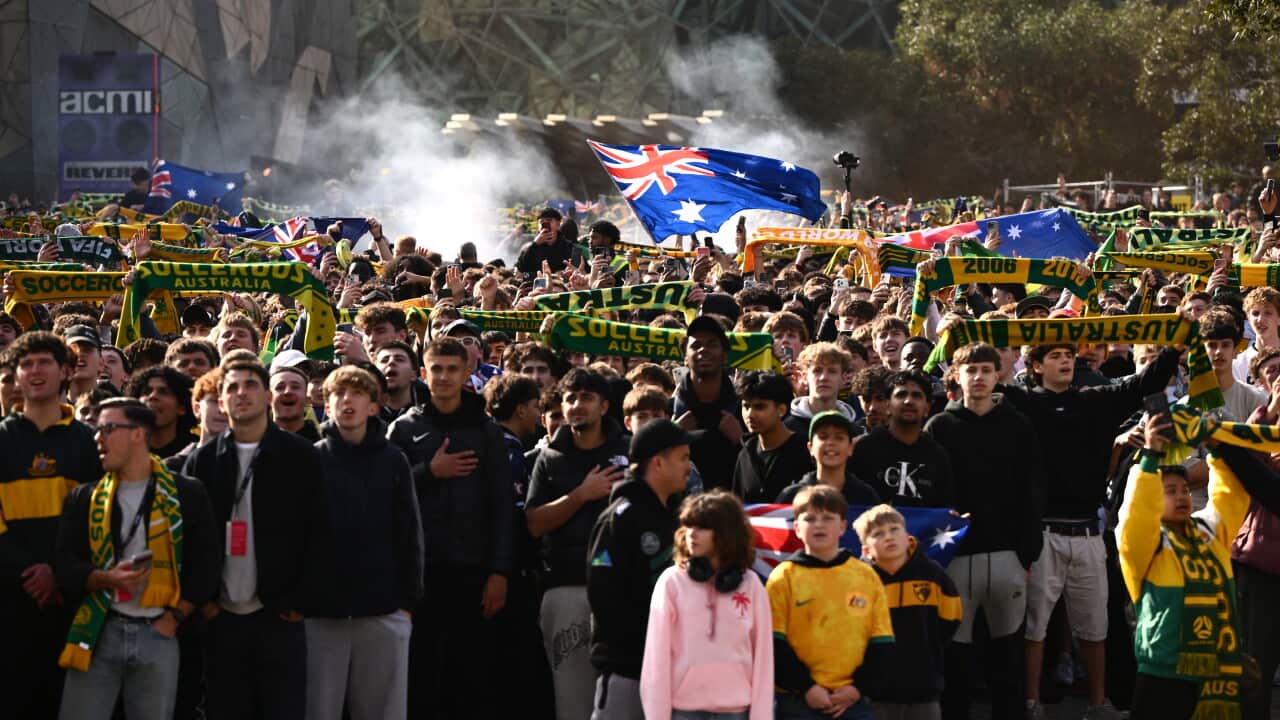
Socceroos supporter group Active Support dubbed the Paraguay match the "great Australian Socceroos sickie" as a "mysterious case of football fever" swept across the nation, and some fans told SBS News they planned to "chuck a sickie".
News that makes sense
Your trusted source for staying up-to-date with the world around you. Get free daily news updates and analysis, straight to your inbox.
Gyms recorded the largest increase, with 37.4 per cent of shifts going unworked — up 14.7 percentage points compared with the average across the four Fridays from 29 May to 19 June.
"With a midday kickoff, the morning and lunchtime crews gyms lean on; front desks, group-fitness instructors and personal trainers appear to have been first out the door," Deputy said.
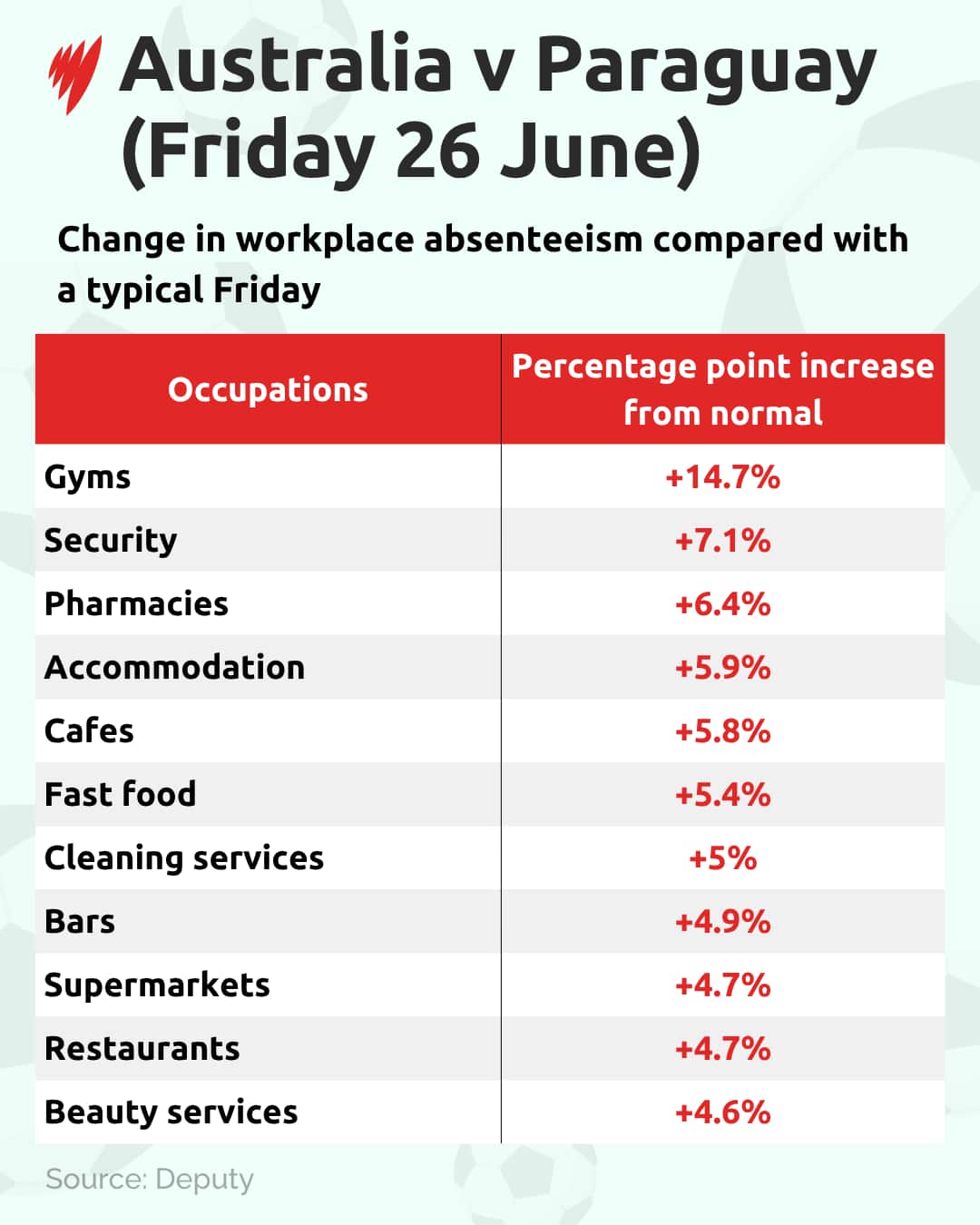
Security services recorded the next-biggest increase, with 12.9 per cent of shifts going unworked (up 7.1 percentage points), followed by pharmacies at 22.4 per cent (up 6.4 percentage points).
Deputy's chief technology officer Ciaran Hale said absenteeism among shift workers increased across almost every frontline industry each time Australia played.
"The Paraguay match was particularly interesting because a lunchtime kickoff dropped right into the middle of the working day, and that had a ripple effect across sectors that keep communities running," he said.
- All the FIFA World Cup 2026 coverage on our World Cup page
- How to watch the FIFA World Cup 2026 on SBS
- Watch all 104 matches of the FIFA World Cup 2026 at our On Demand hub
- When the Socceroos matches start
Security services recorded the largest proportional jump, more than doubling normal absence levels, Hale said.
"Cafes, supermarkets, pharmacies, restaurants and accommodation providers all experienced significant increases as well."
A similar pattern was seen in Australia's earlier group-stage matches against Türkiye and the United States.
For the Sunday afternoon match against Türkiye, security services recorded the highest absenteeism rate at 36.1 per cent of rostered shifts — up 15.3 percentage points from the average across the five Sundays between 10 May and 7 June.
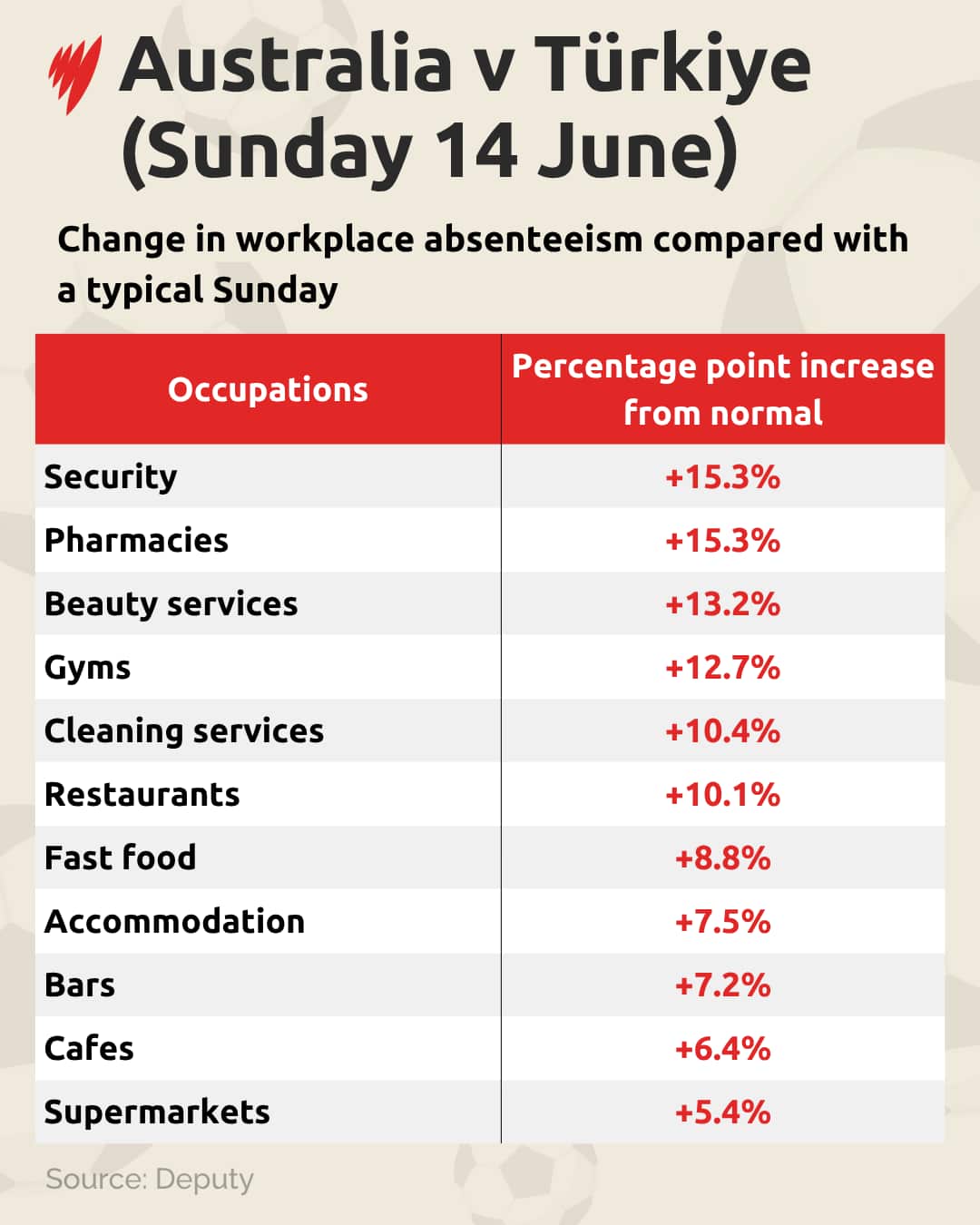
Pharmacies followed at 30.3 per cent (up 15.3 percentage points), ahead of beauty services at 22.7 per cent (up 13.2 percentage points).
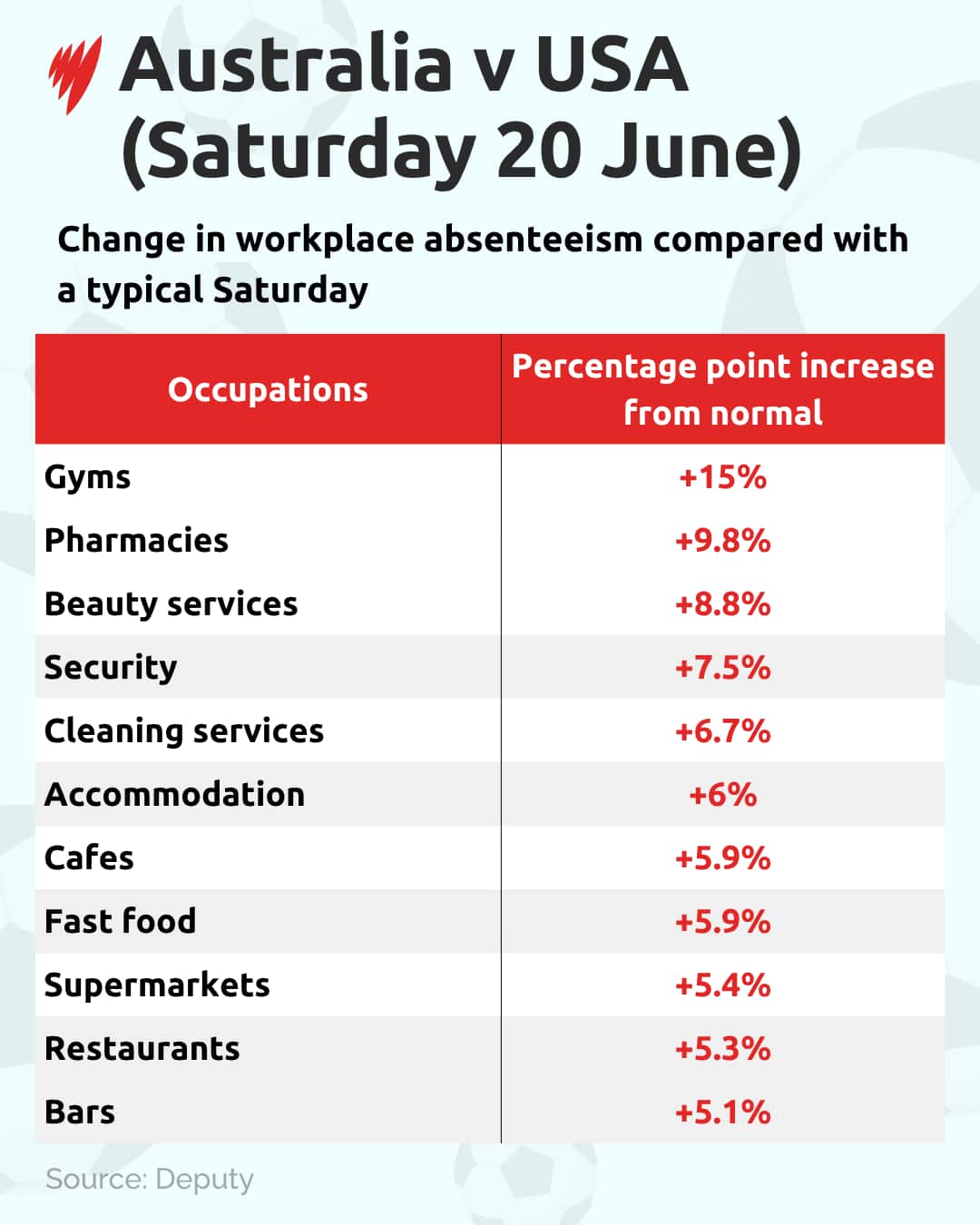
For the Saturday pre-dawn match against the USA, gyms recorded the highest absenteeism rate, with 35.6 per cent of shifts going unworked — 15 percentage points higher than the average across the five Saturdays between 16 May and 13 June.
All five hospitality sectors recorded increases of between five and six percentage points in no-shows on what is typically one of the industry's busiest days.
Hale said the data highlighted the need for employers to plan around major sporting events.
"Every major sporting event leaves an economic footprint," he said.
"What's fascinating is that we're now able to see its workforce footprint in real time, giving employers the opportunity to plan ahead rather than be caught off guard."
Natasha Hawker, managing director of HR consultancy Employee Matters, told SBS News she suspected there was a link between the Socceroos matches and the increase in sick call-ins, but noted it was also winter, meaning many workers would have been genuinely ill.
She also pointed out the data covered industries with large casual workforces, many of them students, where the sense of commitment between employers and employees was often weaker.
"From the employers' side of things, because they are casual workers, they have less commitment to them too," she said.
"If it's busy, they bring more people on. If it's quiet, you don't get shifts.
"That plays out in reverse in terms of that commitment level when you're thinking about a casual worker who goes well, 'I'm just not going to show up'."
Hawker said the increase was also likely driven by the fact that many of the roles were customer-facing, leaving workers unable to watch the match, unlike many office employees.
Her firm, which predominantly works with office-based employers, had not seen an increase in sick leave among clients during the Paraguay match.
"Most organisations that we know very much took the opportunity to organise a watch party at the office, and those who worked from home either started early or finished early," she said.
Hawker said employers hoping to avoid last-minute no-shows during major sporting events such as the World Cup could consider offering incentives, including double-time pay.
Research by US human resources technology company UKG estimated the more than five-week tournament could cost global employers US$17 billion ($24.7 billion) in lost productivity, with 37 per cent of workers planning to adjust their schedules because of the World Cup.
Following an SBS social media call-out last week, dozens of Australians shared their plans for the Paraguay match, with many revealing they had booked annual leave months in advance.
Others said their workplaces had organised pub bookings, and some schools planned to show the game in class, while a few admitted they planned to call in sick.
The trend looks set to continue, with the Socceroos taking on Egypt in the Round of 32 at 4am (AEST) on Saturday, which you can watch live and free on SBS or SBS On Demand.
You can watch all 104 matches of the FIFA World Cup 2026™ live, free and exclusive on SBS, SBS VICELAND and SBS On Demand.
For the latest from SBS News, download our app and subscribe to our newsletter.







