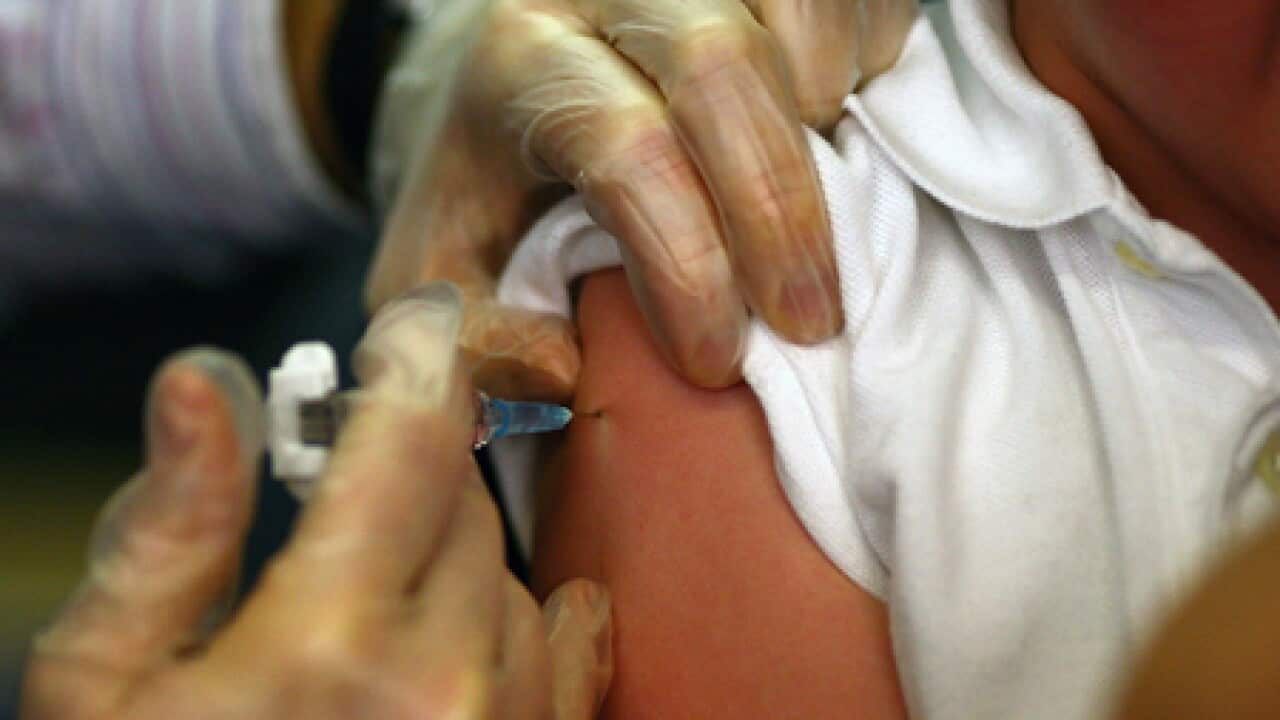
More than 60 West Australian children may have had adverse reactions to the flu vaccine, the state's health department says.
WA Health Minister Kim Hames announced on Thursday that vaccinations for children under the age of five would be halted after a number of reactions to the three-strain vaccine, which includes swine flu.
Australia's chief medical officer Jim Bishop on Friday said health professionals nationwide should immediately stop immunising children under five with the vaccine, as a precaution.
News that makes sense
Your trusted source for staying up-to-date with the world around you. Get free daily news updates and analysis, straight to your inbox.
Free jab
WA Health Department chief health officer Dr Tarun Weeramanthri said a higher-than-expected number of reactions to the vaccine, which is offered free by the state government to children under five, had been reported.
The Princess Margaret children's hospital (PMH) had reported 44 children under 10 had presented with febrile convulsions, of which 23 related to the paediatric flu vaccine.
Of the 23 children, 12 were admitted to hospital.
The average age of children who had reactions to the vaccine was about two years, but children aged between five and 10 also experienced fevers and convulsions.
Convulsions
Dr Weeramanthri said another 40 children under 10 had been taken to other hospitals in the state with febrile convulsions, and work was being done to assess if there was a link to the vaccine.
"Advice from West Australian clinicians has said that there is a consistent clinical picture that they're seeing, with fever and vomiting around six hours and certainly within 12 hours of vaccination," he said.
The WA health department is working with other states and territories to compile data, but there have been no reports of a spike in reactions to the vaccine in other states.
"It's important to get an estimate of both how many have been vaccinated and how many children have potentially had reactions," Dr Weeramanthri said.
TGA inquiries
The department and the Therapeutic Goods Administration (TGA) had honed in on what they thought the cause of the increased reactions was, Dr Weeramanthri said.
"The Therapeutic Goods Administration is working with the manufacturers on two lines of inquiry," he said.
"One is the data from around the country about where we're getting any signals of increased reactions and which batches went where.
"The second is to actually directly test the batches held by the various manufacturers for any impurities."
No increase due to swine flu jab
There had been no reports of an increased reaction rate to the single pandemic swine flu strain vaccine.
"So whether this is an issue about the combination of antigens ... in this vaccine, which has three parts compared to a single vaccine, is something that TGA is looking at," Dr Weeramanthri said.
That's the first time that particular antigen has been included, but one must remember that the strains of flu change regularly and so there are regular changes in the formulation of the flu vaccine."
The WA health department had responded appropriately to the reaction and in a timely fashion, Dr Weeramanthri said.
"As soon as we got information from clinicians, particularly at PMH this week that they were concerned they were seeing something more than what they normally see, and people have to understand there is a normal incidence of febrile reactions after vaccination in children.
Children have 'good tolerance'
"Once we got that information we acted as promptly as we could."
National Centre for Immunisation Research and Surveillance clinical research head Professor Robert Booy said the experience was that children around Australia had demonstrated a good tolerance for the vaccine.
Dr Weeramanthri said he was hopeful a safe vaccination program could be provided once the safety of the vaccine could be ensured.







