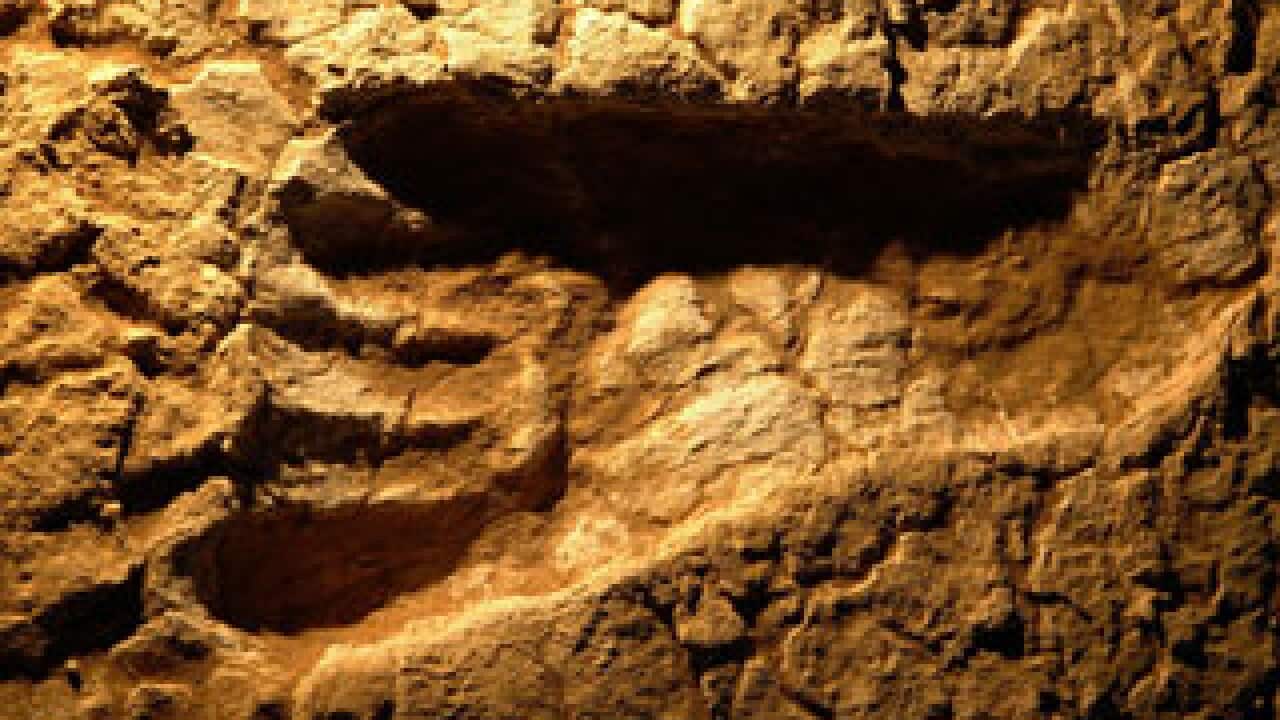
Fossilised footprints, found in a Polish quarry, of a long-extinct creature have prompted palaeontologists to reopen the file on how life in the sea moved to land.
A key theory in evolutionary biology is that tetrapods - four-limbed land-loving vertebrates - emerged from fishes with pairs of lobed fins.
The intermediate stage in the process was fishes called elpistostegids, whose head and body had a tetrapod-like shape but still retained fins instead of hands and feet, according to this idea.
News that makes sense
Your trusted source for staying up-to-date with the world around you. Get free daily news updates and analysis, straight to your inbox.
The star of these "missing link" creatures is Tiktaalik, a large shallow-water fish whose fossilised remains were found in 2006 just 1,000 kilometres short of the North Pole, unearthed from river sediments on Canada's Ellesmere Island.
Fossilised hand and footprints
Tiktaalik lived around 375 million years ago, although even older elpistostegids, dating back to 385 million years, have been found.
But trackways found at a disused quarry at Zachelmie in the Holy Cross Mountains of southeastern Poland have thrown the timeline and the elpistostegids' role into question.
In a paper released by the British journal Nature, a team led by tetrapod sleuth Per Ahlberg of Uppsala University, Sweden, report the finding of a dozen distinctive "hand" and "foot" prints from a creature that lived around 395 million years ago.
That makes them 18 million years older than the earliest tetrapod fossils found so far and a whopping 10 million years earlier than the first known elpistostegids.
The imprints, made in what at the time was the mud of a shallow marine lagoon, are up to 26 centimetres wide, which suggest the tetrapod was around 2.5 metres long.
'Failed evolutionary branch'
There is no sign of body drag, which suggests that the tetrapod must have been floating on the water while walking on the muddy bottom, say the authors.
The find is radical, for it implies that tetrapods showed up much earlier than thought.
Instead of living in river deltas and lakes before sliding on to land, they thrived in shallow seas, trampling the mud of balmy, coral-reef lagoons.
Just as important, the new theory suggests that the once-coveted elpistostegids -- or at least the ones unearthed so far - were just a failed branch rather than part of the stem from which all land vertebrates, including us, evolved.
The prints "force a radical reassessment of the timing, ecology and environmental setting of the fish-tetrapod transition, as well as the completeness of the body fossil record," says the study.







