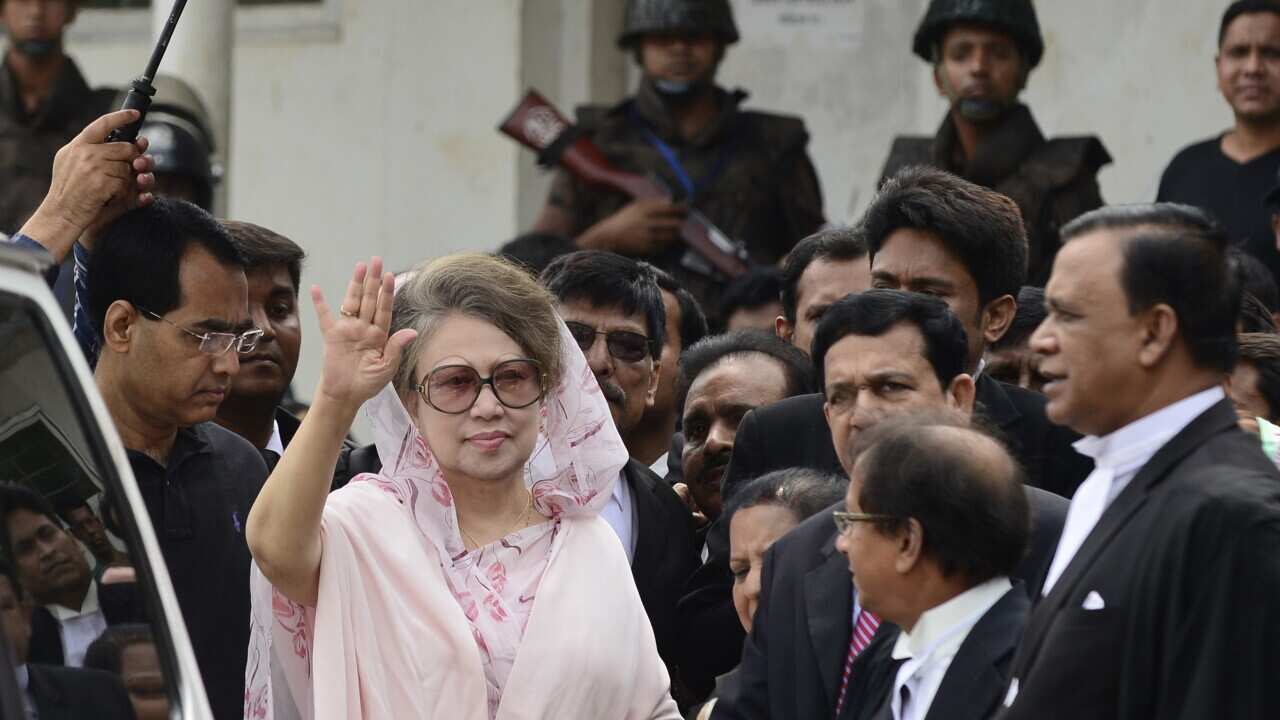
Former Bangladesh Prime Minister Begum Khaleda Zia, head of the opposition Bangladesh Nationalist Party, was ordered on Monday to appear in court to answer the charge of sedition, a move her supporters said was driven by politics.
The case comes amid rising concerns over the growth of Islamist militancy in the Muslim-majority South Asian nation, which saw a string of deadly attacks on secular writers, minorities and foreigners last year.
It was filed by Momtaz Uddin Ahmad Mehdi, a lawyer with the Bangladesh Supreme Court and a supporter of the ruling Awami League. He said that remarks Khaleda made last month about the 1971 war of independence were seditious. She had said there were "controversies" over the numbers who were killed.
News that makes sense
Your trusted source for staying up-to-date with the world around you. Get free daily news updates and analysis, straight to your inbox.
He said the comment hurt him "as a patriot" and that as a citizen, he had a right to file the case.
Politics in poverty-stricken Bangladesh has for decades been marred by violent protests, nationwide strikes and bickering between supporters of Khaleda and current Prime Minister Sheikh Hasina, who have taken it in turns to lead the country.
An affiliate BNP group called for a countrywide protest for Tuesday.
It was not immediately clear what chance the prosecution had of success in the case. Khaleda was ordered to appear in court on March 3.
Mirza Fakhrul Islam Alamgir, acting secretary general of the BNP, dismissed the case as politically motivated.
"This is nothing but a mockery and its aim is to deter Khaleda from politics," he told reporters.
"The intent of the government is to continue its repression of the opposition by police, making confrontational politics."
He said 17,000 opposition activists had been arrested since 2014 and 3,000 were still in jail.
East Pakistan broke away to become independent Bangladesh in 1971 after a war between India and Pakistan. About three million people were killed, according to official accounts.
Hasina opened an inquiry into crimes committed during the war in 2010, paving the way for prosecutions by a war crimes tribunal that Islamists have denounced as part of a campaign aimed at weakening the Islamist Jamaat-e-Islami, a key ally of the BNP.
Four opposition politicians, including three leaders of Jamaat-e-Islami, have been convicted and executed since late 2013.
The executions have come amidst a rise in Islamist militant violence, with militant groups claiming the murder of two foreigners and four secular writers and a publisher last year.







