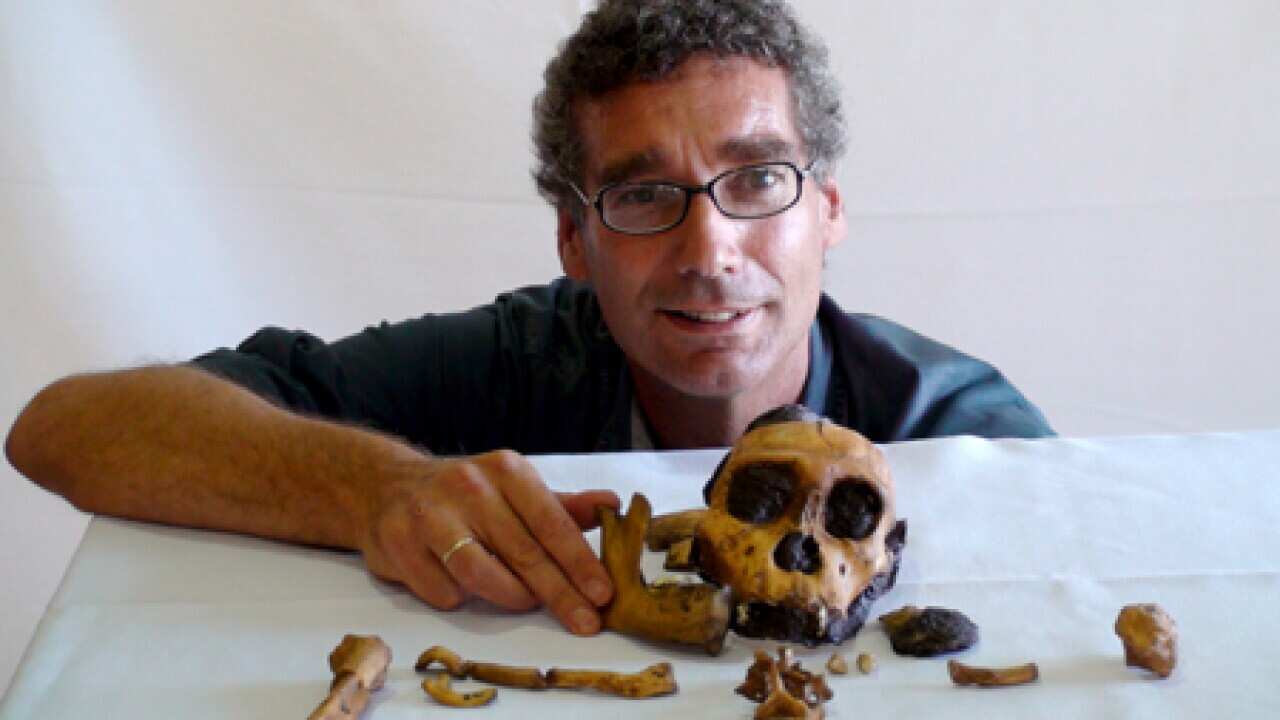
One of the most important discoveries in the field of human evolution has been unveiled in Australia for the first time.
A cast of the nearly complete skeleton of Australopithecus sediba was unveiled at the Australian Academy of Science in Canberra on Thursday by one of its discoverers, Professor Paul Dirks.
The species combines human-like features such as small teeth and jaw, a small flat face, an evolved pelvis and legs that would have allowed it to walk upright and run.
It also possesses more primitive features such as a small brain case and brain and long, ape-like arms and hands.
The 1.9 million-year-old skeleton of a juvenile male was discovered in South Africa in an area known as the cradle of humankind, a world heritage listed site located approximately 50 kilometres northwest of Johannesburg.
News that makes sense
Your trusted source for staying up-to-date with the world around you. Get free daily news updates and analysis, straight to your inbox.
The young male is just one of two nearly complete skeletons found at the site - the other is of an adult female - along with more than 150 other bones from at least four individuals.
The specimen was discovered in August 2008 by a team led by Professor Lee Berger of the University of Witwatersrand in South Africa and Professor Dirks from James Cook University in Queensland.
Professor Dirks says Australopithecus sediba is one of the most important discoveries in the human family tree as it contains features of both the Australopithecine and Homo species.
"Here we have a fairly complete set of skeletons ... that combine very primitive and very evolved features all in one, in quite an unexpected way," he told AAP.
Australopithecus sediba shares features from both Australopithecus africanus and Homo erectus, allowing it to possibly fill the gap between species that more closely resemble modern humans and those that resemble upright walking apes.
"If you add all this up, it becomes a difficult choice to make. Are we dealing here with a member of the family Homo or are we dealing with a member of the family Australopithecus," he said.
"In the end, we chose to call it Australopithecus sediba rather than Homo sediba because of its small brain size and long arms. However, there are others that would like to see it the other way round."







