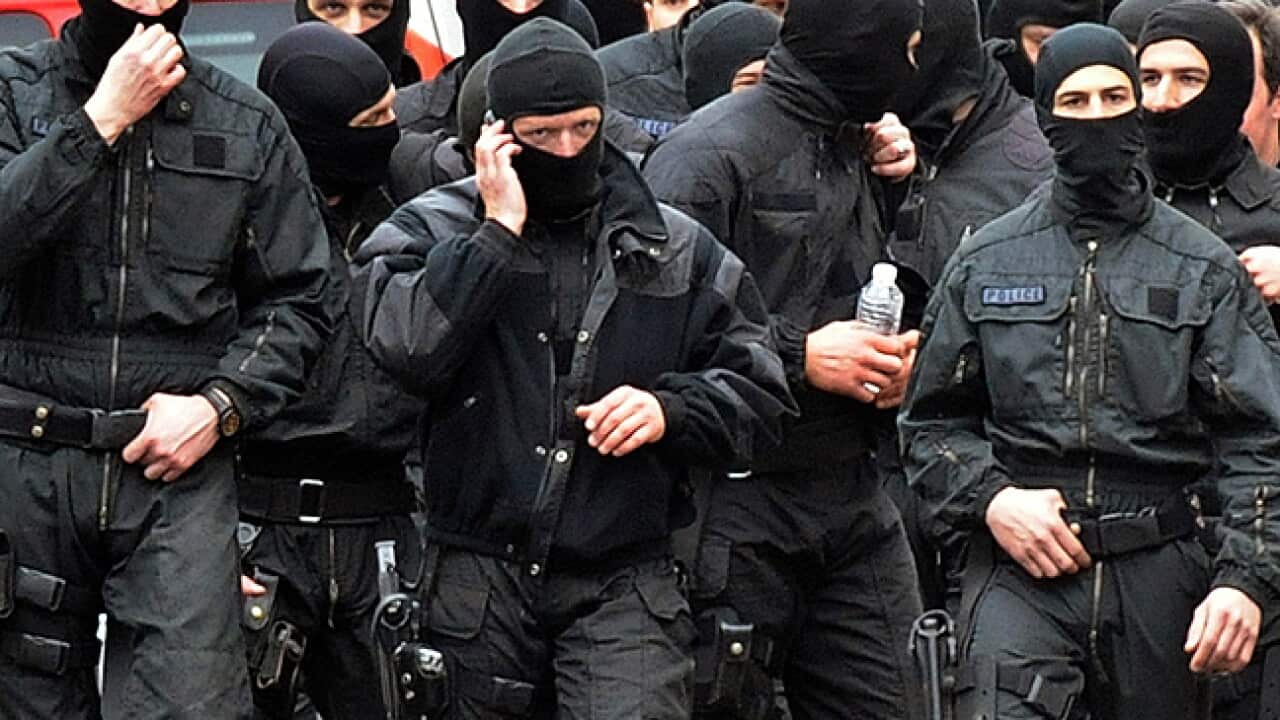
The French government has gone on the defensive after its intelligence services were accused of having failed to keep track of suspected al-Qaeda-trained militant Mohamed Merah, wanted for the killings of seven people.
Merah, 23, died in a police assault on his flat on Thursday. He was wanted in the killings of three French paratroopers, a rabbi and three children ages 4, 5, and 7.
The shootings began March 11 and ended Monday with the slaying of the rabbi and the children at a Jewish school in Toulouse.
With hindsight, Merah's past appears to make him an obvious suspect - he had at least 15 criminal convictions, some with violence, had become a radical Islamist and travelled to Pakistan and Afghanistan for training.
He and his brother were both known to French intelligence because of their fundamentalist Salafist ideology.
News that makes sense
Your trusted source for staying up-to-date with the world around you. Get free daily news updates and analysis, straight to your inbox.
One press report said in 2010 Merah forced a youth to watch videos of al-Qaeda hostage beheadings. When the boy's mother complained, Merah allegedly attacked her, putting her in hospital for several days.
Merah allegedly later went into the street outside the women's house, wearing military fatigues and brandishing a sword, shouting "I'm with al-Qaeda," the Telegramme newspaper reported.
A criminal complaint was lodged and police interviewed the woman but apparently there was no follow up.
Top prosecutor Francois Molins said Merah claimed to have been trained by al-Qaeda in the Pakistani region Waziristan that borders Afghanistan, a notorious hotbed of Islamist militancy.
Molins said the suspect had gone to the region twice and on one occasion had been arrested by Afghan police and handed over to US army troops, who put him on a flight back to France.
French far-right leader Marine Le Pen, who has been lambasting Muslim immigration as part of her presidential election campaign, was quick to accuse the government of "laxity" towards the "fundamentalist risk".
Socialist Jean-Pierre Chevenement, a former defence and interior minister, said the killings were "a warning for services in charge of anti-terrorism".
But members of President Nicolas Sarkozy's right-wing government sought to defend their record, and Sarkozy himself addressed the nation shortly after Merah's death to promise tough new criminal measures.
He vowed to crack down on extremist indoctrination, and prosecute people who regularly consulted jihadist websites or who travelled abroad for indoctrination.
A spokesman for Socialist presidential candidate Francois Hollande said there had indeed been a surveillance "failing" and that Sarkozy's measures were not going to solve society's problems.
"I will happily use the term 'failing'. In the United States, a commission of inquiry would have been set up without any question to see if there's a problem with the surveillance," Bruno Le Roux told AFP.
"In France one could at least ask to know how we could have avoided this drama, or could have acted differently during it?"
"It's not with the announcement of yet another criminal bill that we're going to solve society's problems," Le Roux said of Sarkozy's measures. Interior Minister Claude Gueant defended the DCRI domestic intelligence agency's work.
"The DCRI tracks a lot of people who are involved in Islamist radicalism.
Expressing ideas ... is not enough to bring someone before justice," Gueant said. Foreign Minister Alain Juppe said "light must be shed" on what happened in the run-up to the killings, but insisted there was "no reason" to think there were any failings.
"I understand that one can ask whether there was a failing or not. As I don't know if there was a failing, I can't tell you what kind of failing, but light must be shed on that," Juppe told Europe 1 radio.
Asked why more means were not put into tracking the estimated 15 to 30 hardcore militant Islamists in France, Juppe said: "They are tracked" and Merah "was recently questioned by the intelligence services."
Security expert Francois Heisbourg said "the question should at least be asked" about eventual intelligence errors.
"The Merah brothers were indeed known to the intelligence services. For me there's a real question: why was he not placed under normal, usual surveillance?" he asked, noting however that France's last terrorist attack dated from 1996.
"To err is perfectly human. For me, it was clear that our immunity to attacks couldn't last forever.
One day or another a terrorist was going to slip through the net, but of course that can't excuse any possible errors of judgement."







