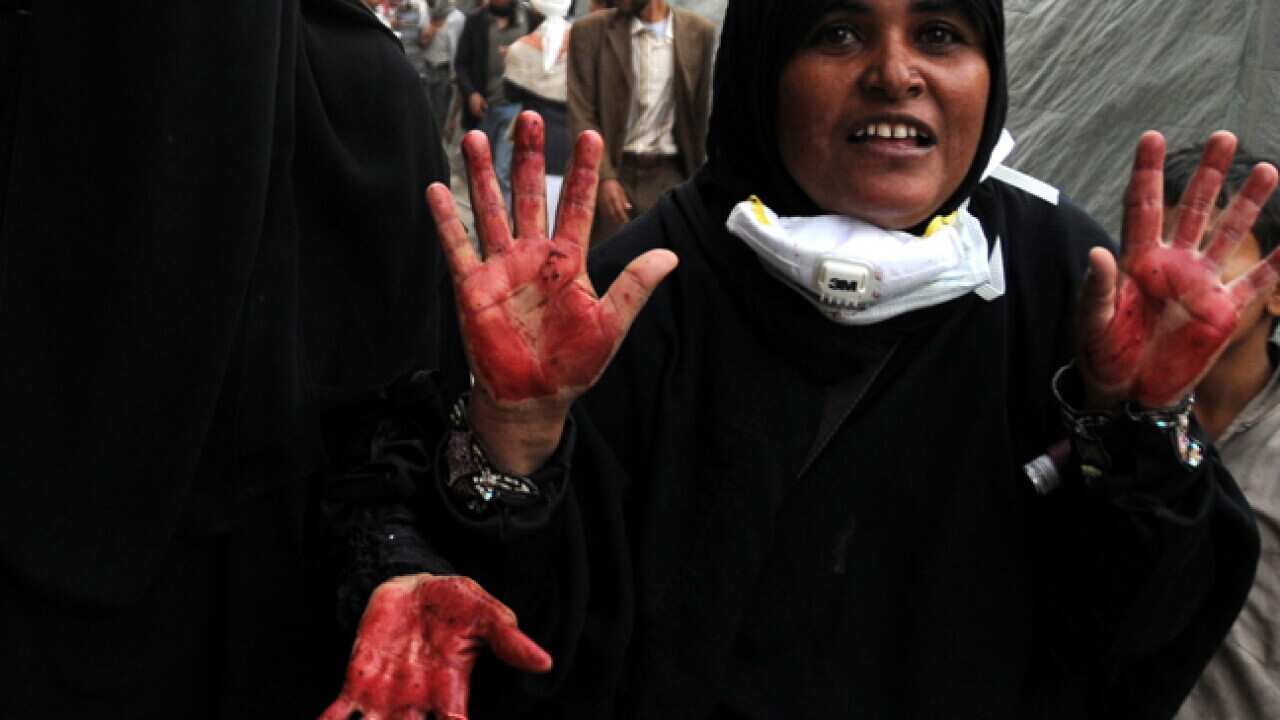
Yemeni security forces killed 20 people, including three dissident soldiers and two children, in the capital Sanaa on Monday, raising the total death toll to 46 in the past 24 hours, medics said.
"Twenty people, including two children and three soldiers from the First Armoured Brigade" were killed in Sanaa, a medic said, referring to a military unit headed by dissident General Ali Mohsen al-Ahmar.
Thousands of protesters calling for the departure of President Ali Abdullah Saleh's regime marched into the centre of Sanaa where they joined tens of thousands who had camped there overnight.
On their way, the protesters clashed briefly with security forces and Saleh supporters near the office of Saleh's son Ahmed who heads the elite Republican Guard units but no casualties were reported, witnesses said.
Monday's march followed a similar one on Sunday attended by tens of thousands, which ended in chaos when security forces and armed civilians opened fire, according to witnesses.
News that makes sense
Your trusted source for staying up-to-date with the world around you. Get free daily news updates and analysis, straight to your inbox.
Heavy machine guns, water cannons and tear gas were also used, they added.
Medics reported 26 people killed and 500 wounded by live rounds, batons or after inhaling tear gas in Sunday's clashes.
Yemen's government on Monday expressed its "sorrow and condemnation" of Sunday's violence and promised an investigation.
"The government of Yemen expresses its sorrow and condemnation for all acts of violence and bloodshed as those happened yesterday in Sanaa," Foreign Minister Abu Bakr al-Qurbi told the UN Human Rights Council in Geneva.
"The government will investigate and hold accountable all those who were in charge of these acts," he added.
"It is unfortunate that these events occurred at a time while some solutions for the political crisis started to appear," said the minister.
During their march on Sunday night, protesters drove out the security forces, who were replaced by troops of dissident General Ali Mohsen al-Ahmar's First Armoured Brigade.
The troops immediately set up roadblocks to protect the demonstrators, who now occupy a three-kilometre stretch of Sanaa, extending from Change Square towards the centre, witnesses said.
"New tents were set up in the centre of Sanaa," one witness said.
Youth groups also called for massive protests across the country on Monday prompting security forces to deploy heavily in the flashpoint city of Taez, the second-largest in Yemen.
The Organising Committee for the Youth Revolt in Sanaa which insisted in a Sunday statement that its actions will remain "peaceful," urged Yemenis to "come out and gather" across the country "day and night" until the regime falls.
It also urged soldiers from the Republican Guard and the central security services to "refuse to obey orders given to them by members of Saleh's family to kill their own people."
The interior ministry had accused protesters of wounding four members of the security forces, throwing petrol bombs at electricity generators, and burning official vehicles.
Oxfam said in a statement, meanwhile, that one in every three Yemeni goes hungry every day because of the months-long political stalemate that has pushed the economy to the verge of collapse and the government towards total paralysis.
"Widespread hunger and chronic malnutrition have taken hold in Yemen," the international charity said in a report on the country of 22 million.
Saleh, who is recovering in Saudi Arabia from wounds received in an explosion in Sanaa in June, last week authorised Vice President Abdrabuh Mansur Hadi to negotiate a power transfer with the opposition.
But the opposition has dismissed calls for dialogue before Saleh, in power since 1978, signs a Gulf-brokered deal that would see him hand power over to Hadi in return for amnesty from prosecution for himself and his family.







