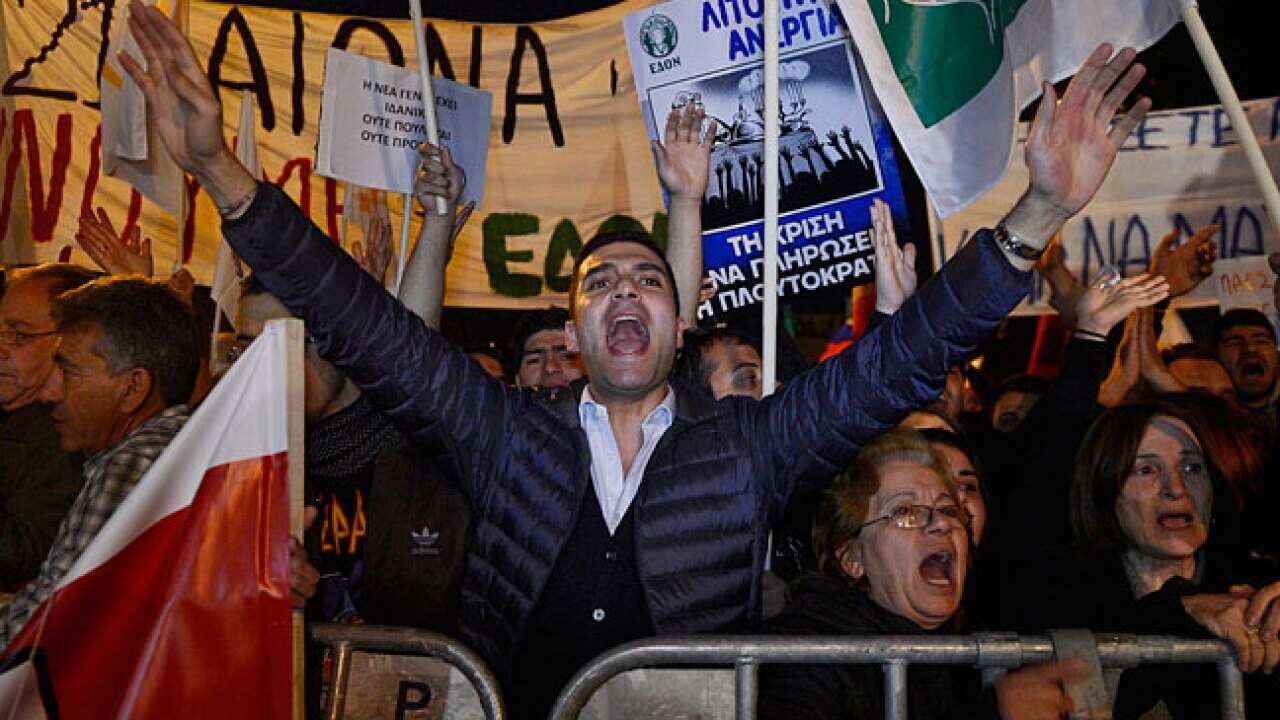
Angry MPs on Tuesday rejected the terms of a bailout aimed at saving Cyprus from bankruptcy, decrying as "blackmail" a deal that had been reached with a troika of lenders that now lies in tatters.
"The bill has been rejected," house speaker Yiannakis Omirou said, as thousands of protesters who had demanded the house spurn the onerous measures exploded in joy outside the parliament building in Nicosia.
Omirou gave a breakdown of 36 votes against, 19 abstentions and none in favour.
News that makes sense
Your trusted source for staying up-to-date with the world around you. Get free daily news updates and analysis, straight to your inbox.
Media reports said the government would now try to renegotiate the terms of the deal with the troika -- the European Union, the European Central Bank and the International Monetary Fund.
It would at the same time seek other ways of making up a 5.8 billion-euro ($7.47 billion) shortfall, with a bond issue, bank restructure and trying to secure more Russian investments among the options.
Omirou, of the socialist Edek party, had earlier told deputies, "There can only be one answer: no to blackmail."
"Our demand must be that this deal must be renegotiated. If we pass this tax there will be no foreign investor who will keep their money here," he warned.
Outside the parliament, equally angry crowds called for a "No" vote and held up signs warning that other financially crippled European nations like Italy and Spain could be next.
Under the 10-billion-euro ($13 billion) deal sealed with eurozone partners on Saturday, a controversial levy of at least 6.75 percent was to be slapped on all bank deposits across the island.
The parliamentary finance committee, in a bid to make the package more palatable, Tuesday dropped the tax on bank savings below 20,000 euros, while retaining at 6.75 percent the levy on deposits of 20,000-100,000 euros and at 9.9 percent for amounts above 100,000 euros.
The measure was not enough to convince lawmakers, with the 19 members of President Nicos Anastasiades's Disy party abstaining and other MPs voting outright against the measure.
Disy coalition partner Marios Garoyian of Diko party had during the debate urged the rescue package be "rejected".
"This is blackmail and Diko proposes the bill is rejected, but yes to an adjustment programme... We want a European rescue, not European destruction," he told fellow MPs.
Rejection of the tax leaves Cyprus with a shortfall of 5.8 billion euros in funds it needs to dig itself out of crippling debt.
Central Bank chief Panicos Demetriades had earlier warned that unless the government managed to raise the shortfall, "it will be considered in breach of the (eurozone bailout) agreement".
Fearing a run on accounts, Cyprus has shut its banks until at least Thursday, with the island's stock exchange closed for the same period. Given the latest developments, there was no certainty the institutions would open this week at all.
With no end in sight to the crisis, Europe's main stock markets suffered further losses and the euro slid on Tuesday.
London's FTSE 100 index of leading companies dipped 0.26 percent, while in Frankfurt the DAX 30 shed 0.79 percent.
In foreign exchange activity, the European single currency slid to $1.2873, from $1.2957 in New York late on Monday, to hit its lowest level since November 22.
The president had even before the session began called an emergency meeting of party leaders for Wednesday morning to "examine alternative plans to address the situation that may arise following developments determined by the parliamentary vote".
A government spokesman said Anastasiades would have further telephone discussions on the terms of the bailout with German Chancellor Angela Merkel later Tuesday, after a first round of talks on Monday.
As the island's leaders raced to stave off bankruptcy, Finance Minister Michalis Sarris was on his way to Moscow to seek an extension to an existing Russian loan.
Finance ministry director Andreas Charalambous told reporters that securing an extension to the loan was "very important" as it would throw Cyprus a lifeline.
"The first issue is we have a large loan maturing in 2016 and if we manage to come to an understanding this will help facilitate our debt repayments and debt sustainability," Charalambous said.
"If we manage to extend the loan the refinancing needs of the economy would be manageable. So it's very important."
Moscow extended Nicosia a 2.5-billion-euro loan in 2011 at a rate of 4.5 percent.
Sarris's goal was to lower that rate and extend the loan's expiration date until 2020 from 2016, reports said.







