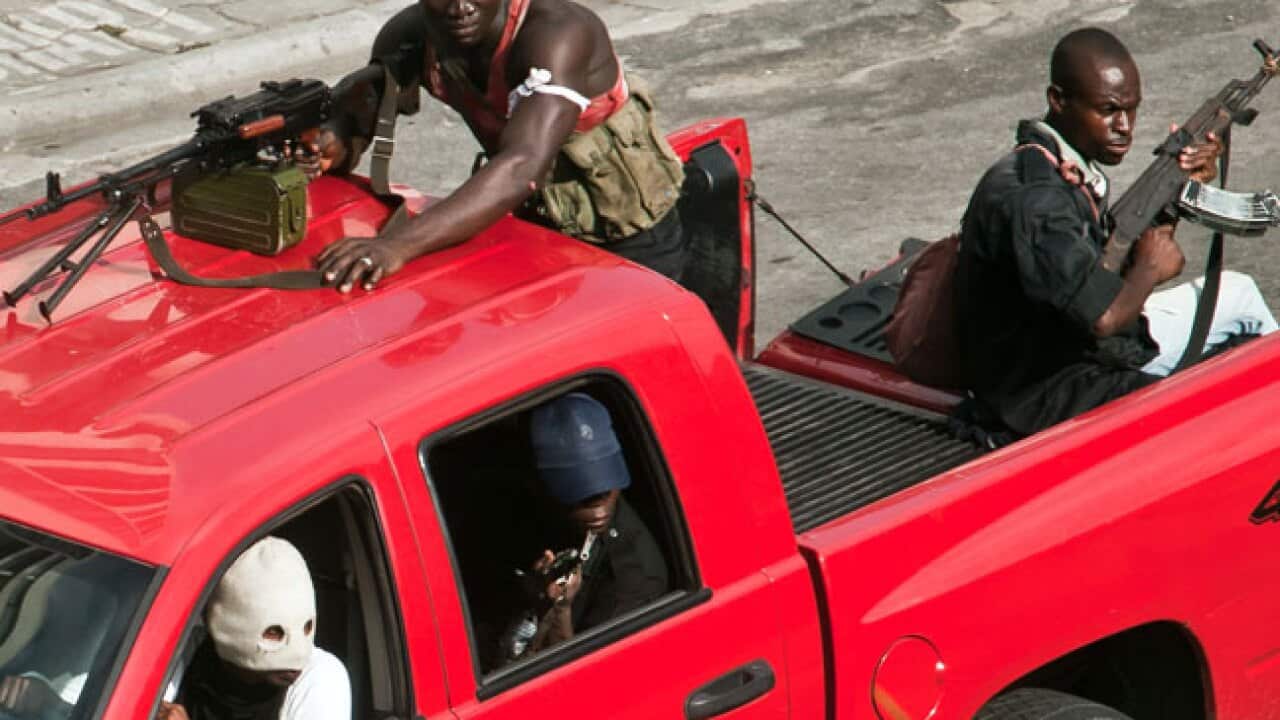
US President Barack Obama says Ivory Coast strongman Laurent Gbagbo should respect the will of his people and "end his claim to the presidency", the White House said.
Obama reiterated the US call for Gbagbo to go in a call he made to Gabon's President Ali Bongo to discuss Ivory Coast, where forces of the elected president Alassane Ouattara are waging an all-out bid to force Gbagbo to go.
The White House said Obama and Bongo shared concerns about the violence in Ivory Coast and discussed the need to end the crisis "as soon as possible".
News that makes sense
Your trusted source for staying up-to-date with the world around you. Get free daily news updates and analysis, straight to your inbox.
"President Obama reiterated his belief that former President Gbagbo needs to respect the will of the Ivorian people and end his claim to the presidency," a White House statement said.
Obama also thanked Bongo "for his leadership and for the important role that Gabon plays as a member of the United Nations Security Council".
French and UN helicopters fired at the Ivory Coast presidential palace on Monday and bases used by Gbagbo's forces after fighters loyal to Ouattara launched a new offensive after a long election dispute.
UN joins Abidjan fighting
French and UN helicopters on Monday fired at the Ivory Coast presidential palace and bases of strongman Laurent Gbagbo as the country's elected president launched an all-out push to make him step down.
The helicopters targeted the presidency, Gbagbo's residence and military barracks in the main city Abidjan, a UN official said, hours after fighters for Alassane Ouattara launched a new offensive after a months-long election dispute.
Heavy artillery fire and explosions shook central Abidjan as the offensive raged into the evening, AFP journalists reported.
"The final assault for the total capture of the residence and the palace will take place in the coming hours. The operation is expected to finish tonight," said Sidiki Konate, the spokesman for Ouattara's prime minister Guillaume Soro.
In a joint operation the United Nations mission UNOCI and former colonial power France's force Licorne (Unicorn) targeted Gbagbo strongholds.
"We launched the operation to protect people by putting heavy weapons, used by special forces of Laurent Gbagbo against people and against the UN peacekeepers, out of harm's way," said UNOCI spokesman Hamadoun Toure.
The mission was in line with UN resolution 1975, adopted on March 30 which ordered sanctions against Gbagbo and also said the UN force should protect civilians and prevent use of heavy weapons.
Joint action result of 'urgent' UN request for help
The joint military action followed an "urgent" request for help by UN Secretary General Ban Ki-moon in a letter to French President Nicolas Sarkozy, officials said.
"It is urgent to launch necessary military operations to put out of action the heavy arms which have been used against the civilian population and the peacekeepers," Ban wrote, according to a copy of the letter obtained by AFP.
Ban accused Gbagbo's forces of having "intensified and escalated" the use of mortars, rocket-propelled grenades and heavy machine-guns against civilians.
They had also targeted the UNOCI headquarters in Abidjan "with heavy-caliber sniper fire as well as mortars and rocket-propelled grenades". Four peacekeepers have been wounded, he said.
"Furthermore, forces loyal to Mr. Gbagbo have attacked UNOCI patrols dispatched to protect civilians and convoys transporting wounded in Abidjan, resulting in several more wounded peacekeepers," added the statement.
But the UN leader insisted the 11,000 peacekeeping force did not have orders to bring down Gbagbo.
"Let me emphasize that UNOCI is not a party to the conflict," Ban said in a statement. "In line with its Security Council mandate, the mission has taken this action in self defense and to protect civilians."
But one of Gbagbo's advisors in Paris, Toussaint Alain, said the strikes were "illegal" and amounted to an "assassination attempt" on Gbagbo.
EU 'welcomes UN efforts'
European Union President Herman Van Rompuy said in a statement he welcomed UN efforts to "protect the civilian population in line with the mandate given by the UN Security Council".
The French military said its action "aimed to neutralise heavy weapons positions in barracks and armoured military vehicles equipped with cannons and rocket launchers".
Amid the tensions Monday, armed men kidnapped two French nationals, a Beninese and a Malaysian from a hotel in Abidjan, diplomatic sources said.
Residents of the city of five million were in lockdown in their homes the whole day while armed men patrolled the streets.
About 1,900 foreigners are under French military protection in Abidjan and 447 others have already left Ivory Coast, according to the French military which had taken over control of the airport in Abidjan and boosted its troop numbers.
Weary of failed diplomatic efforts to resolve the post-election crisis, Ouattara's army launched a lightning offensive further north a week ago, seizing much of the country and entering Abidjan late last week.
Gbagbo was weakened by the desertion of key allies and isolated by the international community when the battle for Abidjan began but later clawed his way back, managing to repulse attacks on his strongholds.
Reports have meanwhile emerged of human rights abuses over the week including the massacre of hundreds of civilians in the western town of Duekoue.
The International Red Cross has said 800 died in Duekoue in one day in an incident "particularly shocking by its size and brutality" while the UN mission gave an initial death toll of 330, saying that both camps were involved.







