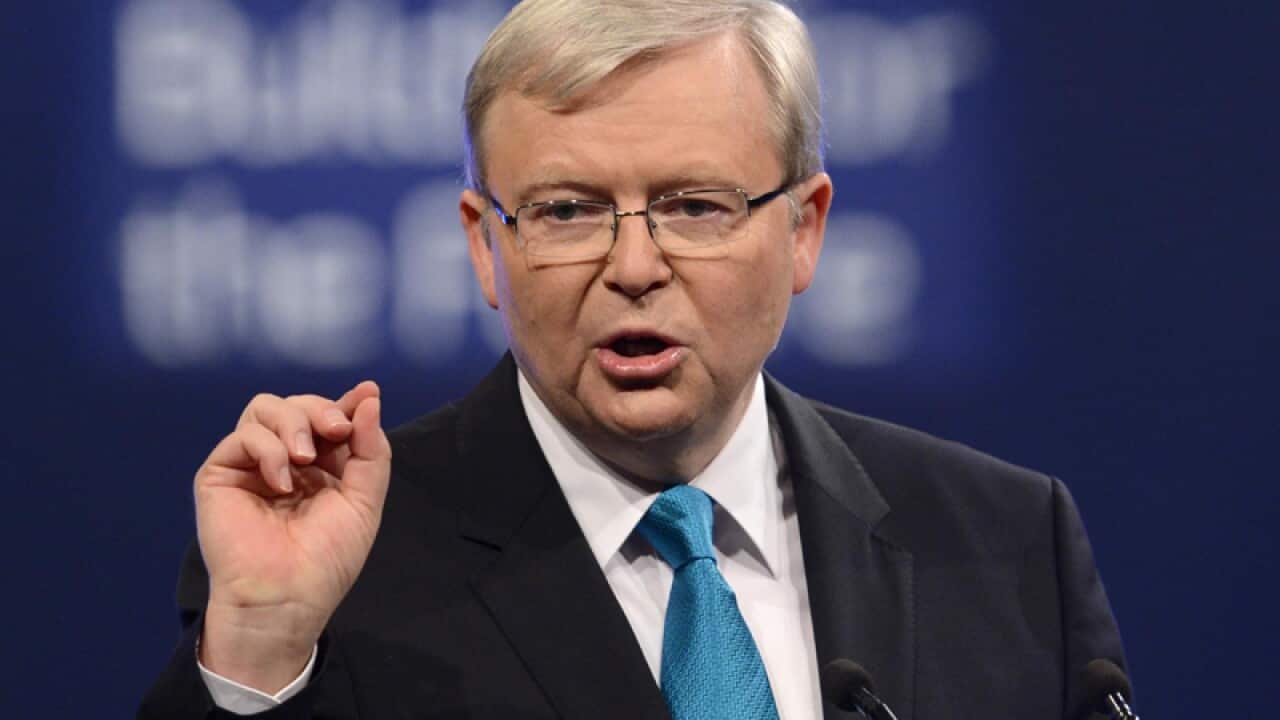
Prime Minister Kevin Rudd says the latest national accounts figures highlight the strength of Australia's economy in an uncertain global economy.
The figures released on Wednesday show gross domestic product (GDP) grew by 0.6 per cent in the June quarter for an annual rate of 2.6 per cent, well below a long-term trend of around 3.25 per cent.
Mr Rudd said was the result was consistent with the government's forecast for 2.5 per cent in the 2013/14 financial year.
"The national accounts data is important because it underlines the continued strength of the Australian economy in a very, very uncertain global economic environment," he told reporters in Melbourne.
Mr Rudd said the Australian economy was 15 per cent larger than it was when Labor came to power in 2007, and had generated about an extra million jobs.
News that makes sense
Your trusted source for staying up-to-date with the world around you. Get free daily news updates and analysis, straight to your inbox.
Australia had grown at twice the rate of Canada, four and half times the rate of the US and six times the rate of Germany. In contrast, the British economy had shrunk by three per cent.
"That's not a bad report card for an Australian economy in difficult economic global circumstances," Mr Rudd said.
Australia has posted 22 years of continued positive growth - 11 under Labor including the Hawke/Keating period, and 11 under the conservatives.
"This is a good record for Australia," he said.
"What I fear most of all is if the consequence of (Opposition Leader Tony) Abbott's massive cuts, his hidden massive cuts, impact the health of our economy and run the risk of triggering a recession."
Treasurer Chris Bowen said the national accounts report also confirmed the economy was undergoing a transition and needed careful and prudent economic management.
"It emphasises the importance of the Rudd Labor government's fiscal strategy, to manage short term pressures with accommodative policy while charting a clear path back to surplus over the medium term," he said in a statement.
Household consumption grew by just 0.4 per cent in the quarter to be 1.8 per cent higher than a year earlier, reflecting continuing caution in consumer spending and borrowing.
But Mr Bowen noted a strong rebound in capital goods imports in the quarter, up 8.8 per cent following a 12.5 per cent fall in the previous quarter.
"This is another positive sign that the economy is transitioning to non-resource sources of growth and investing in future productive capacity," he said.
Additionally, labour productivity rose again in the June quarter by 0.3 per cent, to be 2.2 per cent higher than it was a year ago, and above its long term trend.
"We are managing the transition away from mining investment, and we are doing so with a sound fiscal position and strategy," he said.







