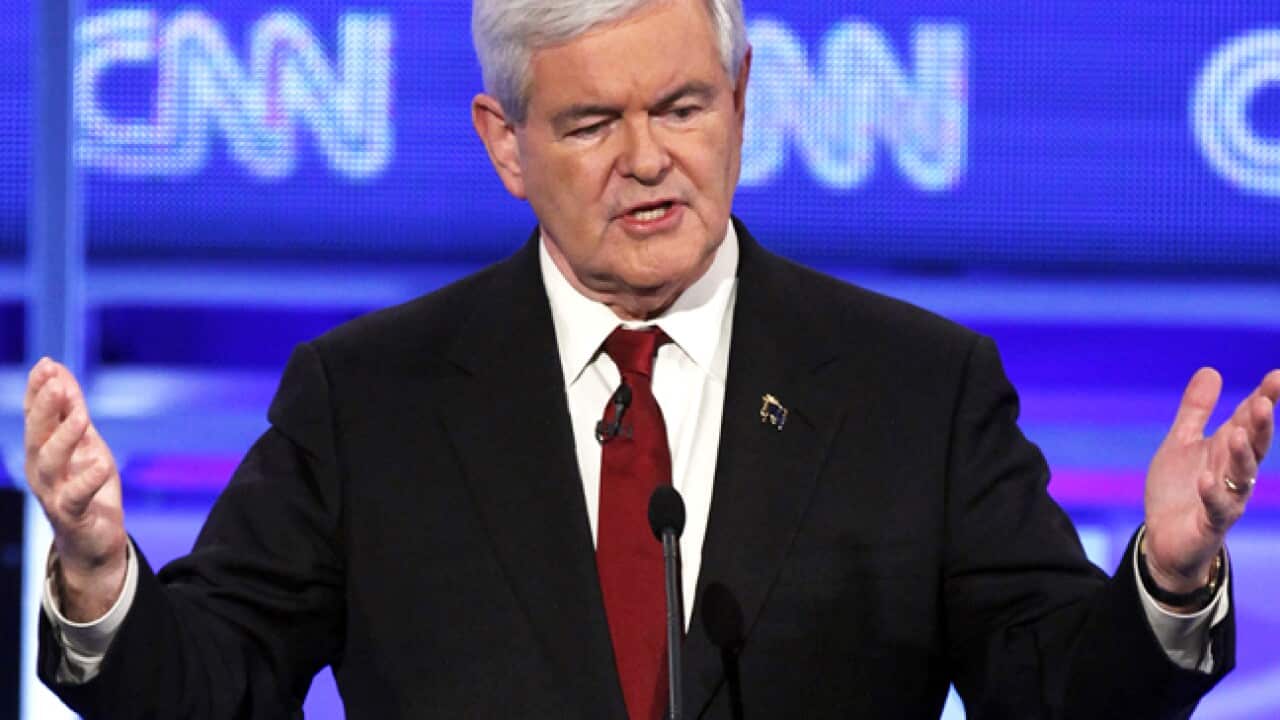
Former House speaker Newt Gingrich cemented his place Tuesday as the main rival to Mitt Romney for the Republican presidential nomination with a solid debate performance on foreign policy.
Buoyed by opinion polls that gave him a four per cent lead over the former Massachusetts governor, Gingrich, whose campaign had been all but written off a few months ago, came out of the blocks firing on national security.
Asked the first question on the Patriot Act, which extended counter-terrorism search and surveillance powers in the wake of the September 11, 2001 attacks, he talked tough and had a stark warning for Americans.
News that makes sense
Your trusted source for staying up-to-date with the world around you. Get free daily news updates and analysis, straight to your inbox.
"I'd look at strengthening it because I think the dangers are literally that great," Gingrich said, adding that there should be "an honest understanding that all of us will be in danger for the rest of our lives."
"I spent years studying this stuff," he said. "You start thinking about one nuclear weapon in one American city and the scale of loss of life and you ask yourself, what should the president be capable of doing to stop that?"
THE UPATRIOTIC ACT
Ron Paul, a veteran congressman from Texas well known for his libertarian views, hit back in a testy exchange, calling the act "unpatriotic."
"Today it seems too easy that our government and our Congresses are so willing to give up our liberties for our security," he countered. "I have a personal belief that you never have to give up liberty for security."
The CNN-moderated debate at DAR Constitution Hall, just a few blocks from the White House, settled down after this initial clash and there were few of the fireworks that characterized earlier debates.
Romney and Gingrich threatened to go at each other at one point when the former House speaker thought he had been interrupted, but otherwise the exchanges were cordial as the usual foreign policy topics were discussed.
GINGRICH EYES ROMNEY'S PERCH
In the topsy-turvy Republican race, Gingrich has emerged as the main threat to Romney, who has built a financial and organizational advantage with machinery from his previous run in 2008 and looks like the man to beat.
Gingrich must show he has more staying power than Minnesota Congresswoman Michele Bachmann, Texas Governor Rick Perry and retired pizza executive Herman Cain, who have all surged only to wither in the full glare of the campaign spotlight.
A poll of nationwide Republican voters released Tuesday by Quinnipiac University showed Gingrich leading the field with 26 percent support, compared to 22 percent for Romney. A CNN poll had Gingrich leading by the same margin.
ATTACK ON OBAMA
Romney, attacked by the White House before the debate for a disingenuous campaign ad, did not take a step back and launched a fierce counter-attack on President Barack Obama's foreign policy and patriotism.
Accusing him of seeing the United States as "just another nation with a flag," he said Obama "apologizes for America."
"President Obama seems to think we're going to have a global century, an Asian century. I believe we have to have an American century where America leads the free world and the free world leads the entire world," he said.
As Gingrich has soared in the polls, so Cain and Perry have fallen as their campaigns have been derailed by a slew of stumbling responses, and in Cain's case by sexual harassment allegations.
While Gingrich, Paul and Romney were omnipresent at this debate, Cain was anonymous. In one cringe-worthy moment he called CNN moderator Wolf Blitzer Blitz instead of Wolf, before offering a stumbling apology.
Gingrich could be Romney's toughest challenge yet as he retains ties to the party establishment and is polling strongly in Iowa, the first state to vote when the Republican nomination battle begins in earnest on January 3.
The 68-year-old veteran of Congress was a central figure in US politics in the 1990s, rising to become House speaker as Republicans turned the tide on 40 years of majority rule by the Democratic Party.
But he fell from grace and resigned in 1998 after losing a battle of wills over a government shutdown with then president Bill Clinton. His popularity then plummeted further amid revelations about his private life.
The confessed adulterer has divorced twice and left his first wife following her treatment for cancer - actions seen as potentially fatal to his chances of winning over social conservatives, a key Republican voting bloc.
Gingrich's campaign was almost over before it started when staff walked out en masse in June as he went on a Greek cruise vacation with his wife only weeks after announcing his candidacy.
The candidate, in unusually jovial form after Tuesday night's debate, paraphrased writer Mark Twain's famous line saying: "The reports of my death were premature."







