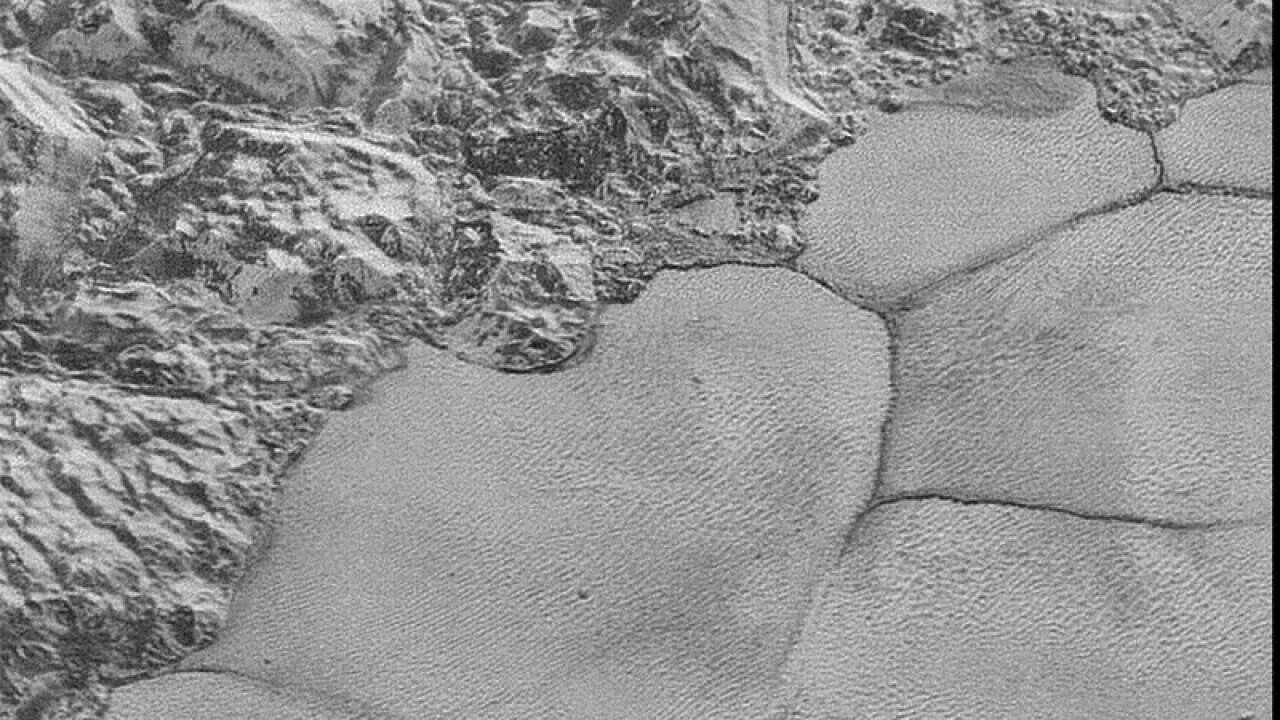
Scientists have discovered dunes on Pluto made of tiny frozen grains of methane.
The pale grey and white ridges were revealed by NASA's New Horizons spacecraft during its 2015 flyby.
A British-led team announced the findings on Thursday in the journal Science.
Researchers say the dunes appear to be made mostly of icy specks of methane the size of sand, with some frozen nitrogen likely mixed in.
Thought to be relatively recent, the parallel rows of dunes are in Pluto's heart-shaped region at the base of mountains as tall as the Alps and formed from giant blocks of ice with frosty methane snow caps.
News that makes sense
Your trusted source for staying up-to-date with the world around you. Get free daily news updates and analysis, straight to your inbox.
These plains in the left lobe of Pluto's "heart" are known as Sputnik Planitia.
Scientists were surprised to find dunes given Pluto's thin, weak atmosphere.
They suggest nitrogen ice coating the surface of Sputnik Planitia transformed into gas that lifted methane particles into the air.
Pluto's gentle winds then carried and deposited the grains.
Dunes have already been found on Mars, Venus, Saturn's moon, Titan and even a comet. Pluto's are the only ones known to consist of methane.
The study's lead author, Matt Telfer of Plymouth University in the UK, noted there were dunes on the scorching surface of Venus under a dense atmosphere and in the distant reaches of the solar system at minus 230C under a thin atmosphere.
Researchers liken the dunes to those at White Sands, New Mexico, or California's Death Valley.
The team has yet to determine the height of the dunes. Telfer guesses they are at least tens of metres tall.
Launched in 2006, New Horizons was the first spacecraft ever to visit Pluto, passing within 12,500km.
It's now heading towards an object in the Kuiper Belt nicknamed Ultima Thule, about 1.6 billion kilometres beyond Pluto, on January 1.







