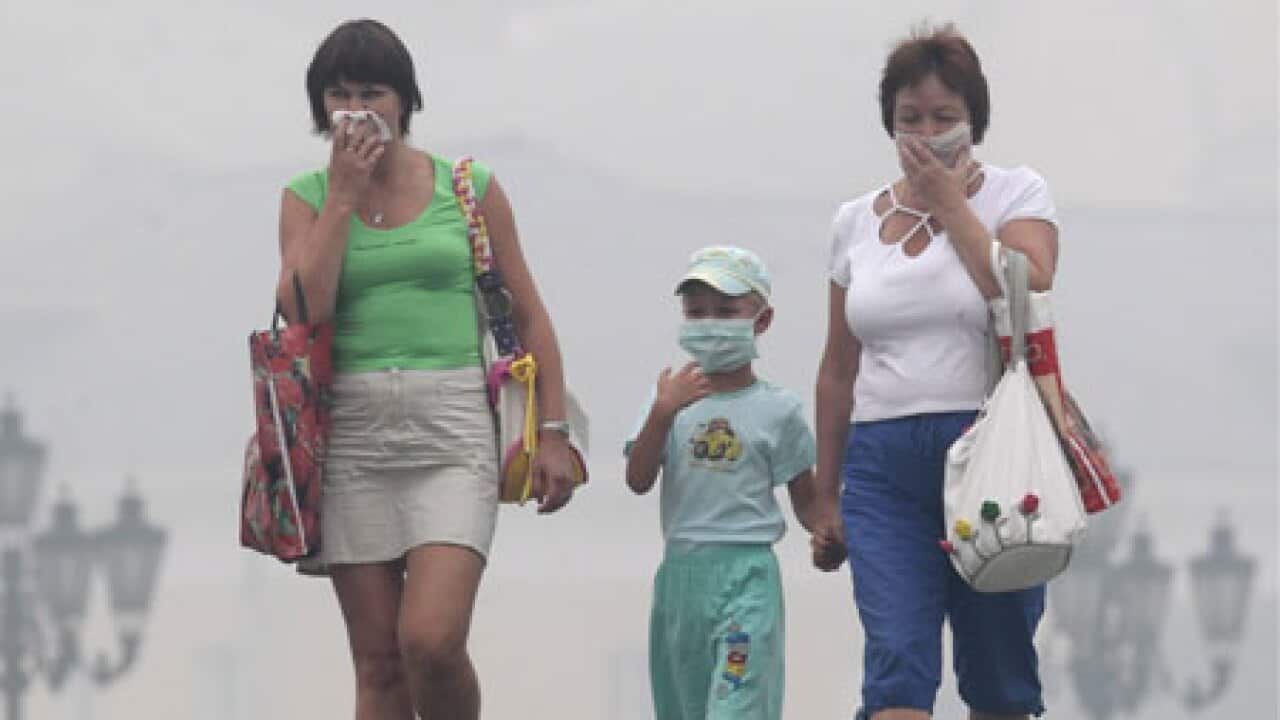
The daily mortality rate in Moscow has doubled and morgues are overflowing amid an acrid smog caused by the worst heatwave in Russia's thousand-year history, officials said.
The smog from the peat and forest fires burning in the countryside around 100 kilometres outside the city has choked Moscow for days, seeping into apartments, offices and even the metro, and causing thousands to flee.
"In usual times 360-380 people are dying each day. Now it is around 700," the head of Moscow's health department, Andrei Seltsovsky, said in televised remarks, adding that city morgues were filled almost to capacity.
The number of people who called for medical aid due to fire-induced problems grew over the weekend by 60 per cent, officials quoted by state news agency RIA Novosti said.
Emergency services meanwhile reported about 557 wildfires were burning over 174,000 hectares in central Russia and the Moscow region, with flames also raging close to a nuclear reprocessing site in the Urals.
News that makes sense
Your trusted source for staying up-to-date with the world around you. Get free daily news updates and analysis, straight to your inbox.
And Prime Minister Vladimir Putin announced that record drought would slash the grain harvest in the leading wheat producer by about 10 million tonnes.
Television reports said the smoke reached Russia's second city of Saint Petersburg and the Urals' main city of Yekaterinburg was also veiled in smog. Russia's top meteorological official, Alexander Frolov, said the heatwave was the most severe in the country's millennium-long history.
"No similar heatwave has been observed neither by ourselves nor by our ancestors," he told a televised news conference.
"This is a completely unique phenomenon." More than 104,000 people - a record number for the current year - flew out of Moscow on Sunday, a spokesman for Russian state aviation agency Rosaviatsia, Sergei Izvolsky, said.
The figure for the same day a year ago stood at around 70,000 people, he said. Officials at Moscow airports assured that reduced visibility would not impact flights, saying that "enough was visible near the airports to ensure we could receive and send off airplanes," ITAR-TASS news agency reported. Many of those who stayed pulled white-and-blue gauze masks over their faces to protect themselves from the haze, while national media accused authorities of covering up the true scale of the environmental disaster and related deaths.
State air pollution monitoring service Mosekomonitoring said Monday's carbon monoxide levels in the Moscow air were 2.2 times higher than acceptable levels.
They had been 3.1 times worse on Sunday and 6.6 times worse on Saturday.
With the German embassy already closed indefinitely, the US State Department said it was studying a request to fly out of Moscow children and other family members of its embassy staff.
Many Muscovites laid the blame for the catastrophe on the government, saying it was not doing enough to shield them from the smog, and bloggers shared survival tips ranging from producing oxygen at home to sleeping on the balcony.







