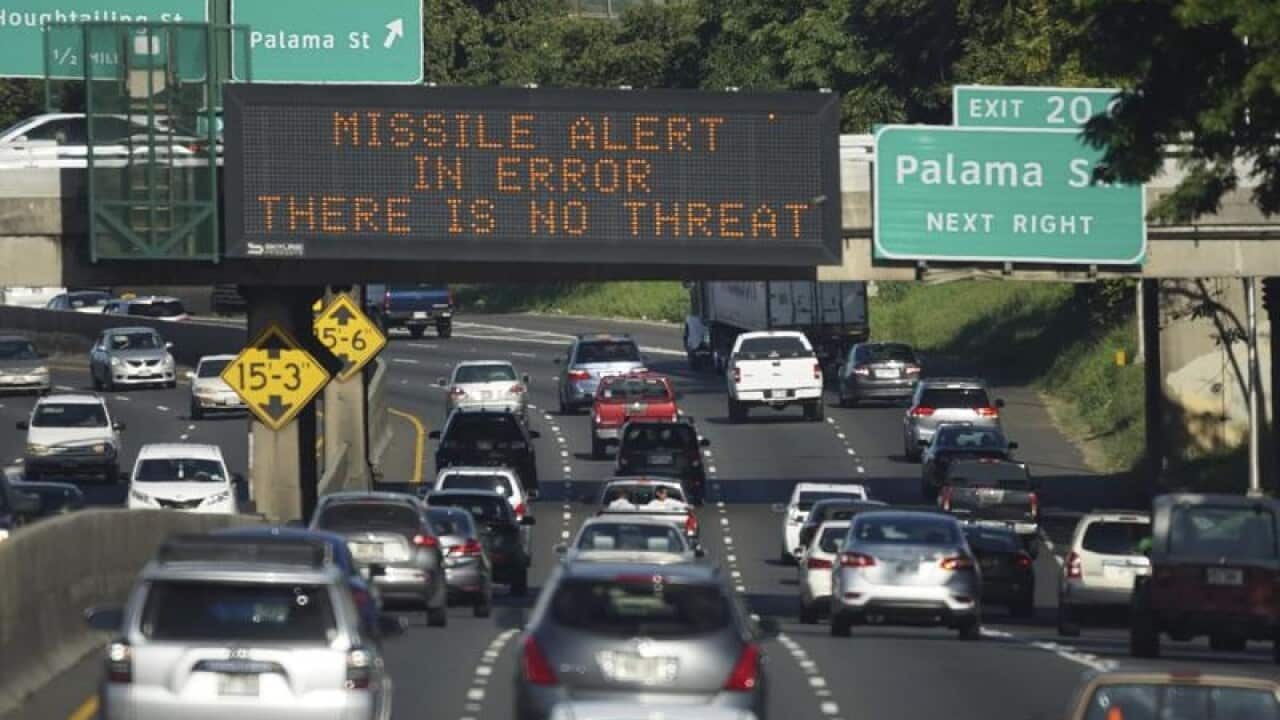
Human error and a lack of adequate fail-safe measures during a civil defence warning drill led to the false missile alert that stirred panic across Hawaii over the weekend, a state emergency management agency spokesman has acknowledged.
Elaborating on the origins of Saturday's false alarm, which went uncorrected for nearly 40 minutes, spokesman Richard Rapoza said the employee who mistakenly sent the missile alert "has been temporarily reassigned" to other duties.
Rapoza said an internal investigation of the blunder would be completed by week's end and that the Hawaii Emergency Management Agency welcomed outside review by the Federal Communications Commission, which has jurisdiction over wireless US alert systems.
Rapoza also said that no further drills of the emergency alert system would be conducted until new measures were put in place to reduce the chance of future false alarms and to swiftly withdraw any warnings sent in error.
FCC Chairman Ajit Pai said on Sunday that the agency's probe of the incident so far suggested "reasonable safeguards or process controls" were lacking, a point that Rapoza said officials at the Hawaii Emergency Management Agency did not dispute.
News that makes sense
Your trusted source for staying up-to-date with the world around you. Get free daily news updates and analysis, straight to your inbox.
The error occurred when, in the midst of a drill during a shift change at the agency, an employee made the wrong selection from a "drop-down" computer menu, choosing to activate a missile launch warning instead of the option for generating an internal test alert, Rapoza said.
The employee, believing the correct selection had been made, then went ahead and clicked "yes" when the system's computer prompt asked whether to proceed, Rapoza said.
Governor David Ige initially said on Saturday that "an employee pushed the wrong button."
The resulting message, issued amid heightened international strains over North Korea's development of ballistic nuclear weapons, stated: "EMERGENCY ALERT BALLISTIC MISSILE THREAT INBOUND TO HAWAII. SEEK IMMEDIATE SHELTER. THIS IS NOT A DRILL."
It was transmitted to mobile phones and broadcast on television and radio across the Pacific island state shortly after 8am on Saturday, and took 38 minutes to be retracted by an official all-clear message.
The mistake unleashed hysteria and confusion across the state, home to some 1.4 million people and a heavy concentration of US military command structure.
Civil defence officials have said that in the event of a real missile attack from North Korea, people in Hawaii would have only about 12 minutes to find shelter.
US President Donald Trump said the US government would be involved in looking into what went wrong.
"It's a state thing but we are going to now get involved in that," Trump told reporters in Florida when asked about the false alarm.







