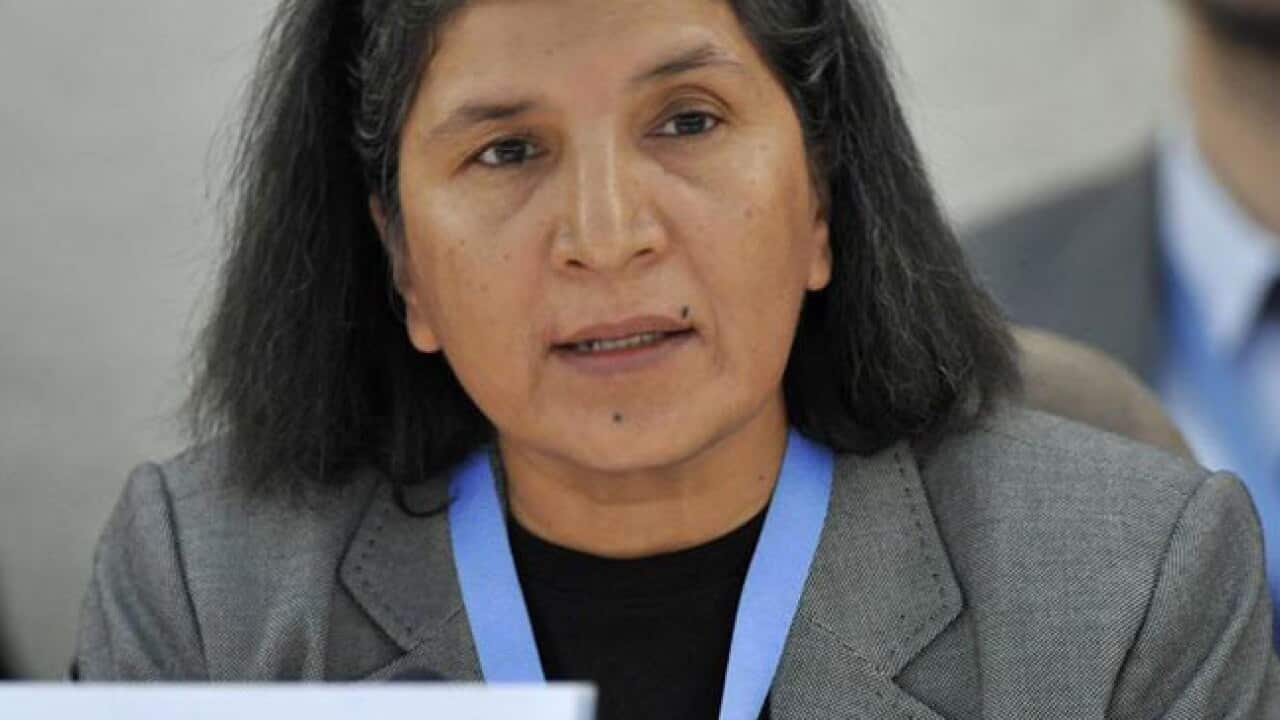
A top United Nations official has expressed concern over the level of domestic violence being experienced by Indigenous women in Australia.
(Transcript from World News Australia Radio)
The Special Rapporteur on Violence against Women was invited to Australia by groups wanting to bring international attention to the issue.
News that makes sense
Your trusted source for staying up-to-date with the world around you. Get free daily news updates and analysis, straight to your inbox.
Earlier this year, United Nations Special Rapporteur on Violence against Women, Rashida Manjoo, made a study tour of Australia.
She attended community meetings across the country.
Ms Manjoo was invited by the Australian Human Rights Commission and the Australian government.
She wasn't required to produce an official report.
But she says the visit highlighted to her how Indigenous communities need more targetted domestic violence programs.
"I think the struggle differs. As a starting point, the histories are different from the dominant white society. the history of exclusion, of oppression, of discrimination, does not resonate in the same way for all Australians. I think that the history of denial of access to justice, access to health, access to education is also different. and I think the solutions and the remedies that are imposed on Indigenous communities also ignores the fact that the designers of policies, laws and programs have not properly ascertained what will work in a community."
Ms Manjoo says a common concern raised by Indigenous communities was that they often were not given enough control of their community's domestic violence programs.
"At these roundtables that I attended, one of the issues that came up is that there's insufficient consultation. So Indigenous communities not feeling part of the process of contributing to, and articulating what the community needs are, what the community's demands are, in a way that is respected and responded to. The second is consulting about community needs is one thing, but developing capacity and skills in that community to create autonomy is another challenge, and if there's no sustainability, in terms of, just inclusion is not sustainability. Inclusion is very superficial. Participatory democracy requires respect, requires responsiveness. But it requires a deep and sustained commitment to the autonomy of others."
One of the communities Ms Manjoo visited during her study tour was the town of Fitzroy Crossing in Western Australia, where violence against women has often been linked to excessive alcohol consumption.
Chief Executive Officer of the Marninwarntikura women's Resource Centre, June Oscar, led a community initiative in 2007 to impose permanent restrictions on the purchase and consumption of alcohol in Fitzroy Crossing.
Ms Oscar says there's been a big drop in alcohol-related violence since the restrictions were introduced.
She says the change from within her community needed to happen under the guidance of the Indigenous community, but that the input of the non-Indigenous community is also needed to tackle the problem.
"I think it makes a huge difference and we've engaged men and women from our community. But we've also partnered with non-Indigenous experts in their respective fields that are working alongside of people from our community. And I think that's where we've been able to create maximum opportunity and benefits and responses in the support that's needed for issues as complex and deep as the ones we are tackling."
A key challenge posed in attempting to provide assistance to Indigenous women experiencing domestic violence is providing services in the languages spoken by clients.
Ms Oscar says several different Indigenous communities reside in the Fitzroy Crossing area, meaning that as many as four different languages are spoken.
"It helps to have an understanding of the languages spoken and to employ local people into the positions so that the spoken communication isn't a barrier. Sometimes there's no need for any spoken communication when it comes to people seeking support at the refuge. They just may need to be left alone for a while until they're ready to speak."
Indigenous rights advocate Vicki Roach previously experienced domestic violence.
She has since become a senior client facilitator and Aboriginal Liason with St George Women's Housing, a New South Wales-based non-government organisation that provides housing to women experiencing domestic violence.
Ms Roach says the Indigenous women who seek assistance from her organisation are often reluctant to leave their communities, despite being at risk of violence.
She says this can sometimes make it difficult for the service to protect its clients.
"Their special needs are staying in community, being close to extended family or immediate family, especially their mums usually. And well we had one woman that relocated from Broken Hill and came down to us, but she kept going back. You know, she'd go back and sort of ring us and say, you know, 'give the house to someone else, I'm going to stay here in Broken Hill.' And then she'd ring back the next day and say 'please don't give my house away, I'm coming back.' "
Across Australia, women experiencing domestic violence can seek temporary shelter in refuges, the locations of which are generally kept secret.
In remote communities where many Indigenous women live, that's not an easy task.
However, June Oscar from the Marninwarntikura women's Resource Centre says that's not been a problem in Fitzroy Crossing.
She says men in her community rarely attempt to enter the town's refuge illegally, out of respect for traditional Aboriginal law.
"It's a place for women and children. And whilst we have male partners coming to speak to their wives or their partners whilst they're there or the next day, people are respectful and acknowledging of the protocols around Aboriginal women's law and custom, so that has been a measure that's helped to protect. And people are living in two worlds in our community, we are living in this modern reality, but we are also living according to custom and tradition as well."
The UN Special Rapporteur on Violence against Women, Rashida Manjoo's most recent trip to Australia was sponsored by the Aboriginal Family Violence Prevention and Legal Service in Victoria.







