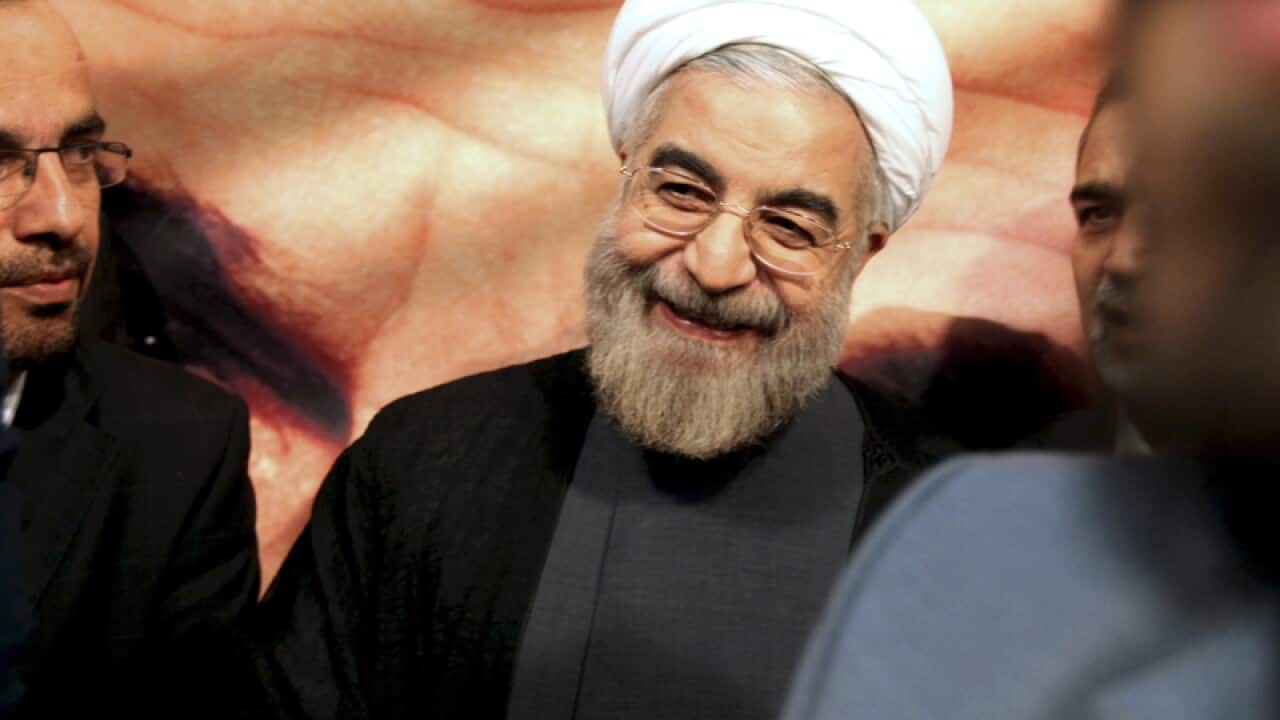
The election of the moderate Hassan Rowhani as Iran's new president is a game-changer which could set a new tone and soothe tensions with the West over Tehran's disputed nuclear program, analysts say.
Dubbed a "sheik diplomat" for his negotiating skills in tortuous nuclear talks, the moderate cleric raised hopes internationally after he emerged as the victor of the key polls on Saturday.
Rowhani has vowed to end the nuclear stalemate which has led to crushing Western sanctions on Iran.
His policies under reformist president Mohammad Khatami were abandoned in 2005 when President Mahmoud Ahmadinejad was elected and Rowhani quit his post over differences.
In his first statement, Rowhani called on world powers to treat Iran with respect and recognise its rights, an apparent allusion to its controversial nuclear program.
News that makes sense
Your trusted source for staying up-to-date with the world around you. Get free daily news updates and analysis, straight to your inbox.
"This is a victory of intelligence, of moderation, of progress ... over extremism," he said.
"A new opportunity has been created by this great epic, and the nations who tout democracy and open dialogue should speak to the Iranian people with respect and recognise the rights of the Islamic republic."
Then they will "hear an appropriate response", added Rowhani, who has championed a more constructive engagement with world powers.
"Rowhani's victory is not regime change in Iran - but it is a game changer," said Foreign Policy magazine.
Although the "Supreme Leader (Ayatollah Ali Khamenei) and the Revolutionary Guards continue to control all levers of power", Rowhani's election could see Washington "adopt a new approach to strengthen reformists", it added.
Tehran has been engaged since 2006 with the P5+1 - the UN Security Council permanent members, Britain, China, France, Russia, the US, plus Germany - over its controversial nuclear work, but with no breakthrough.
Former British foreign secretary Jack Straw, who dealt with Rowhani in negotiations on Iran's nuclear program, called him a "very experienced diplomat and politician".
"What this huge vote of confidence in Dr Rowhani appears to show is a hunger by the Iranian people to break away from the arid and self-defeating approach of the past and for more constructive relations with the West," The Sunday Times newspaper quoted him as saying.
The United States, which along with Israel and the West suspects Iran's nuclear program is aimed at developing weapons - a charge Tehran vehemently denies - hailed the win as a "potentially hopeful sign".
"If he is interested in ... mending Iran's relations with the rest of the world, there's an opportunity to do that," White House Chief of Staff Denis McDonough told CBS News's Face the Nation.
"If he lives up to his obligations under the UN Security Council resolution to come clean on this illicit nuclear program, he will find a partner in us, and there will be an opportunity for that." But others were far more cautious.
"We are not expecting a quantum shift," a European diplomat said, speaking on condition of anonymity, adding that "there will be no fundamental changes but perhaps a difference in style".
Genevieve Abdo, an Iran expert at the Washington-based Stimson Center think-tank, said there would be very little change on the nuclear issue or Iran's support for Syria's embattled leader Bashar al-Assad.
"I think that generally we might see a honeymoon in the beginning, because this historically has been the way the Iranians operate.... But I'm very sceptical that there will actually be any progress on the nuclear issue and I think on Syria there will be no change whatsoever.
"The regime is concerned about its domestic situation.... I think that they will try, perhaps, with this new president to appease the public, whatever that requires, for some time.
But then I think it's probably back to the status quo," she added. Azadeh Kian-Thiebaut, a political science professor at Paris University, said the West was better off with Rowhani in its efforts to normalise ties with Tehran.







