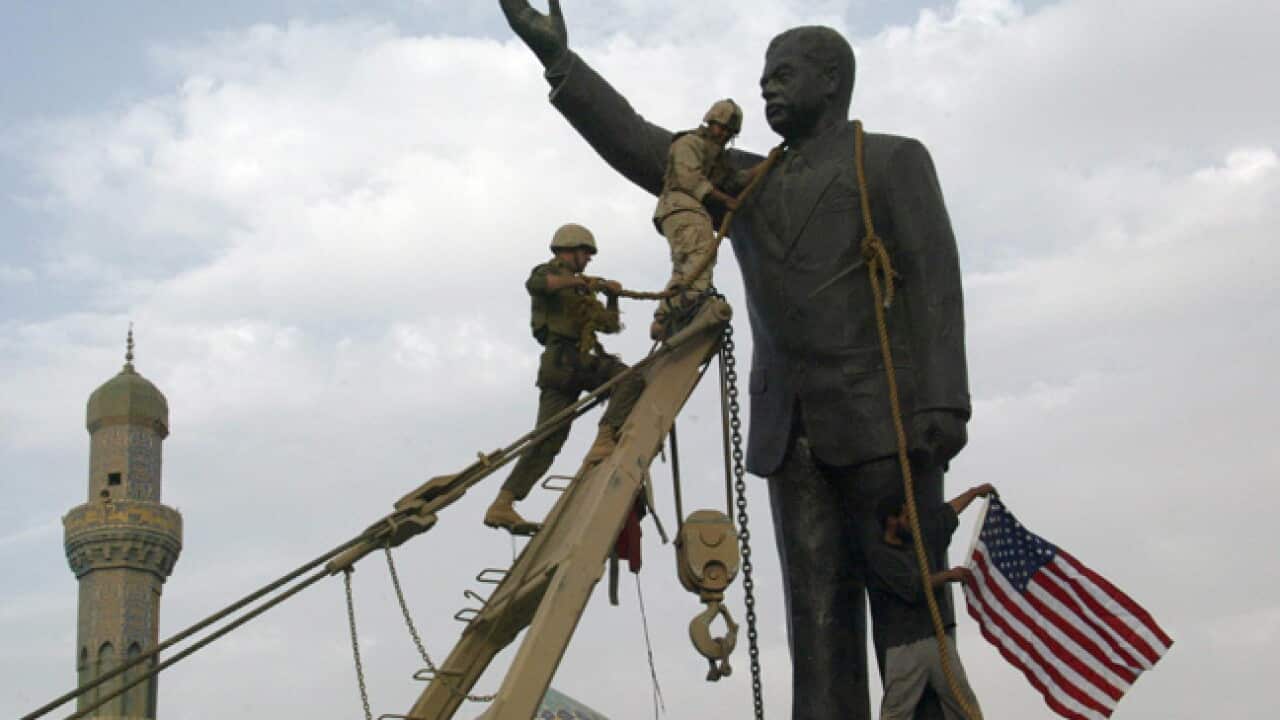
Remembered the world over for the iconic images of Iraqis pulling down a statue of Saddam in central Baghdad's Firdos Square -- helped in no small part by an American military unit -- the fall of the capital is a far more emotive day in Iraq than the anniversary of the invasion itself weeks earlier.
The day the statue fell on April 9, 2003, Saddam's vaunted army had largely melted away, and was seen as defeated and demoralised.
But the sense of elation felt by many Iraqis that day, at seeing a dictator who had ruled Iraq for more than two decades fall, was matched by a feeling of bitterness among others who felt their country had been occupied by a foreign power.
News that makes sense
Your trusted source for staying up-to-date with the world around you. Get free daily news updates and analysis, straight to your inbox.
Those divisions in how April 9 is seen within Iraq have spurred the government to eschew any formal commemorations.
Though the war itself was relatively brief -- six weeks after foreign troops invaded, then-US president George W. Bush infamously declared the mission accomplished -- its aftermath was bloody and fractious.
Caught between Shiite militia groups and Sunni insurgents, US and coalition forces paid a heavy price: some 4,800 foreign troops died in Iraq, more than 90 percent of them American.
Iraqis suffered even more. Britain-based organisation Iraq Body Count recently estimated that at least 112,000 Iraqi civilians died in the decade after the invasion, while thousands of soldiers and policemen were also killed.
The anniversary comes at a significant juncture in Iraq, barely 10 days ahead of provincial elections, the country's first polls since US troops withdrew at the end of 2011.
The credibility of the vote has been drawn into question as a result of still-high bloodshed -- a dozen candidates have been killed -- and by a cabinet decision for a partial postponement that means only 12 of the country's 18 provinces will go to the polls.
Though markedly less powerful than in their 2006 and 2007 heyday, militant groups -- particularly Al-Qaeda front group the Islamic State of Iraq -- also remain capable of mounting spectacular mass-casualty attacks, and often target Shiite Muslims and the security forces in a bid to destabilise the country.
The violence is frequently blamed on political disputes between Prime Minister Nuri al-Maliki, a Shiite, and many of his erstwhile partners in Iraq's unity government, allowing militants to exploit divisions on the ground which give them room to manoeuvre.







