(Transcript from SBS World News Australia Radio)
It follows Chinese media reports quoting a senior official as saying police will stop handing out labour camp sentences this year (2013).
News that makes sense
Your trusted source for staying up-to-date with the world around you. Get free daily news updates and analysis, straight to your inbox.
Police can currently lock people up for up to four-years without trial, under a system lawyers and rights activists say is open to abuse.
There has been no official announcement from the Chinese government that it is to abolish re-education through labour.
There have only been media reports.
But the government has spoken of further reform.
The rights group Amnesty International says the government needs to release full details.
Amnesty's head in East Asia, Roseann Rife, says Chinese authorities could simply be planning to replace re-education through labour with another form of arbitrary detention.
"There are currently some pilot projects that have been going on for years now under a new title of illegal behaviour correction. So it is quite possible that there would simply be another form under another title taking the place of the re-education through labour system. And that of course does nothing to improve or change the situation. It just replaces one thing with another."
There's also scepticism from Australian representatives of the Falun Gong sect, long a target of Chinese authorities.
William Luo is the president of Queensland's Falun Gong Association.
"I hear the news, but we will see until it has really happened, because most people do not trust the Communist Party what they say. They don't have any reputation now."
The Communist Party introduced the system of re-education through labour in the mid-1950s to suppress anti-Communist elements.
Critics say it was soon expanded to include people who had committed so called "petty transgressions" - misdemeanours not amounting to crime.
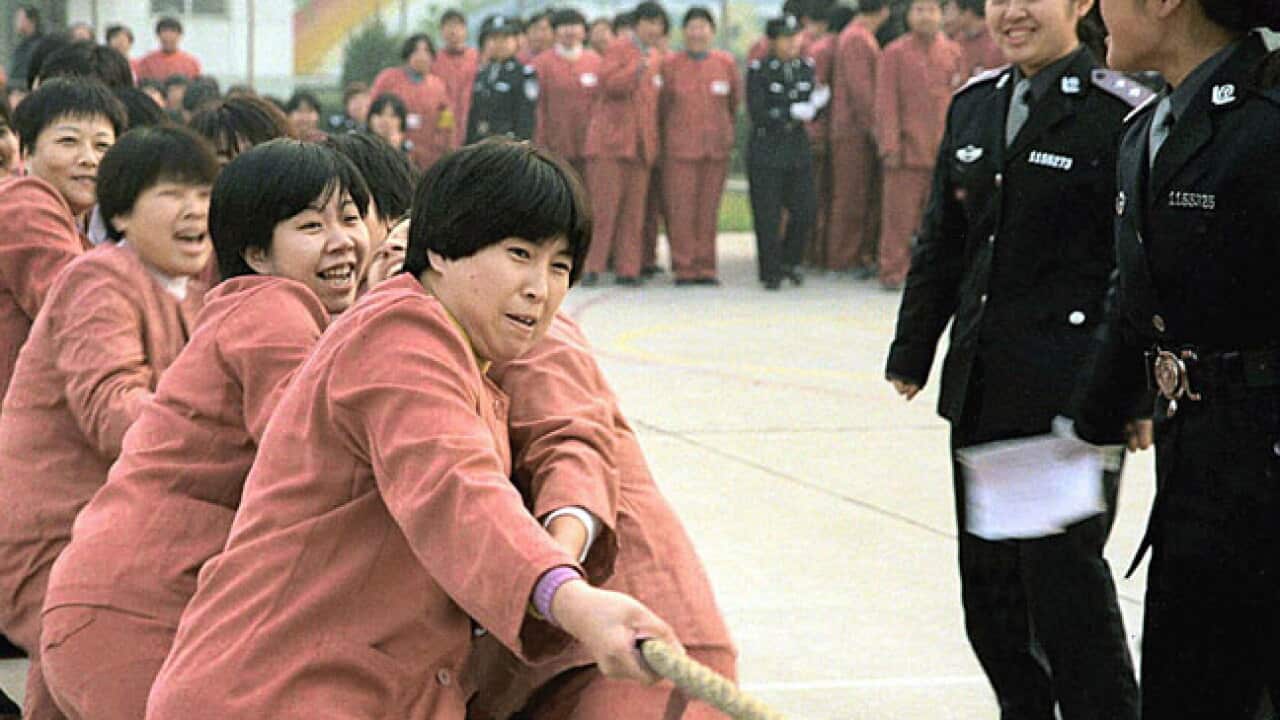
According to state broadcaster CCTV China has over 300 labour camps holding more than 300-thousand prisoners.
The system is administered by the police, who can order a person be detained for between one and three years, with the possibility of a one-year extension.
Associate Professor Sarah Biddulp of Melbourne Law School says the laws giving police their powers are fairly vague, affording them broad discretion about who is sentenced.
She says it is therefore very easy for police to abuse their powers.
"There is no effective oversight of the use of those powers. Even though the law proscribes that a person can challenge an administrative decision in the court it's quite difficult in practice for people who are subject to administrative detentions by the police to exercise those powers effectively."
Human rights activists say those sent to the re-education through labour camps include Falun Gong practitioners, unemployed and homeless people, sex workers, and people who have supposedly engaged in extra-marital affairs.
The New York-based group, Human Rights Watch, says detainees are often forced to work in harsh and dangerous conditions, and in some cases are subject to physical abuse, degrading treatment, and torture.
The regulations governing the system state a detainee will be sent to an education centre, and put to work for not more than six hours a day in exchange for "appropriate wages".
But Professor of Chinese law at the University of Sydney, Bing Ling, says the regulations are flouted.
"It is now applied to cover all kinds of problematic behaviour so to speak. Anything that the government does not approve. And the environment in which this type of punishment is administered is almost the same as prison. There were news reports in China that suggest for instance the inmates will have to work more than 10-hours a day in the education camps. The so called appropriate wages to be paid to those inmates could be as little as 8 yuan per month. Eight yuan is equivalent to one-and-a-half Australian dollars.'"
Professor Ling says two high profile cases of detention have provoked outrage in China, and fuelled public demands for reform.
"There was a case involving a woman who was a persistent petitioner against the government and the courts in relation to what she considered to be the police's unfair treatment of her daughter, who was a rape victim. But in the end she was put into education through labour for one year. That decision was later overturned by the government. There is another case involving a lower level government official who basically was disseminating blog posts on the internet that were critical of the government. He was was charged with subversion, but the prosecutors refused to prosecute because of lack of evidence. So he was put into education through labour for two years. Again that decision was overruled later on. These cases aroused enormous sympathy and outrage in the public."
Associate Professor Sarah Biddulp says in recent years there have major reforms to the system, with the drug prohibition law in 2008 the most significant change.
"In some provinces there was a very high proportion, even in some places up to 90 per cent of people in re-education through labour were actually drug dependent people. And in 2008 the drug prohibition law required that all drug dependent people have been dealt with in a different way. Since that reform in 2008 all drug dependent people have been taken out of re-education through camps. That has meant that the population in re-education through labour has decreased quite dramatically."
Associate Professor Biddulp says in the past six-months there have been trials of a new more lenient form of detention in China.
The trials have been modelled on proposed legislation, which would reduce the term of detention from a maximum four-years to 18-months, and make camps semi-open, allowing detainees to go out to work or home for the weekend.







