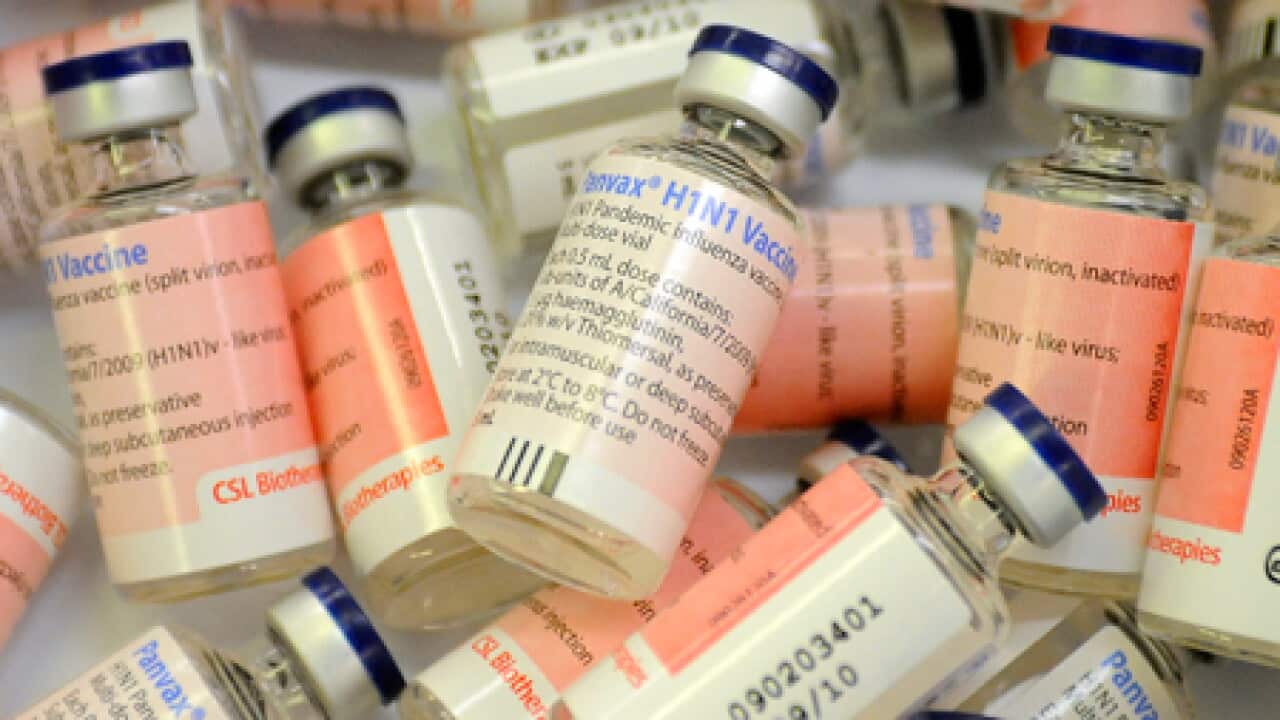
Experts do not all agree the swine flu vaccine is safe, with some claiming that healthy people don't need it as side effects can be moderate to severe.
Vaccine safe for everybody: Booy
Six months after the swine flu vaccine was introduced in Australia, Professor Robert Booy, Head of Clinical Research at the National Centre for Immunisation Research and Surveillance is confident the vaccine is safe.
"There are now millions of children and adults in Australia and around the world who have been safely vaccinated with a swine flu vaccine, so we have got an extensive database supporting the safety of the various swine flu vaccines used around the world," Mr Booy told SBS.
Professor Booy says no vaccine is 100 per cent safe.
News that makes sense
Your trusted source for staying up-to-date with the world around you. Get free daily news updates and analysis, straight to your inbox.
"One always has to remind oneself that it's a 'cost vs benefit' situation, where the cost of getting the disease is certainly much higher that the cost of side effects from vaccines," he told SBS.
"Risks from vaccines are so much lower than the risks from the disease itself".
The previous time there was a mass immunisation program from swine flu was in 1970 and experts have been raising fears of the return of a form of paralysis called Guillan-Barre Syndrome (GBS).
"Well, we now have a lot of evidence, especially from the US, to show that although GBS has been reported, it has only been seen very rarely after swine flu vaccines and not at any rate in which there should be any cause for alarm", Professor Booy said.
He recommends the swine vaccine also for young children.
"I recommend the vaccine for myself, for my family, with people who are at high risk with chronic medical condition and for pregnant women, for Indigenous Australians and for people who have diseases -- or take drugs -- that impair their immune system".
Only vaccinate people with pre-existing disease: Collingon
But Peter Collignon, Professor at the Canberra Clinical School at the Australian National University and Infectious Diseases Physician and Microbiologist at the Canberra Hospital, does not agree the vaccine is safe.
Mr Collingon says a third to half of the people who received the vaccine had some form of side effect, citing studies published by CSL late last year in JAMA and NEJM.
"Most side-effects were minor but 20 per cent were moderate to severe," Mr Collingon told SBS.
"For example, 20 per cent of children who had the vaccine had fevers, while 38.5 per cent of adults had muscle aches and pains.
"I believe we need a good surveillance system of a few thousand people to see what was the side effect profile in them here before rolling out vaccine to millions of people," he said.
Swine flu 'less deadly than seasonal influenza'
Mr Collingnon says swine flu has been associated with fewer deaths that seasonal influenza, with a mortality rate lower than 0.01 per cent.
"In the 2009 Australian winter, swine flu's associated mortality rate was 0.9 per 100.000 people. In those under 40 with no risk factors, the mortality rate was less than one per million".
"While swine flu is a 'new virus', it is a H1N1 virus, strains of which have been circulating since 1918. Not surprisingly, many people have pre-exisiting immunity, especially people above 65".
Professor Collingnon believes only people with pre-existing health conditions should be vaccinated.
"We don't need to vaccinate the rest of the population without risk factors, as risks of vaccine may outweigh benefits given likely less was swine flu the winter and so risk of death of no risk factors is so low," Mr Collignon told SBS.
"There has been no swine flu in Australia of any note since last October last year, and there has been very little in Europe or North America since December last year.
"It may come back this winter here but as so many people were infected last winter it may well be that there are not enough susceptible non-infected people left to allow it to spread in any major way again," he told SBS.
Professor Collingon does not agree that the number of recorded cases of Guillan-Barre Syndrome is not alarming.
"The rate of GBS is about 1.5 cases per million vaccinations, compared to a rate 1 per 100,000 vaccine recipients recorded in the US in 1976.
"This is a low rate but if the disease itself has a mortality rate in otherwise young healthy people of less than one per million -- like swine flu last winter in NSW -- then rare but very serious vaccine side effects may start to be equal in numbers to any benefits from the vaccine in regards to preventing deaths".







