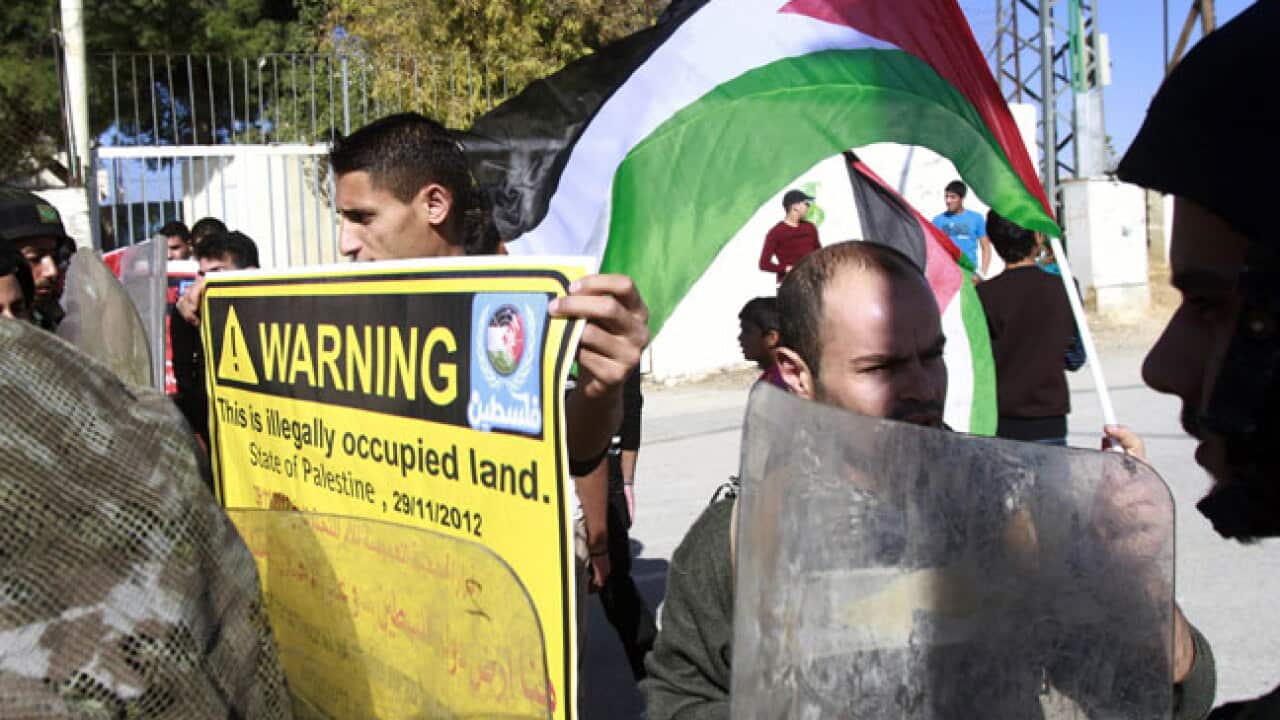
Israel has revealed plans to build 3,000 more settler homes in east Jerusalem and the West Bank after a historic UN vote to recognise Palestine as a non-member observer state, with Washington describing the move as "counter-productive".
In the Thursday vote in New York, the United Nations General Assembly overwhelmingly backed a resolution recognising Palestine within the 1967 borders as a non-member observer state.
Israel lashed out in response on Friday, with an official confirming to AFP plans to build the 3,000 settler homes, without specifying exactly where they were to be sited.
News that makes sense
Your trusted source for staying up-to-date with the world around you. Get free daily news updates and analysis, straight to your inbox.
Washington said the plan would make resuming peace talks harder.
"We reiterate our longstanding opposition to settlements and east Jerusalem construction and announcements. We believe these actions are counterproductive and make it harder to resume direct negotiations or achieve a two-state solution," said National Security Council spokesman Tommy Vietor.
State Department spokeswoman Victoria Nuland said that, despite past failures, Washington would keep trying to get Israelis and Palestinians to the negotiating table.
"That's the only way that we are going to get to two states for two peoples with a sovereign, viable and independent Palestine living side by side in peace and security with a Jewish and democratic Israel," she said.
Like Israel, the Obama administration had tried to stop the Palestinian push for UN recognition, saying it would put another obstacle in the path to peace and that statehood could only come through negotiations with Israel.
Palestinian leader Mahmud Abbas called for a return to peace talks, but criticised Israel's latest settlement plans.
"I've said a thousand times that we want to resume negotiations and we are ready to do it," Abbas told reporters in New York.
"We are not setting any condition but there are at least 15 UN resolutions which consider settlement activity as illegal and an obstacle to peace which must be removed," he said. "Why do (the Israelis) not stop settlement?"
Palestine Liberation Organisation official Hanan Ashrawi told AFP "it is an act of Israeli aggression against a state, and the world needs to take up its responsibilities."
Israeli Prime Minister Benjamin Netanyahu had warned that by going to the UN, the Palestinians had "violated" previous agreements with Israel, such as the 1993 Oslo Accords, and that his country would "act accordingly."
Such talks have been on hold since September 2010, with the Palestinians insisting on a settlement freeze before returning to the negotiating table and the Israelis insisting on no preconditions.
Israel has long feared that if the Palestinians won the rank of a UN non-member state, they could pursue the Jewish state for war crimes at the International Criminal Court -- particularly over settlement.
With their newly acquired status, the Palestinians now have access to a range of UN agencies as well as to the ICC, but Abbas said he had no plans to immediately petition the tribunal.
"We now have the right to appeal the ICC, but we are not going to do it now and will not do it except in the case of Israeli aggression," he said.
Israeli media reports said that some new settlement construction would be in a highly contentious area of the West Bank known as E1, a corridor that runs between the easternmost edge of annexed east Jerusalem and the Maaleh Adumim settlement.
Palestinians bitterly oppose the E1 project, as it effectively cuts the occupied West Bank in two, north to south, and makes the creation of a viable Palestinian state highly problematic.
The Palestinians want east Jerusalem as capital of their state and vigorously oppose expansion plans for Maaleh Adumim, which lies five kilometres (three miles) from the city's eastern edge.
Linking the settlement and the city is an idea espoused by hardliners within Netanyahu's rightwing Likud party but strongly opposed by Washington.
Arab east Jerusalem was captured by Israel with the rest of the West Bank in the 1967 Six Day War and later annexed in a move not recognised by the international community.
Israel considers all of Jerusalem as its "eternal, indivisible" capital, and does not view construction in the eastern sector to be settlement activity.







