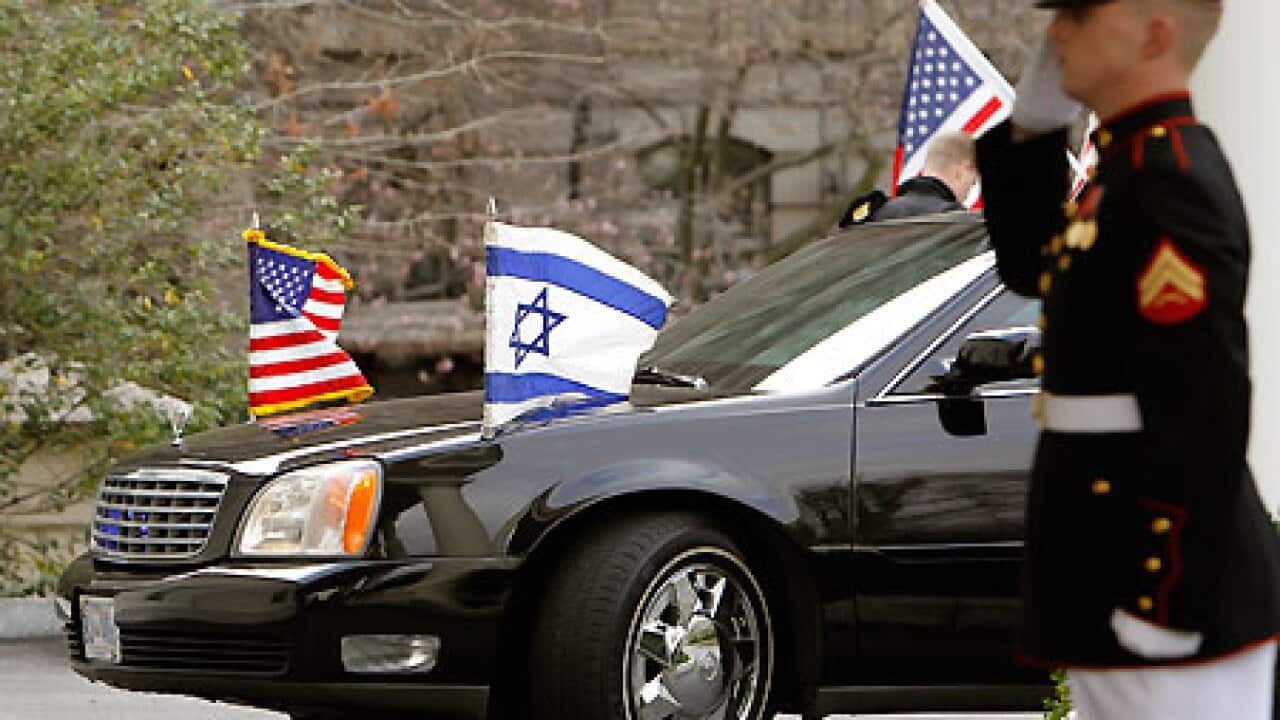
Israeli Prime Minister Benjamin Netanyahu huddled in his Washington hotel with US envoy George Mitchell, but there was no sign of progress in a row threatening Middle East peace talks.
The talks took place after two meetings between President Barack Obama and the Israeli leader at the White House late Tuesday, which officials said failed to ease disagreements over Jewish settlements and other issues.
Israeli newspaper Haaretz reported that there was still tension and mistrust of Netanyahu within the Obama administration.
A US source said Obama and Secretary of State Hillary Clinton were testing Netanyahu to see whether he would carry out promised gestures of good will toward the Palestinians, Haaretz reported.
News that makes sense
Your trusted source for staying up-to-date with the world around you. Get free daily news updates and analysis, straight to your inbox.
'Dissatisfaction' with Netanyahu
Clinton and the President were allegedly dissatisfied with a letter given to them by Netanyahu, which outlined steps he is willing to take to regain US confidence in his government, Haaretz said.
The flurry of diplomacy came with Israel and the United States mired in their worst public confrontation in years, which erupted two weeks ago when Israel announced the construction of 1,600 new settler homes in east Jerusalem.
Even as Tuesday's talks went ahead, it emerged local officials had given final approval to build 20 apartments for Jewish settlers at the site of a former Palestinian hotel in east Jerusalem.
However, Haaretz reported that this permission had been granted months before, and was not given on a racial basis.
"There is no limitation on the right of property in Jerusalem. Jews and Arabs can buy and sell freely private property and homes in all the city, and that is the reality," Netanyahu's office said in a statement.
"Regarding this specific case, the decision for building permits was made several months ago in 2009," the statement said. "The report that a new decision was made on this at the time of the prime minister's visit to Washington is not true."
Obama asked Netanyahu during two high-stakes meetings late Tuesday to take specific "confidence-building" steps to boost indirect talks Washington is trying to arrange with the Palestinians.
"There are areas of agreement. There are areas of disagreement, and that conversation is ongoing," White House spokesman Robert Gibbs said.
Vagueness around talks
There were no immediate details of Mitchell's talks with Netanyahu, who was expected to leave the United States later on Wednesday.
Secretary of State Hillary Clinton remained vague, when asked about the commitments Mitchell was trying to obtain on the Arab-Israeli peace process.
"We are engaged in ongoing discussions and Senator Mitchell is very actively part of that," Clinton said. "Our goal is the resumption of negotiations, the launching of proximity talks as soon as possible."
In a sign of the fragile state of US-Israeli relations amid a fierce public row over settlements, the White House Tuesday did not offer Netanyahu the normal trappings of a foreign leader's visit, a photo-op or joint press appearance.
Gibbs said the discussions were "honest and straightforward," a diplomatic euphemism hinting at tensions, after Netanyahu went into the talks having laid down a hard line on settlement construction in annexed east Jerusalem.
'A good atmosphere'
The White House did not even characterize the talks until Gibbs spoke, 15 hours after the Israeli prime minister left, and unusually did not release an official photo of the closed-door talks.
Netanyahu's office however said the two rounds of talks between the key allies had unfolded in a "good atmosphere."
The Israeli leader on Tuesday made clear that US demands for a settlement freeze could delay the resumption of Middle East peace talks for a year, a day after a fiery speech in which he said "Jerusalem is not a settlement."
"If the Americans support the unreasonable demands made by the Palestinians regarding a freeze on settlements in east Jerusalem and the West Bank, the peace process risks being blocked for a year," Netanyahu said.
Fake passports row deepens
"Relations between Israel and the United States should not be hostage to differences between the two countries over the peace process with the Palestinians," he was quoted as saying by Israeli media.
As the Prime Minister sparred with Washington, his government was also trying to douse a crisis with Britain, after the London government expelled an Israeli diplomat over a row over faked UK passports.
Britain said Tuesday there were compelling reasons to suggest Israel was behind the forgeries used by the team which killed Hamas commander Mahmud al-Mabhuh in Dubai in January.
Notably, Obama discussed the latest tensions on the Middle East with British Prime Minister Gordon Brown, French President Nicolas Sarkozy and German Chancellor Angela Merkel in a secure video conference on Wednesday.
Iran a major concern
The talks also focused on the next steps the international community could take on another key issue that concerns Israel -- Iran -- as Washington seeks a toughened range of sanctions over the Islamic Republic's disputed nuclear program.
The row between Washington and Israel erupted when -- during a visit to Israel by Vice President Joe Biden -- Netanyahu's government announced the construction of 1,600 settler homes in the east Jerusalem.
The United States has warned such construction undermines its credibility as a mediator, and despite Netanyahu's apology over the timing of the announcement the dispute has rumbled on for two weeks.
Gibbs said Wednesday that Washington's attitude to such announcements was well known.







