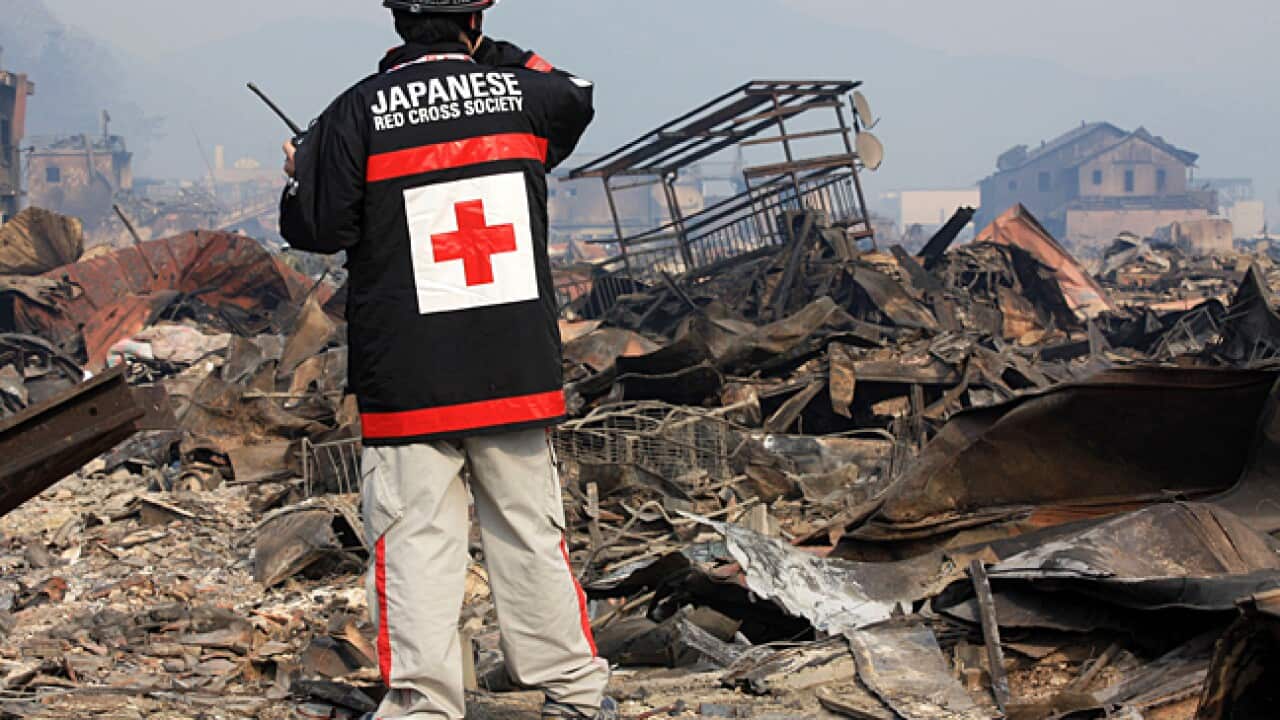
A powerful aftershock that rocked an area of Japan still reeling from last month's earthquake and tsunami disaster killed three people and injured around 100, emergency services said.
The Fire and Disaster Management Agency said a 63-year-old woman in Yamagata prefecture died after her respirator failed when the power was knocked out by the 7.1 magnitude tremor.
"Her respiratory equipment was found turned off. We believe the machine was turned off due to the outage," a spokesman for the agency said.
The agency said one person also died in Miyagi prefecture -- the area worst hit by the 9.0 magnitude quake of March 11 and the tsunami it spawned.
News that makes sense
Your trusted source for staying up-to-date with the world around you. Get free daily news updates and analysis, straight to your inbox.
The quake, which hit at 11.32pm local time (0032 AEST), was initially measured at magnitude 7.4, according to the US Geological Survey (USGS), which said it struck 66 kilometres east of Sendai at a shallow depth of 25.6 kilometres.
USGS seismologists later downgraded its strength to 7.1, and revised its depth to 49km.
Workers battling to control the stricken Fukushima nuclear plant on Japan's northeast coast were ordered to evacuate, plant operator Tokyo Electric Power Co (TEPCO) said.
"After the earthquake and the tsunami warning, all the workers evacuated to a safe area. The company confirmed all the workers have cleared the plant safely," a TEPCO spokesman said.
"We have no information immediately indicating any abnormality at Fukushima Daiichi plant," a spokesman told a press conference.
Japan's weather bureau issued a tsunami alert for its Pacific coast, saying that waves of up to two metres could hit the shoreline. The warning was lifted about 90 minutes later.
Footage from broadcaster NHK showed that the power was off in parts of Sendai, a regional commercial hub that was heavily affected by the March 11 quake.
The broadcaster said gas and water leaks were being reported in some areas of the city.
Although the epicentre was at a distance of 333 kilometres from Tokyo, it caused buildings to shake in the Japanese capital.
"Please do not hesitate to leave for higher ground, nor try to return to the coast line.
Please do not try to check the status of the coastline," broadcaster NHK said repeatedly.
Its advice not to go to the coastline was supposedly addressed to fishermen worried about their boats.
Workers have been grappling to tame runaway reactors at the Fukushima plant, which was badly damaged by the massive tsunami that hit Japan's northeast on March 11.
Cooling systems were knocked out, leaving the temperature of the nuclear cores to rise and setting off a scramble to prevent a meltdown.







