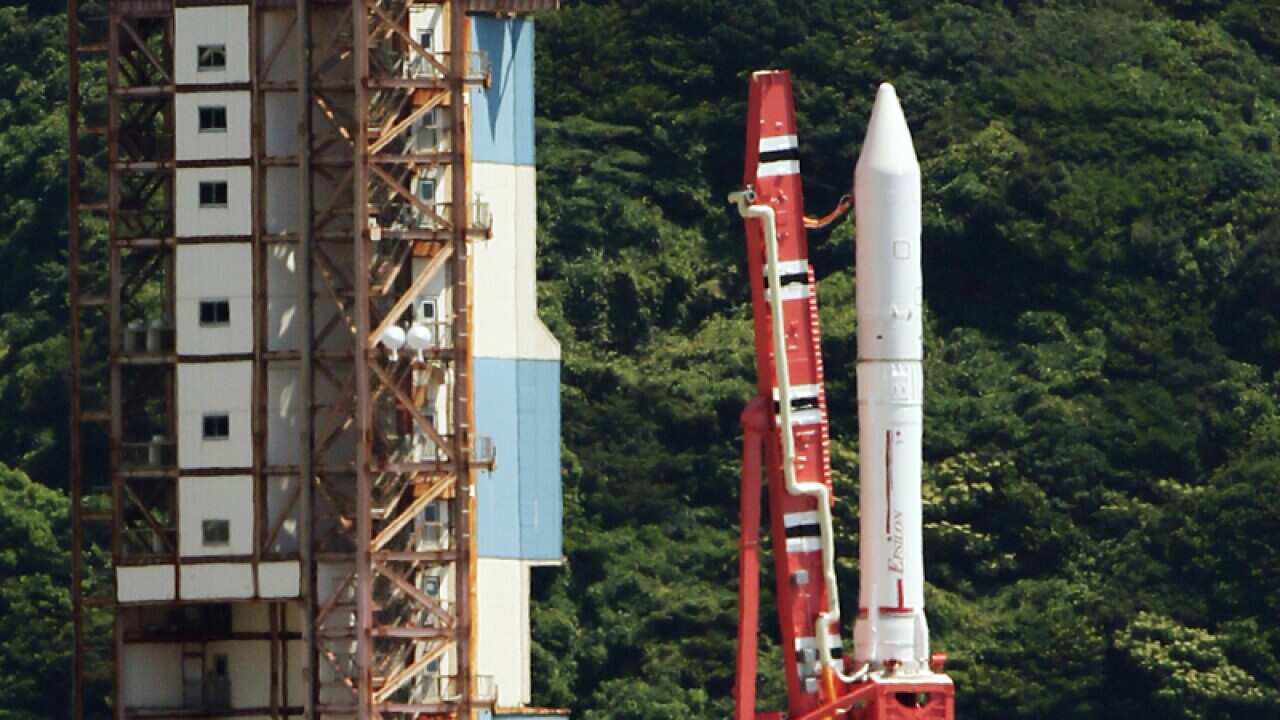
Japan suspended the launch of its next-generation solid-fuel rocket just seconds before lift-off after engineers discovered a technical glitch, the space agency says.
Japan Aerospace Exploration Agency (JAXA) had planned to launch the Epsilon rocket from Uchinoura Space Centre in Kagoshima, southwestern Japan, on Tuesday using just two laptop computers in a pared-down command centre.
But the countdown was automatically stopped just 19 seconds before the planned blast-off "as an emergency measure due to some abnormal positioning" of the rocket, a JAXA spokeswoman said.
"We cancelled today's launch and can't say anything about the timing of our next launch, as the cause of the trouble is still unknown," the spokeswoman said.
The three-stage Epsilon - 24 metres long and weighing 91 tonnes - was scheduled to release the telescope SPRINT-A at an altitude of 1000 kilometres.
News that makes sense
Your trusted source for staying up-to-date with the world around you. Get free daily news updates and analysis, straight to your inbox.
SPRINT-A is the world's first space telescope for remote observation of planets including Venus, Mars and Jupiter from its orbit around Earth, the agency said.
The Epsilon is about half the size of the nation's liquid-fuelled H2-A rocket and a successor to the solid fuel M-5 rocket that was retired in 2006 because of its high cost.
The small-sized rocket is equipped with artificial intelligence "for the first time in the world" that allows autonomous checks by the rocket itself, JAXA said.
"It also allows us to carry out launching procedures, including ignition, through only two laptop computers," another JAXA spokeswoman said.
At the control centre only eight workers were engaged in the launch operation, compared with about 150 people usually needed when JAXA launches its mainstream H2-A rocket.







