
in brief
- Japan is undergoing its biggest military expenditure since World War Two.
- Its defence minister said the spend is urgently needed to counter Chinese and Russian threats.
Japan needs to boost its military with a "sense of urgency and crisis", its defence minister said on Tuesday, as a new government assessment reiterated growing risks posed by China, North Korea, and Russia.
Japan is already beefing up military spending and security cooperation in Asia, deploying missile launchers to outer islands, moving to acquire "counter-strike" capabilities, and easing rules on weapons exports.
But Shinjiro Koizumi said in a preface to the annual defence white paper that it was "imperative that Japan further reinforce and transform its defence capabilities with a stronger sense of urgency and crisis than ever before".
In the Asia-Pacific, "not only are China and North Korea further strengthening their military capabilities, China-Russia and Russia-North Korea are also reinforcing their cooperation", he added.
The new white paper said China was "intensifying its activities" in the region around Japan, "extending beyond the so-called first island chain to the second island chain".
News that makes sense
Your trusted source for staying up-to-date with the world around you. Get free daily news updates and analysis, straight to your inbox.
It listed a series of incidents in 2025, including activities by Chinese aircraft carriers and the "unusual close approach" by Chinese aircraft to Japanese planes in two incidents in June and July.
Japanese jets scrambled 595 times in the year to 31 March 2026, including 366 sorties against Chinese aircraft and 214 for Russian planes.
This compares to 704 the previous year and was the fewest since at least 2021.
Japan decided in April to lift its self-imposed ban on weapons exports, but the white paper highlighted problems in the country's production base that could jeopardise procurement and innovation.
Strengthening regional ties
Koizumi also said that he and US counterpart Pete Hegseth had "exchanged candid views" on the "unwavering" US-Japan alliance, while also increasing security cooperation with the Philippines, Australia, and South Korea to realise a "a free and open Indo-Pacific".
"As the security environment becomes increasingly and rapidly severe, what is required now is to strengthen resilience against crises all across the entire Indo-Pacific region," Koizumi said.
"In order to do so Japan will build and expand multilayered networks among allies and like-minded countries, and enhance interconnectivity with like-minded countries and others in every area."
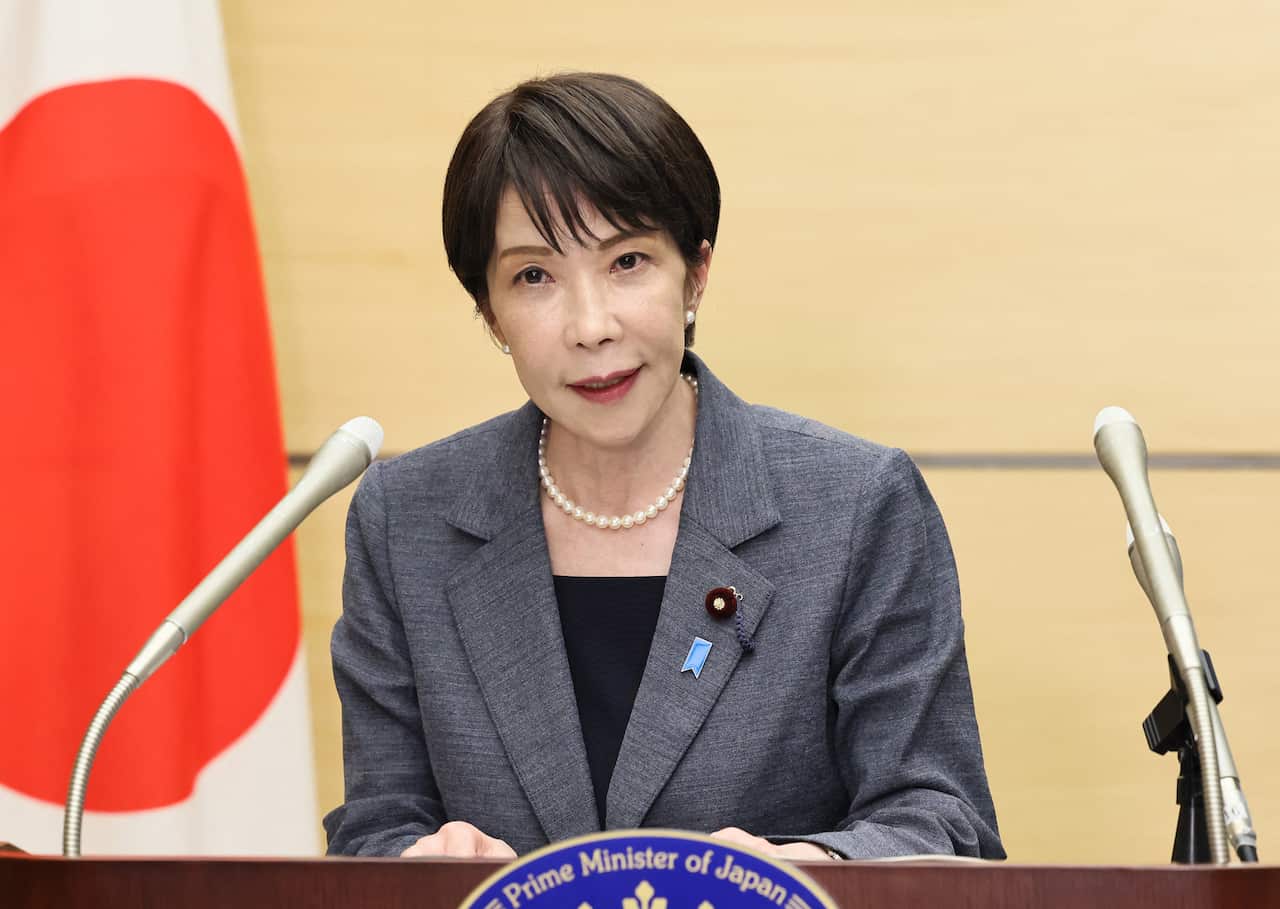
The link between defence and future prosperity comes as Takaichi's administration prepares a new national security strategy.
Military experts expect it to call for further spending increases aimed primarily at deterring China from starting a conflict with Taiwan that could also draw Japan into a prolonged war.
Biggest military buildup since WWII
China has expressed alarm at what it sees as a return to "new militarism" by Japan, with relations worsening since Japan's hawkish new Prime Minister Sanae Takaichi made comments about Taiwan last year.
Beijing reacted furiously in November when Takaichi said Japan could deploy its Self-Defense Forces if a Chinese attack on Taiwan also threatened Japan’s survival, demanding that she retract what it called an "egregious" remark.
Tokyo has assembled a patchwork of tax increases, spending reforms and one-off revenues to finance Japan's largest military buildup since World War Two, which has pushed defence-related spending to 2 per cent of gross domestic product. But Takaichi has yet to explain clearly how she would pay for a further expansion without adding pressure on Japan's already stretched public finances.
Her government secured a record 122.3 trillion yen ($1.1 trilion) budget for the year to March 2027 and later added a 3.1 trillion yen ($28.3 billion) supplementary package to cushion households and businesses from higher energy costs, underscoring the competing demands on the public purse.
Much of the new defence spending so far has gone on missiles capable of striking targets more than 1,000 km away. A significant share of any further increase is expected to go toward drones and other unmanned weapons of the kind deployed extensively by Ukraine in its war with Russia.
— With additional reporting by the Reuters news agency.
For the latest from SBS News, download our app and subscribe to our newsletter.







