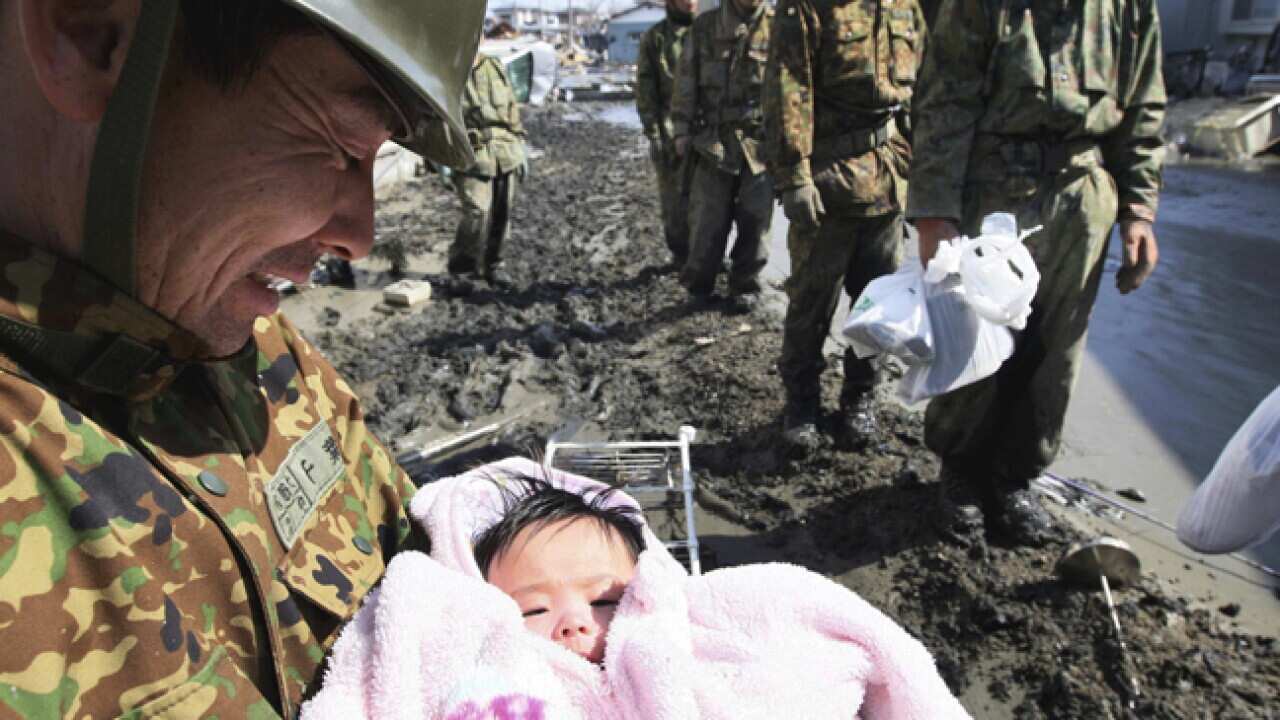
Rescue teams searching through the shattered debris of whole villages swept away by the wall of water on Japan's northeast coast found 2,000 bodies in the region of Miyagi.
Millions have been left without water, electricity, fuel or enough food and hundreds of thousands more were homeless after the monster waves engulfed whole towns.
More than 10,000 people were feared to have perished in one prefecture alone in the aftermath of an earthquake US seismologists said had a magnitude of 9.0, raising their previous estimate of its strength.
News that makes sense
Your trusted source for staying up-to-date with the world around you. Get free daily news updates and analysis, straight to your inbox.
Kaori Ohashi, 39, a mother-of-two working in a facility for the elderly with severe dementia near Sendai, spent two nights trapped in the building after its first floor was submerged by Friday's tsunami.
"Snow started to fall and it became dark. We lost power. I thought 'This is a nightmare'," Ohashi told AFP after she was rescued.
The police chief in Miyagi prefecture, which includes Sendai and which took the full force of the massive tsunami, said the death toll was certain to exceed 10,000 in his region alone.
At least 1.4 million people in Japan were temporarily without running water and more than 500,000 were taking shelter in evacuation centres, said the UN's Office for the Coordination of Humanitarian Affairs.
At a hospital in the fishing town of Kesennuma hit by the tsunami, an official said basics supplies were desperately needed.
"We are critically short of water. Water is very important here. To save it, we need a lot of disposable dishes. We need blankets as well."
A tearful elderly woman in the devastated town of Minamisanriku told public broadcaster NHK: "I need to go to hospital. I need medicine."
But it was the fear of a nuclear disaster on top of the devastating quake that gripped the nation as it struggled with a crisis described by Prime Minister Naoto Kan as the worst since World War II.
Officials have already declared an exclusion zone within a 20-kilometre radius of the plant and evacuated 210,000 people.
At one shelter, a young woman holding her baby told public broadcaster NHK: "I didn't want this baby to be exposed to radiation. I wanted to avoid that, no matter what."
Aid workers and search teams from across the world joined 100,000 Japanese soldiers in a massive relief push as the country suffered a wave of major aftershocks and a false alarm over a new tsunami.
The foreign ministry expressed its "heartfelt appreciation" for offers of help pouring in from around the world, and said rescue teams from 11 countries including China were now on the ground.
With ports, airports, highways and manufacturing plants shut down, the government has predicted "considerable impact on a wide range of our country's economic activities".
Leading risk analysis firm AIR Worldwide said the quake alone would exact an economic toll estimated at between $14.5 billion and $34.6 billion (10 billion to 25 billion euros) -- even leaving aside the effects of the tsunami.
Rolling blackouts began across the nation in a bid to save power, with the heavily nuclear-dependent nation rocked by the crisis at Fukushima as well as an oil refinery fire.
The UN said power and gas supplies were critical, with the Japanese winter bringing sub-zero temperatures overnight and snow and rain forecast for coming days.
Russia said it was ready to divert 6,000 MW of electricity from its far east to help Japan deal with the power shortfall.
Miki Otomo told how her sister managed to escape the tsunami's black tide of wrecked houses and cars near Sendai.
"My older sister was in a bus when the wave came behind them. The bus driver told everybody to get out of the bus and run," Otomo told AFP. "My sister was able to get away but some people just couldn't run fast enough."
Otomo is now staying at an evacuation centre in a local school with about 1,000 other exhausted survivors who cheated death.
"We need food and clothes. Everyone had to run away before grabbing things to wear," one woman at a shelter in the small port city of Minamisanriku, where authorities say 10,000 people are unaccounted for, she told NHK.







