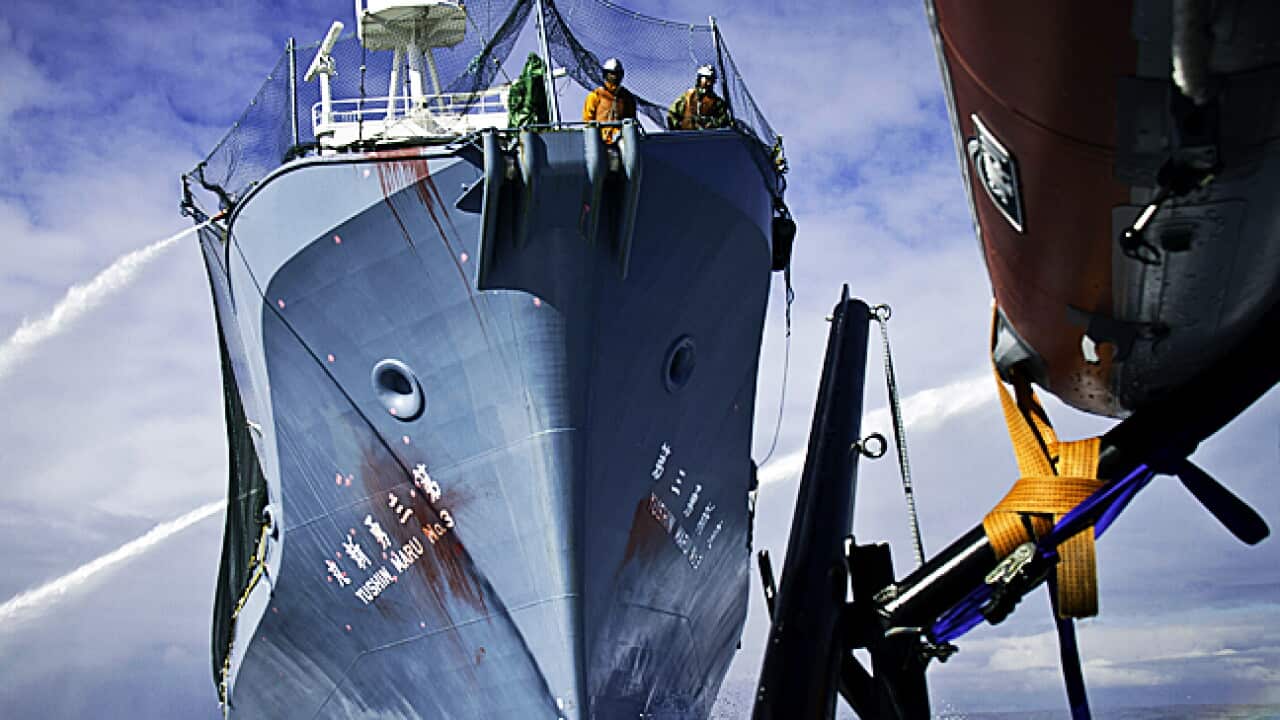
With the whaling season to begin in December, Japan is reportedly spending $US27 million on upgrading its fleet to improve the safety of its crew.
A spokesman for the whaling fleet could not immediately confirm the figure, which was reported in Japanese media, but anti-whaling group Sea Shepherd say they are prepared for anything thrown at them.
News that makes sense
Your trusted source for staying up-to-date with the world around you. Get free daily news updates and analysis, straight to your inbox.
"Spending $27 million to make sure they can do that means it is shaping up to be the most confrontational year Sea Shepherd has ever had in the Southern Ocean," Jeff Hansen, director of Sea Shepherd Australia, told AAP on Tuesday.
In the past, Japanese whalers have used water cannons and long-range noise weapons against activists.
Sea Shepherd has thrown butyric acid "stink bombs" at the fleet and used long ropes to foul propellers and frustrate the Japanese efforts.
Ships have clashed, with one Sea Shepherd vessel sunk after a confrontation in January 2010.
The federal government on Tuesday received confirmation from Tokyo that the whale hunt would resume this year.
Environment Minister Tony Burke said: "We say to Japan they do not need to do this. There is no justification for continued whaling.
"Australia unequivocally condemns commercial whaling. We don't accept that this is scientific, it should not go ahead."
Australia has begun legal action against Japan in the International Court of Justice, with initial submissions already made.
Foreign Minister Kevin Rudd has said the government is disappointed whaling will take place in the Southern Ocean Whale Sanctuary.
"There is widespread concern in the international community at Japan's whaling program and (there are) widespread calls for it to cease," Mr Rudd said on Tuesday in a joint statement with Mr Burke and Attorney-General Robert McClelland.
Sea Shepherd has vowed that its campaign in 2011 will be of equal strength to last year's, when it deployed three ships and 100 activists to the Southern Ocean and sent the Japanese fleet home months early.
It has called its planned operation "Divine Wind", which translates into Japanese as kamikaze, the word used by suicide pilots in World War II.
In a statement Sea Shepherd founder Paul Watson said Japanese whalers would have to kill his activists to make them stop.
Commercial whaling has been banned since 1986, but Japan continues to hunt the mammals under an exception that allows limited kills for scientific research.
Greenpeace told AAP they would be concentrating their efforts on lobbying Japan and would not be sending a ship to the Southern Ocean to confront the Japanese whalers.







