Switzerland freezes plans to build new nuclear plants, Germany raises questions about its nuclear future and opposition to atomic reactor construction mounts from Turkey to South Africa.
Will explosions and other worries at a tsunami-stricken Japanese nuclear plant halt what has come to be known as the nuclear renaissance? Fears about nuclear safety that took a generation to overcome after the accidents at Chernobyl and Three-Mile Island are resurfacing around the globe.
They are casting new doubt on a controversial energy source that has seen a resurgence in recent years, amid worries over volatile oil prices and global warming.
"Europe has to wake up from its Sleeping Beauty slumber" about nuclear safety, Austria's Environment Minister Nikolaus Berlakovich told reporters in Brussels. He suggested an EU-wide stress test for nuclear plants, much like European banks have been tested for their ability to cope with financial shocks.
Yet some experts and officials say those fears are overblown, given the exceptional nature of Japan's earthquake and ensuing tsunami.
News that makes sense
Your trusted source for staying up-to-date with the world around you. Get free daily news updates and analysis, straight to your inbox.
The Japanese blasts may slow the push for more nuclear plants, but appear unlikely to stop it, given the world's fast-growing energy needs.
The governments of Russia, China and Poland said they are sticking to plans to build more reactors.
Even earthquake-prone Chile says it won't discard a nuclear option.
Spain warned against hasty decisions. Japan's nuclear plant explosions come as the US government looks to expand its nuclear energy industry by offering companies tens of billions in financial backing.
Administration officials said the US would seek lessons from the Japanese crisis but said the events in Japan would not diminish the United States commitment to nuclear power.
"It remains a part of the president's overall energy plan," White House spokesman Jay Carney said.
"When we talk about reaching a clean energy standard, it is a vital part of that." In Atlanta, the CEO of Southern Co said on Monday he does not expect Japan's problems to delay construction of two more nuclear reactors in Georgia, at the first nuclear plant in the United States to break ground in a generation.
Elsewhere, governments began questioning their vision of a nuclear-energised future amid rising threats of a meltdown at one Japanese reactor.
Switzerland ordered a freeze on new plants or replacements "until safety standards have been carefully reviewed and if necessary adapted," Energy Minister Doris Leuthard said.
The decision put on hold the construction of nuclear power stations at three sites approved by Swiss regulatory authorities. Switzerland now has five nuclear power reactors that produce about 40 per cent of the country's energy needs. It also has nuclear research reactors.
In Germany, the government said it is suspending for three months a decision to extend the life of its nuclear power plants. That also means that two older nuclear power plants will be taken off the grid shortly - at least for now - pending a full safety investigation, Chancellor Angela Merkel told reporters.
A previous government decided to shut all 17 German nuclear plants, but Merkel's administration last year moved to extend their lives by an average 12 years.
The European Union called a meeting Tuesday of nuclear safety authorities to assess Europe's preparedness in case of a nuclear emergency.
Individual EU members including Britain, Bulgaria and Finland also urged a nuclear safety review.
Meanwhile, opposition voices rose up in Turkey and Sweden to renounce or scale back governments' nuclear expansion plans.
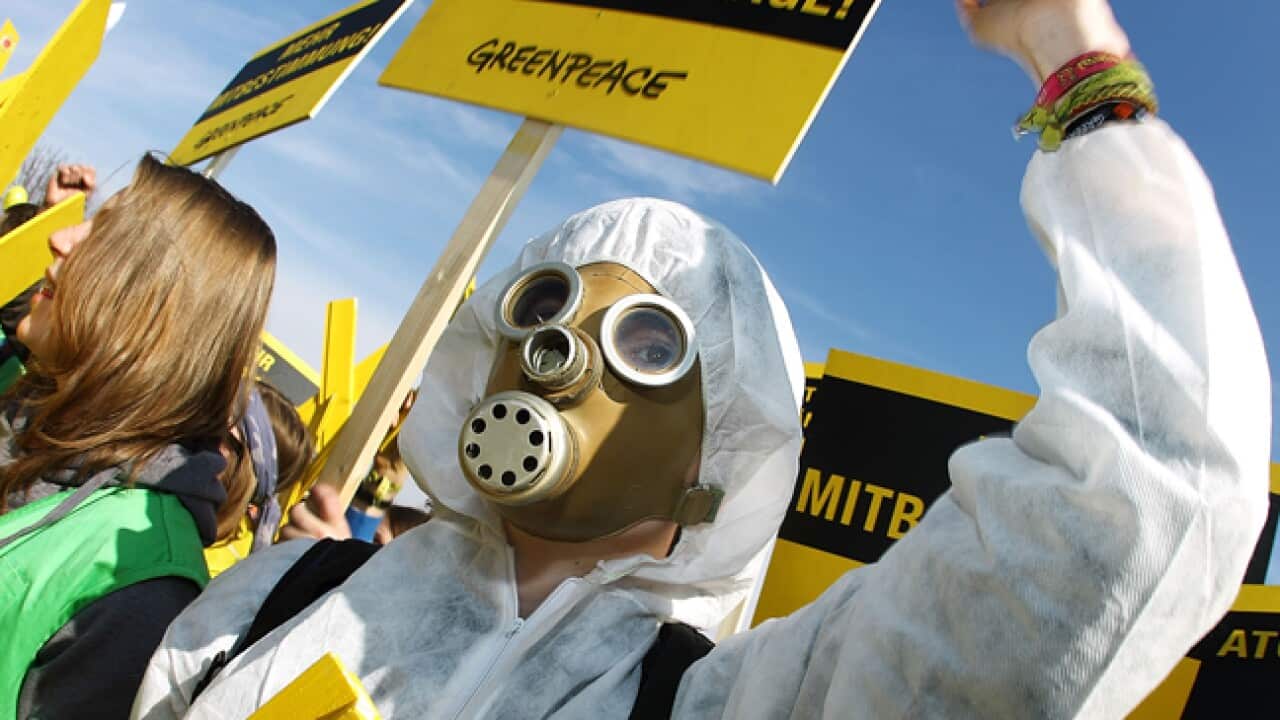
And anti-nuclear groups staged rallies around France, the world's most nuclear-dependent country, as the government sought to reassure the public that the risks remain minimal.
Environmental group Earthlife Africa said it wants South Africa, the only African country with an existing nuclear plant, to follow Germany's example. But South African government officials want to expand nuclear power.
German popular opinion continues to favour non-nuclear sources of energy.
But elsewhere in Europe, people have become increasingly open to using nuclear power as memories fade of the accident in Chernobyl, Ukraine - the world's worst nuclear accident, 25 years ago next month.
Eastern Europe sees nuclear energy as a way of gaining a measure of independence from Russia's burgeoning gas and oil empire.
Statistics from the International Atomic Energy Agency show there are 442 nuclear reactors in operation worldwide, with 65 new facilities under construction.
Construction last year was started on 14 new reactors - in China, Russia, India, Japan and Brazil. In 2005, in comparison, ground was broken for only three reactors.
Boosters have argued that new-design reactors pose fewer safety risks, and that nuclear-produced electricity doesn't emit the pollution that causes global warming.
Even as Japan's damaged reactors were beginning to deteriorate on Friday, Chilean President Sebastian Pinera told state television that "the new so-called smart technologies, are technologies that are absolutely earthquake-proof in terms of security.
And that's why we are studying this option, because Chile can't categorically reject any alternative in energy generation".
The head of the Ukrainian Chernobyl Union called for setting up nuclear safety squads of professionals trained to respond to nuclear accidents who could be rapidly dispatched to any accident site.
"Nuclear accidents will continue happening as nuclear energy develops," Yuri Andreyev told the AP.







