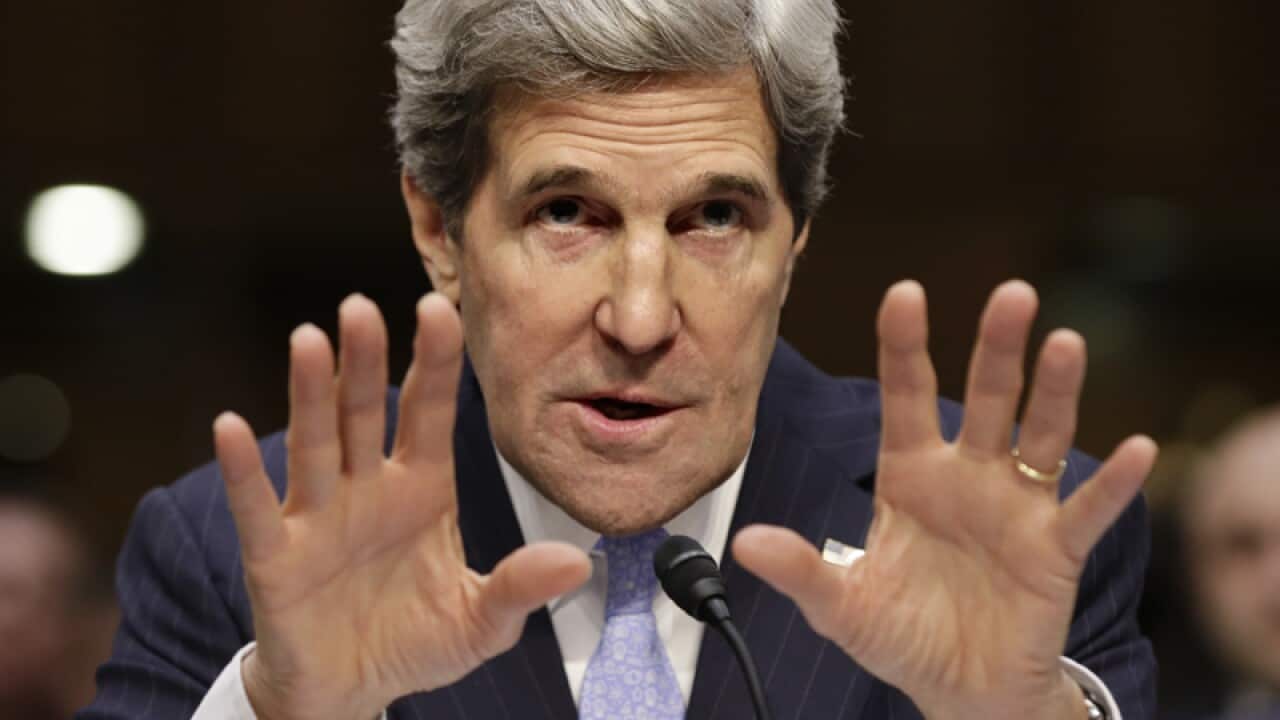
New US Secretary of State John Kerry held out an olive branch to sanction-hit Iran, saying the world would respond if Tehran seriously addressed its nuclear program at upcoming talks.
"The choice is really ultimately up to Iran," Kerry told his first press conference since becoming America's top diplomat a week ago.
Tehran, which has been hit by crippling international sanctions, has agreed to meet with the six world powers working to rein in its suspect nuclear program for a new round of talks in Almaty, Kazakhstan on February 26.
News that makes sense
Your trusted source for staying up-to-date with the world around you. Get free daily news updates and analysis, straight to your inbox.
In his first comments on Iran since taking the helm of the State Department, Kerry assured the Iranian leadership that "the window for diplomacy is still open" as they prepare for the next talks.
"The international community is ready to respond if Iran comes prepared to talk real substance and to address the concerns, which could not be more clear, about their nuclear program," the new secretary of state vowed.
"If they don't, then they will choose to leave themselves more isolated. That's the choice," Kerry said, speaking after his first bilateral talks with Canadian Foreign Minister John Baird.
In talks held last May in Baghdad, the so-called P5+1 -- the United States, China, Russia, Britain, France and Germany -- demanded Iran scale back its uranium enrichment, the part of its program that causes the most concern because it could provide the key ingredient for a nuclear bomb.
But because the P5+1 stopped short of offering relief from the sanctions, Iran walked away at the third round of talks in Moscow.
British Foreign Secretary William Hague has said the P5+1 will put forward an "updated and credible" offer to Iranian leaders at the Almaty talks.
Iran insists its nuclear program is peaceful, but many in the international community suspect that Tehran's real aim is to develop an atomic bomb.
"We believe that beyond Iran's support, material support for terrorism, beyond their abysmal and deteriorating human rights record, the threat of a nuclear-armed Iran is the biggest threat to international peace and security," said Baird, the Canadian foreign minister.
"I share the view that a diplomatic solution is possible," he added, saying Canada wanted Iran to "change course and rejoin the international community."
Tehran has been calling for scaling back biting sanctions that are hurting the Iranian economy.
But instead, the United States tightened sanctions Wednesday on Iran to further choke off its oil income and limit Tehran's ability to freely use the money it gets from oil exports.
The global sanctions have also targeted Iran's access to the world banking system, slowing its economy, accelerating inflation and boosting the ranks of the jobless.
And they have led to the collapse of the national currency, which lost more than two thirds of its value in a 20-day span starting in late September.
Tehran is also being pressured by the UN's atomic watchdog agency to allow broader access to its nuclear facilities in a bid to resolve outstanding issues over the Islamic republic's past atomic activities.
Supreme leader Ayatollah Ali Khamenei angrily accused Washington this week of trying to negotiate with Tehran at gunpoint, as he rejected an offer of direct US-Iran talks.
"I am not a diplomat but a revolutionary and I speak frankly," Khamenei told air force commanders in remarks published on his website. "You (Americans) are pointing the gun at Iran and say either negotiate or we will shoot."
A Gallup poll found that most Iranians are feeling the pain of sanctions but still support a civilian nuclear program.
The US polling firm, which spoke to 1,000 Iranians by telephone over December and January, found that 83 percent said international economic sanctions had affected their livelihoods, with nearly half blaming the United States.
Washington broke off relations with Iran in 1980 in the aftermath of the storming of the US embassy in Tehran, when 52 Americans were taken hostage by Islamist students.
Since then, the United States has been vilified by the Islamic republic as the "Great Satan."







